
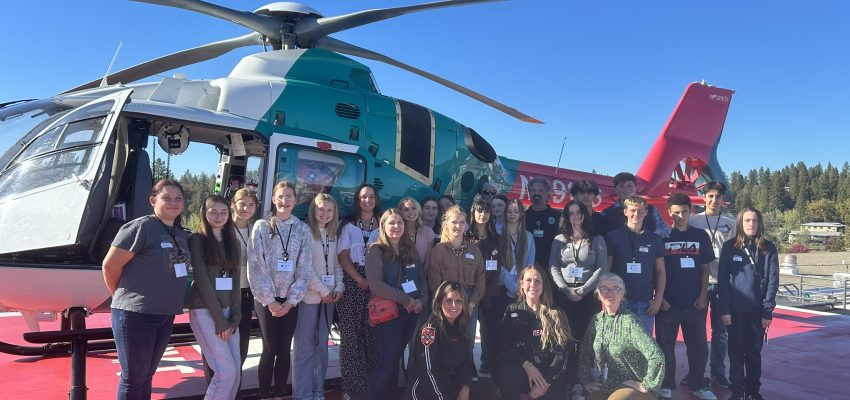

In an era defined by rapid technological advancements, the landscape of nearly every profession is undergoing a profound transformation. Healthcare, perhaps more than any other field, stands at the precipice of a revolution, driven by breakthroughs in data science, genomics, and most notably, artificial intelligence. As an AI specialist and tech enthusiast, I’m always looking for initiatives that not only prepare the next generation for the future but actively inspire them to shape it. It was with great interest, therefore, that I learned about the Nevada County Superintendent of Schools (NCSOS) and their annual Exploring Careers in Health Institute.
This remarkable program, held during Fall Break from October 20–23, offered 25 bright high school students from across Nevada County an immersive, hands-on journey into the intricate world of medicine. While the immediate focus was on traditional and emerging healthcare roles, the underlying message for these young minds is clear: the future of healing is inextricably linked with innovation. These aren’t just students exploring jobs; they are prospective pioneers on the cusp of defining what innovative healthcare careers will look like in a world increasingly powered by intelligent systems.
Innovative Healthcare Careers: A Glimpse into Tomorrow’s Medicine
The NCSOS Exploring Careers in Health Institute isn’t merely an informational seminar; it’s a meticulously crafted four-day experience designed to ignite passion and provide practical exposure. For high school students, the concept of a career in healthcare can often seem daunting, a distant aspiration shrouded in complex medical jargon and years of demanding study. Programs like this demystify the path, bringing it to life through direct engagement. Imagine a student, perhaps still undecided about their future, spending a day shadowing a nurse, observing a surgical simulation, or even learning about the latest diagnostic technologies. These are the kinds of ‘aha!’ moments that can solidify a career choice or even spark a new interest previously unconsidered.
The institute, proudly sponsored by NCSOS, aims to inspire students by showcasing the vast array of opportunities within health and medical fields. This includes not just the celebrated roles of doctors and nurses, but also the equally critical positions of medical technologists, public health specialists, physical therapists, pharmacists, and even bioinformaticians – roles that are becoming increasingly essential in our data-rich world. The value of such early exposure cannot be overstated. According to a study by the National Academies of Sciences, Engineering, and Medicine, early exposure to career pathways significantly increases students’ likelihood of pursuing those fields, especially in STEM-related areas which now undeniably include much of modern healthcare.
What sets this institute apart is its emphasis on the ‘hands-on’ aspect. This isn’t theoretical learning; it’s practical application. While the specifics of each activity might vary year to year, one can envision students engaging in mock surgeries using advanced simulators, practicing basic first aid and CPR, learning about patient care protocols, or even understanding the administrative backbone of a hospital. These experiences move beyond textbooks, allowing students to feel the weight of responsibility, the thrill of discovery, and the profound impact of medical work. They learn about the human element – empathy, communication, resilience – which remains paramount, even as technology advances.
Furthermore, in a rapidly evolving field like healthcare, understanding the nuances of innovative healthcare careers means appreciating the interdisciplinary nature of modern medicine. It’s not just about treating illness; it’s about preventative care, public health initiatives, technological integration, and ethical considerations. Programs that highlight this breadth are invaluable, showing students how their diverse skills – from problem-solving to compassionate communication – can find a home in this dynamic sector.
Beyond the Bedside: The Role of Technology and AI in Modern Healthcare Education
As an AI specialist, I firmly believe that preparing students for future healthcare roles means acknowledging the transformative power of technology, particularly artificial intelligence. AI is not merely an auxiliary tool; it’s rapidly becoming an integral component of nearly every facet of healthcare, from diagnosis and treatment to patient management and drug discovery.
Consider the impact of AI in diagnostics. Algorithms trained on vast datasets of medical images can detect subtle signs of disease, often with greater accuracy and speed than the human eye. Radiologists, rather than being replaced, are empowered with AI tools that help them make more informed decisions. Similarly, in personalized medicine, AI analyzes genetic data, lifestyle factors, and patient histories to predict disease risk and tailor treatment plans, moving us closer to truly individualized care.
Surgical robotics, guided by AI, offer unprecedented precision, leading to less invasive procedures and faster patient recovery. Telehealth platforms, which saw exponential growth during the pandemic, leverage AI for scheduling, triaging, and even conducting preliminary diagnostic assessments. These are not futuristic pipe dreams; they are present realities shaping innovative healthcare careers right now.
For students participating in the NCSOS institute, these technological shifts present both challenges and immense opportunities. They are not just being prepared for the healthcare of today, but for the healthcare of tomorrow, where data literacy, computational thinking, and an understanding of ethical AI implications will be as crucial as anatomical knowledge. The demand for professionals who can bridge the gap between medical expertise and technological prowess is soaring. This includes roles like AI ethicists in healthcare, medical data scientists, health informatics specialists, and even AI-assisted surgical technicians.
While the original content focuses on the hands-on experience, it’s essential to interpret this through a modern lens. A truly ‘hands-on’ experience today must implicitly or explicitly involve engaging with technology. Whether students are using simulation tools that run on sophisticated algorithms, learning about electronic health records, or even discussing the impact of AI-driven drug discovery, they are engaging with the future of medicine. Early exposure to these technological dimensions helps cultivate a mindset of adaptability and innovation, which will be vital for thriving in the evolving healthcare landscape.
Cultivating Future Innovators: The Impact of Experiential Learning
The success of programs like the Exploring Careers in Health Institute lies in its foundation of experiential learning. Unlike passive classroom instruction, experiential learning immerses students directly in the subject matter, fostering deeper understanding and stronger retention. When students can see, touch, and interact with the realities of a profession, it transforms abstract concepts into tangible experiences.
For high school students, this type of engagement is particularly powerful. It allows them to test their interests without the long-term commitment of a degree program. They can discover if the fast-paced environment of an emergency room truly excites them, or if the meticulous work of a lab technician aligns with their personality. Such insights are invaluable, guiding them towards educational pathways that genuinely resonate with their aptitudes and aspirations. This clarity can prevent costly changes in college majors and foster a more committed, purpose-driven educational journey.
Moreover, these institutes often connect students with mentors – active professionals who can share their experiences, offer advice, and provide a real-world perspective that textbooks cannot. These connections are critical for building professional networks and understanding the day-to-day challenges and rewards of a particular career. In the context of innovative healthcare careers, having mentors who are themselves adapting to new technologies can provide invaluable guidance on skill development and career navigation.
The Nevada County community also benefits immensely from such initiatives. By nurturing local talent and encouraging students to pursue healthcare careers, NCSOS is indirectly addressing potential future workforce shortages within the region. As the global population ages and healthcare demands increase, a robust and well-trained local workforce becomes a vital asset. Investing in these students today is an investment in the health and well-being of the community tomorrow.
Ultimately, the Exploring Careers in Health Institute is more than just a four-day program; it’s a launchpad for future leaders and innovators in medicine. It instills not only knowledge but also confidence, critical thinking skills, and a sense of purpose. These are the foundational elements required to tackle the complex medical challenges of the 21st century, whether those challenges involve traditional patient care or the ethical deployment of cutting-edge AI in clinical settings.
The initiative by the Nevada County Superintendent of Schools is a shining example of how educational institutions can proactively prepare the next generation for an increasingly complex and technologically advanced world. By offering immersive, hands-on experiences, the Exploring Careers in Health Institute is not just exposing students to existing roles but inspiring them to envision and create the innovative healthcare careers of the future. These young minds are being equipped not only with an understanding of current medical practices but, more importantly, with the curiosity and critical thinking skills needed to adapt, innovate, and lead in a healthcare landscape continually reshaped by technology, data, and artificial intelligence.
As an AI specialist, I see these programs as crucial bridges between traditional education and the demands of the future workforce. They empower students to not only participate in the healthcare revolution but to actively drive it, ensuring that the human touch remains at the heart of medicine, even as machines become more intelligent. The future of health is bright, and it rests in the hands of these inspired and capable young innovators.










