
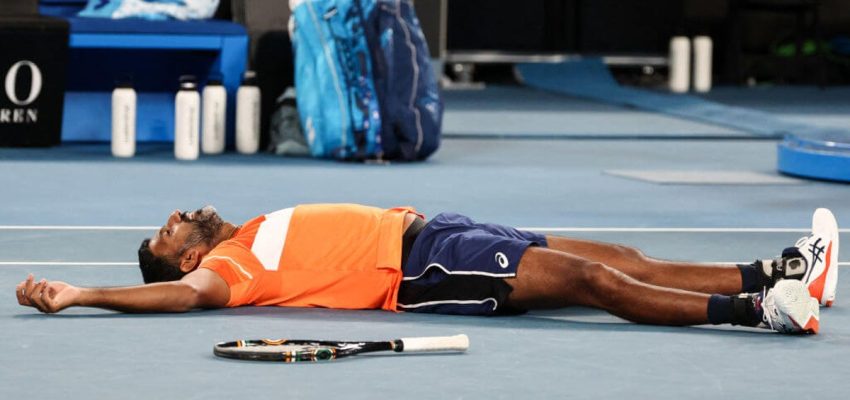

In the fast-paced world of professional sports, where youth and raw athleticism often dominate headlines, stories of enduring excellence and age-defying achievement are rare gems. Even rarer are those narratives that see an athlete not just sustain, but significantly elevate their performance well into an age when most have long since retired or faded from contention. Such is the extraordinary tale of Rohan Bopanna, the Indian tennis maestro whose recent departure from the professional circuit marks the end of an era, but more importantly, solidifies his place as one of the most inspiring figures in the sport’s history.
At 45 years young, Bopanna exited the hallowed courts of professional tennis, leaving behind a legacy punctuated by a late-career surge that defied conventional wisdom and captivated fans worldwide. His journey wasn’t just about winning titles; it was a testament to resilience, unwavering dedication, and the relentless pursuit of improvement – qualities that resonate deeply whether one is navigating the complexities of a Grand Slam final or pioneering advancements in artificial intelligence. As we reflect on his storied path, we uncover not just a collection of impressive statistics, but a masterclass in peak performance achieved against all odds.
Rohan Bopanna’s Journey: From Karnataka Courts to Global Acclaim
The story of **Rohan Bopanna’s remarkable career** didn’t begin with immediate stardom. Born in Bengaluru, Karnataka, India, in 1980, Bopanna initially harbored dreams of playing cricket, a national obsession. However, a pivot to tennis in his early teens gradually set him on a different, equally ambitious course. He turned professional in 1995, embarking on a path that would, for many years, see him toil in the challenging world of professional tennis without the global recognition he would later achieve. While he played singles in his early career, it quickly became apparent that his powerful serve, aggressive net play, and innate tactical understanding were perfectly suited for the doubles court, a specialization he embraced with profound success.
His breakthrough on the international stage truly began to blossom with his partnership with Pakistan’s Aisam-ul-Haq Qureshi. Dubbed the “Indo-Pak Express,” their collaboration transcended mere sport. At a time of persistent political tensions between their home nations, Bopanna and Qureshi showcased a powerful message of peace and unity through their partnership. Their on-court chemistry was undeniable, leading them to their first ATP Tour final in 2007 and, crucially, a Grand Slam final appearance at the 2010 US Open. Though they fell short in a hard-fought match, their run captivated audiences and brought them significant acclaim. This partnership wasn’t just about tennis; it was a humanitarian statement, earning them nominations for the Arthur Ashe Humanitarian of the Year Award. This period laid the groundwork for Bopanna’s tactical prowess and mental fortitude, essential building blocks for the extraordinary achievements that lay ahead. After their successful run, Bopanna continued to form partnerships with various top players, including Mahesh Bhupathi, Daniel Nestor, and Florin Mergea, accumulating more ATP Tour titles and cementing his status as a formidable doubles specialist.
Defying Age and Expectations: The Late-Career Renaissance
What truly sets **Rohan Bopanna’s remarkable career** apart is not just his longevity, but the unparalleled quality of his performances in his late 30s and early 40s. In a sport where physical demands are immense and reflexes tend to wane, Bopanna seemed to discover a new gear. Many professional tennis players consider retirement by their mid-30s, yet Bopanna was just beginning to hit his stride, entering what can only be described as a second, even more illustrious, prime. His incredible resilience and strategic evolution allowed him to compete, and win, against opponents who were often half his age.
The seeds of this late-career surge were sown years earlier. In 2017, partnering with Gabriela Dabrowski, Bopanna clinched his first Grand Slam title, winning the French Open Mixed Doubles. This victory, achieved at 37, was a significant milestone, showcasing his ability to perform at the highest level. However, the true zenith of his age-defying achievements came even later. The 2023 and 2024 seasons saw Bopanna reach unprecedented heights. In 2023, he reached the US Open Men’s Doubles final with Matthew Ebden, demonstrating that he was still a top contender. But it was in 2024 that he rewrote history.
At the venerable age of 43, Bopanna ascended to the World No. 1 ranking in men’s doubles, becoming the oldest player in the Open Era to achieve this feat. This was not a transient moment; it was a testament to consistent, high-level performance. Just days later, partnering once again with Matthew Ebden, he captured the Australian Open men’s doubles title, marking his first men’s doubles Grand Slam championship. This victory wasn’t merely a personal triumph; it was a powerful statement about dedication, fitness, and the human potential to push boundaries irrespective of age. His disciplined regimen, including meticulous attention to physical conditioning, nutrition, and recovery, played a crucial role. In an era where sports science offers advanced tools for athlete longevity, Bopanna expertly leveraged these resources, combining them with his deep understanding of the game and an unwavering mental toughness. He often spoke about the importance of continuous learning, adapting his game, and maintaining a positive mindset, lessons that resonate far beyond the tennis court.
Beyond the Court: A Legacy of Inspiration and Sportsmanship
Beyond the titles and the historic records, **Rohan Bopanna’s remarkable career** leaves behind a profound legacy of inspiration and sportsmanship. He has been a beacon for Indian tennis, demonstrating that with dedication, Indian athletes can compete and succeed at the pinnacle of global sports. His journey has undoubtedly motivated countless aspiring tennis players in India and across the world, proving that dreams are not bound by age or initial setbacks. He embodies the idea that a career is not a sprint, but a marathon, often with unforeseen surges and triumphs awaiting those who persevere.
Moreover, Bopanna has been a respected figure in the locker room, known for his professionalism, integrity, and gracious demeanor, whether in victory or defeat. His commitment to making a positive impact extends beyond the baseline; he has been actively involved in various philanthropic initiatives. Most notably, his ‘Stop War, Start Tennis’ initiative with Aisam-ul-Haq Qureshi used their unique partnership to promote peace and understanding, demonstrating how sport can be a powerful catalyst for social change. This commitment to using his platform for a greater good further solidifies his standing as a true ambassador for the sport. His career teaches us valuable lessons about resilience, the power of collaboration, and the importance of finding your unique path to success, even if it takes longer than anticipated.
As the curtain falls on Rohan Bopanna’s professional tennis journey, we are left to marvel at a career that truly defied expectations. His story is a powerful reminder that passion, discipline, and an unyielding will to improve can lead to extraordinary achievements, even in the most demanding of arenas. He wasn’t just a player; he was a phenomenon who reshaped perceptions of what’s possible in an athlete’s twilight years, proving that experience, when coupled with relentless effort, can indeed trump youth.
His departure from the competitive circuit leaves a void, but the inspiration gleaned from **Rohan Bopanna’s remarkable career** will undoubtedly endure. For those of us who appreciate the art of peak performance, the triumph of the human spirit, and the beauty of defying conventional narratives, Bopanna’s journey offers a compelling blueprint. It’s a testament to the fact that with continuous dedication and a belief in one’s own evolving capabilities, the most remarkable successes can often be found precisely where and when they are least expected.










