
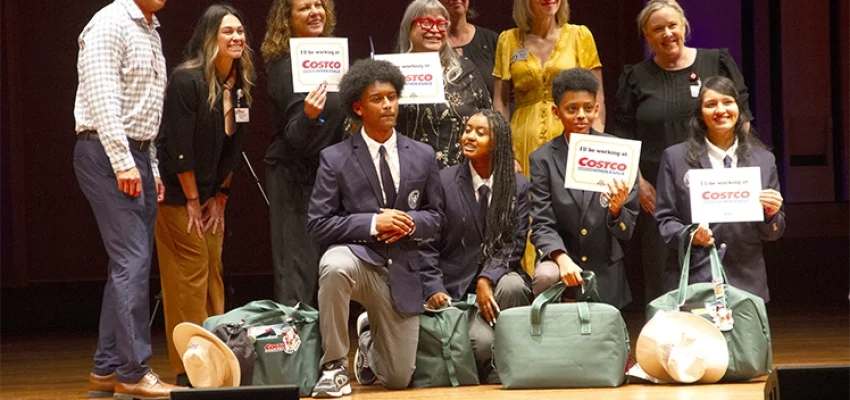

The landscape of education and career preparation is undergoing a profound transformation. As an AI specialist, I often find myself pondering the skills and experiences that will truly equip the next generation for a world increasingly shaped by artificial intelligence and automation. Traditional academic models, while foundational, sometimes struggle to bridge the gap between theoretical knowledge and the dynamic demands of the professional world. This is precisely why innovative initiatives, which focus on practical experience and mentorship from an early stage, are not just valuable – they are essential.
Today, I want to shine a light on one such groundbreaking program: the **Cristo Rey Draft Day** event at Cristo Rey Jesuit Seattle High School. This initiative isn’t merely about finding students a job; it’s about fundamentally reshaping their educational journey, instilling a professional ethos, and providing an unparalleled entry point into the corporate world. In an era where adaptability, problem-solving, and human-centric skills are paramount, this model offers a powerful blueprint for preparing young minds for a future that is, without a doubt, going to be more complex, interconnected, and technologically advanced than ever before.
Cristo Rey Draft Day: Forging Tomorrow’s Workforce
The **Cristo Rey Draft Day** is more than just an annual event; it’s the cornerstone of an innovative Corporate Work-Study Program (CWSP) that defines the Cristo Rey Network’s unique educational model. Originating in Chicago in 1996, the Cristo Rey approach has since expanded to 39 high schools across the United States, serving over 12,000 students from underserved communities. The Seattle iteration, Cristo Rey Jesuit Seattle High School, exemplifies this powerful mission: to provide a high-quality, college-preparatory education to students who otherwise wouldn’t have access to it, while simultaneously equipping them with real-world professional experience.
Imagine being a high school student, donning professional attire, and formally interviewing for a position at a leading corporation. This isn’t a mock exercise; it’s the reality of the **Cristo Rey Draft Day**. On this pivotal day, students are matched with corporate partners, embarking on year-long work placements that are fully integrated into their academic schedule. Each student typically works one full day a week, or, more innovatively, a team of four students shares one full-time equivalent entry-level job. This means that throughout their four years of high school, students accumulate invaluable professional experience, working alongside seasoned professionals in environments that range from bustling tech campuses to dynamic financial institutions and community service organizations.
Beyond the immediate benefit of gaining practical skills, the CWSP addresses a critical financial barrier. The earnings from these corporate placements directly contribute to covering up to 70% of the students’ tuition costs. This ingenious model makes a rigorous private education accessible to families who might otherwise find it out of reach. It’s a testament to the power of partnership: corporations gain dedicated, eager, and increasingly skilled young talent, while students receive an education and a professional foundation that would be difficult to replicate elsewhere.
Corporate partners for the Cristo Rey Jesuit Seattle High School program include an impressive roster of local and national leaders, such as Amazon, Alaska Airlines, BECU, Catholic Community Services, and many more. These partnerships are not merely philanthropic gestures; they are strategic investments in human capital. The companies benefit from the students’ contributions, infuse their workplaces with diverse perspectives, and actively participate in shaping the next generation of professionals. The commitment from these organizations underscores the recognized value of the **Cristo Rey Draft Day** and the subsequent work-study experience.
Beyond the Resume: Cultivating Future-Ready Skills
In a world increasingly augmented and, in some cases, transformed by AI, the skills valued in the workforce are evolving rapidly. While technical proficiency remains crucial, the emphasis is shifting towards uniquely human capabilities that machines cannot easily replicate. This is precisely where the Cristo Rey model shines. The **Cristo Rey Draft Day** and the subsequent work-study program are not just about performing tasks; they are meticulously designed to cultivate a comprehensive suite of future-ready skills.
Students in the CWSP learn essential professional etiquette, from effective communication and email composition to the importance of punctuality and meeting deadlines. They develop critical thinking skills by observing real-world problems and contributing to solutions. Teamwork, collaboration, and adaptability become second nature as they navigate corporate environments, interact with diverse colleagues, and take on new responsibilities. These are the so-called ‘soft skills’ – or, more accurately, ‘power skills’ – that are becoming indispensable in any career path, especially those intersecting with technology.
As AI takes over more routine and repetitive tasks, the demand for human attributes like creativity, emotional intelligence, complex problem-solving, and cross-functional collaboration will only intensify. A report by the World Economic Forum, for instance, consistently highlights these skills as critical for the jobs of tomorrow. By immersing students in professional settings, the **Cristo Rey Draft Day** initiative gives them a head start in developing these very competencies. They learn to navigate ambiguity, take initiative, and understand the nuances of organizational culture – experiences that cannot be simulated in a classroom alone.
Furthermore, the mentorship aspect is invaluable. Working alongside adults who are experts in their fields provides students with role models and insights into various career paths they might never have considered. This exposure broadens their horizons, ignites their ambitions, and demystifies the professional world. For many students, this might be their first direct interaction with a corporate environment, breaking down preconceived notions and opening doors to possibilities previously unimagined. This early exposure to the professional realm, coupled with a rigorous academic curriculum, creates a uniquely well-rounded individual poised for success in college and beyond.
A Blueprint for Societal Impact and Educational Innovation
The **Cristo Rey Draft Day** and the entire CWSP represent a powerful paradigm shift in how we approach education and workforce development, particularly for underserved populations. It’s a sustainable model that leverages the resources and expertise of the private sector to empower students, fostering not only individual success but also broader societal upliftment. By directly connecting education with employment opportunities, the program addresses systemic inequities and builds pathways to upward mobility.
From an innovation standpoint, the Cristo Rey model is a brilliant example of how educational institutions can adapt to serve evolving needs. It’s a proactive approach to future-proofing students’ careers by integrating hands-on learning with academic rigor. This kind of synergy between academia and industry is something that many educational reforms aspire to, and Cristo Rey has successfully implemented it at scale. It creates a virtuous cycle: students gain experience and fund their education, businesses gain valuable talent and contribute to their communities, and society benefits from a more skilled and diverse workforce.
The long-term impact of programs like the **Cristo Rey Draft Day** extends far beyond individual students. It contributes to building a more inclusive and resilient workforce capable of navigating the challenges and opportunities presented by technological advancements, including AI. As we continue to automate and innovate, the human element – critical thinking, creativity, and the ability to collaborate – will become even more precious. Initiatives that foster these capabilities from a young age are not just preparing students for a job; they are preparing them to be active, contributing citizens in an increasingly complex global society. They are building the foundations for a future where human ingenuity and machine intelligence can complement each other, driving progress for all.
In conclusion, the **Cristo Rey Draft Day** at Cristo Rey Jesuit Seattle High School stands as a beacon of educational innovation. It is a powerful testament to the transformative potential of experiential learning, strategic partnerships, and a deep commitment to equity. By providing students from underserved communities with invaluable real-world experience, mentorship, and financial support, the program not only equips them with immediate professional skills but also cultivates the critical human attributes necessary to thrive in an AI-driven future.
As an AI specialist, I firmly believe that the future of work will demand a unique blend of technical acumen and profoundly human capabilities. Programs like Cristo Rey’s are not just reacting to this future; they are actively shaping it, ensuring that a diverse and capable generation is ready to lead. This model offers a compelling vision for how we can empower all students to navigate the complexities of modern careers, fostering not just academic achievement, but a genuine readiness for the challenges and opportunities of tomorrow’s world.










