

In an era dominated by technological shifts, the narrative often focuses on artificial intelligence (AI) and automation as disruptive forces, poised to reshape industries and, in some cases, replace human labor. While this perspective holds a grain of truth in certain sectors, it profoundly misses the mark when applied universally. As an AI specialist, writer, and tech enthusiast, I’ve spent considerable time exploring the nuances of this revolution, and what I consistently find is a more optimistic, collaborative story unfolding in an unexpected yet crucial arena: the skilled trades. Far from being rendered obsolete, these vital professions are on the cusp of a profound transformation, becoming more efficient, safer, and innovative thanks to the intelligent integration of AI.
The image of the skilled tradesperson often conjures notions of calloused hands, grit, and time-honored techniques passed down through generations. And while these essential qualities remain, the toolkit for the modern artisan is rapidly expanding to include sophisticated digital instruments. We are witnessing a paradigm shift where AI is not merely an add-on but an integral partner, elevating human capabilities and preparing a new generation for jobs that are not just high-demand, but also high-tech. This isn’t about replacing the human element; it’s about augmenting it, enabling skilled workers to achieve unprecedented levels of precision, safety, and productivity. The future of craftsmanship is not solely manual; it’s a powerful fusion of human ingenuity and artificial intelligence.
AI in skilled trades: A New Era of Craftsmanship and Efficiency
The pervasive influence of AI extends far beyond the data centers and self-driving cars that often dominate headlines. Its impact is increasingly palpable on construction sites, in HVAC systems, within electrical grids, and across a multitude of other hands-on professions. Historically, these trades have relied on manual expertise, years of experience, and physical labor. While these foundations remain critical, the introduction of AI is ushering in an era where work is smarter, faster, and remarkably more precise.
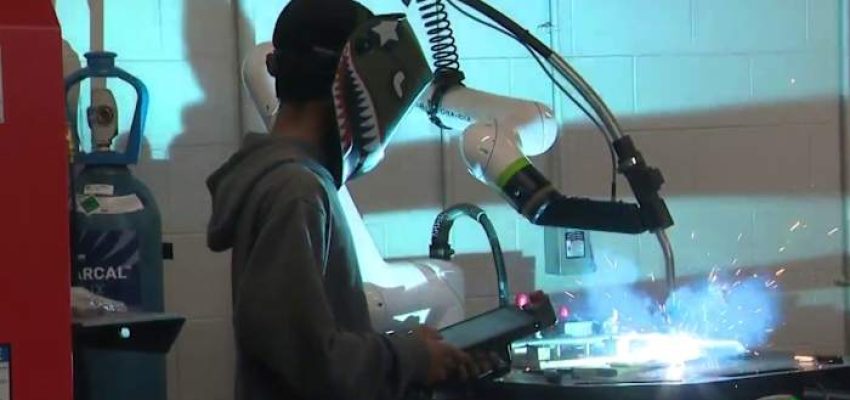
Consider the welding profession, for instance. Traditionally, welding demands immense skill, precision, and adherence to rigorous safety protocols. The margin for error can be costly, both in terms of material waste and structural integrity. Today, advanced robotics, often powered by AI, are taking over repetitive or hazardous welding tasks. These robotic systems, equipped with computer vision and machine learning algorithms, can execute welds with superhuman consistency and accuracy, especially in difficult-to-reach areas or for large-scale production. This doesn’t mean human welders are becoming redundant; instead, their roles are evolving. They transition from executing every single weld to programming, supervising, and maintaining these sophisticated machines, focusing their expertise on complex, intricate, or custom projects that still demand a human touch and critical problem-solving skills. Moreover, AI-driven quality control systems can scan finished welds in real-time, identifying defects that might be imperceptible to the human eye, thus drastically reducing rework and enhancing product reliability. This is a clear demonstration of how AI in skilled trades enhances human output.
In the realm of HVAC and plumbing, predictive maintenance systems are transforming how professionals approach repairs and installations. Instead of reactive fixes after a system failure, AI algorithms analyze data from sensors embedded in heating, ventilation, and air conditioning units, as well as plumbing networks. These algorithms can detect subtle anomalies in performance, temperature fluctuations, or pressure drops, predicting potential equipment failures long before they occur. This allows technicians to schedule proactive maintenance, preventing costly breakdowns, extending equipment lifespan, and ensuring uninterrupted service for clients. For a skilled HVAC technician, this means shifting from emergency calls to strategic planning, optimizing energy consumption for buildings, and leveraging data to make informed decisions about system upgrades and efficiency improvements. It’s a move from fixing symptoms to optimizing entire systems, a testament to the power of integrating AI in skilled trades.
The construction industry, often perceived as slow to adopt new technologies, is also experiencing significant disruption. AI-powered project management software optimizes scheduling, resource allocation, and logistics, reducing delays and cost overruns. Autonomous heavy equipment, from bulldozers to excavators, is beginning to perform earthmoving and repetitive tasks with greater efficiency and safety, especially in hazardous environments. Drones equipped with AI for computer vision conduct site inspections, monitor progress, and identify potential safety hazards or structural inconsistencies with remarkable speed and accuracy, providing real-time data to site managers and engineers. This level of data-driven insight was unimaginable just a few years ago, fundamentally changing how projects are planned, executed, and monitored, making construction sites safer and more productive. The blend of traditional construction know-how with advanced AI tools is defining a new blueprint for the sector.
Empowering the Modern Artisan: AI as a Tool for Precision, Safety, and Innovation
Beyond automating repetitive tasks, AI serves as an indispensable tool that amplifies the capabilities of the individual skilled worker. It’s about empowering artisans with unprecedented levels of precision, enhancing workplace safety, and fostering an environment ripe for innovation. One of the most compelling applications of AI in this context is through augmented reality (AR) and virtual reality (VR) technologies.
Imagine an electrical apprentice attempting to wire a complex industrial panel or a plumber diagnosing an elusive leak behind a wall. With AR glasses, they can overlay digital instructions, schematics, or even real-time diagnostic data directly onto their field of vision. This ‘x-ray vision’ allows them to see hidden components, receive step-by-step guidance for intricate procedures, or identify potential problems without physically dismantling structures. This not only accelerates learning and reduces errors for new entrants but also provides experienced professionals with instant access to vast databases of knowledge and expert insights, significantly boosting efficiency and accuracy on the job. Companies like Honeywell and Siemens are already integrating AR solutions for field service technicians, demonstrating tangible improvements in first-time fix rates and reduced downtime.
Safety, a paramount concern in many skilled trades, is also being profoundly impacted by AI. AI-powered computer vision systems can continuously monitor construction sites or factory floors for safety compliance, detecting if workers are not wearing appropriate personal protective equipment (PPE), identifying unsafe behaviors, or even predicting potential hazards before they lead to accidents. For instance, if a worker approaches a dangerous zone without a hard hat, the system can issue an immediate alert. Similarly, AI can analyze data from equipment sensors to predict mechanical failures, preventing catastrophic incidents and ensuring machinery operates within safe parameters. This proactive approach to safety moves beyond reactive measures, creating a more secure working environment for everyone involved. The advent of ‘cobots’ – collaborative robots – further exemplifies this. Designed to work alongside humans, cobots can handle heavy lifting or perform tasks in hazardous conditions, protecting workers from strain and exposure to danger, while still allowing the human to retain oversight and decision-making authority.
Furthermore, AI fuels innovation by processing vast amounts of data to identify patterns, optimize designs, and discover new efficiencies. In architecture and engineering, generative design AI tools can explore thousands of design permutations for structural components or building layouts based on specified parameters (e.g., strength, material cost, energy efficiency) in a fraction of the time it would take a human designer. This allows skilled engineers and architects to focus on creative problem-solving and client-specific customization, leveraging AI to handle the computational heavy lifting. The synergistic relationship between human creativity and AI computational power is pushing the boundaries of what’s possible, redefining the benchmarks for precision and ingenuity across various disciplines of AI in skilled trades.
Bridging the Skills Gap: Preparing the Next Generation for AI-Enhanced Trades
The integration of AI into skilled trades presents not just technological advancements, but also a significant imperative for education and workforce development. The traditional pathways to skilled trades, primarily through vocational schools and apprenticeships, are excellent foundational models. However, they must evolve to incorporate the digital literacy and technical prowess required for an AI-enhanced future. The original content highlights programs that ‘go beyond textbooks to prepare students for high-demand jobs.’ This sentiment is more relevant than ever.
The demand for skilled professionals remains robust across the globe. According to reports from organizations like the U.S. Bureau of Labor Statistics and various European agencies, significant shortages are projected in trades like welding, electrical work, and HVAC in the coming decade. The challenge is not just filling these roles, but filling them with individuals who possess a hybrid skill set: deep understanding of their craft combined with proficiency in digital tools, data analytics, and AI interaction. This means that vocational training must expand beyond traditional tools and techniques to include programming fundamentals, operating robotic systems, interpreting sensor data, and utilizing AR/VR applications for diagnostics and training. Educational institutions and industry leaders are starting to recognize this, developing curricula that blend hands-on practical skills with cutting-edge technology.
For example, some modern welding programs now include modules on robotic welding operation and programming, alongside traditional stick welding. HVAC training now integrates smart building management systems and AI-driven diagnostics. Electrical apprentices are learning about smart grids, renewable energy integration, and the programming behind automated home and industrial systems. These programs are designed to create ‘hybrid professionals’ – individuals who are not only masters of their trade but also adept at leveraging technology to enhance their work. This holistic approach makes the trades more appealing to a new generation of learners who are digital natives, attracting talent that might have otherwise gravitated towards purely tech-focused careers. It is essential that we invest in these educational transformations to ensure the continued relevance and growth of AI in skilled trades.
The emphasis should be on problem-solving, critical thinking, and adaptability – skills that AI cannot replicate but can profoundly augment. Students need to understand how to interpret data generated by AI systems, troubleshoot complex automated processes, and continually learn new technologies as they emerge. Apprenticeships, long the backbone of skilled trades education, can now be enhanced with AI-powered simulations for safe, repeatable practice of hazardous or complex tasks, providing personalized feedback to accelerate learning. This commitment to continuous learning and technological integration is paramount to bridging the existing skills gap and preparing a workforce ready for the challenges and opportunities of tomorrow.
The narrative of AI’s impact on the workforce often oscillates between fear and unbridled optimism. However, for the skilled trades, the reality is proving to be a compelling story of synergy and elevation. AI is not merely a tool for automation but a transformative partner that enhances precision, bolsters safety, and unlocks new avenues for innovation within professions that are critical to our daily lives and economic infrastructure. From robotic welders to AR-guided technicians and AI-optimized construction sites, the future of craftsmanship is undeniably intelligent.
As we continue to navigate the currents of technological progress, it becomes clear that the most successful path forward involves a collaborative embrace of AI. It empowers our skilled artisans to work smarter, safer, and with greater impact, ensuring that these vital professions remain at the forefront of innovation. The preparation of the next generation for these AI-enhanced trades is not just about adopting new tools; it’s about fostering a mindset of continuous learning and adaptation, recognizing that the most profound achievements often arise when human ingenuity is augmented by the limitless potential of artificial intelligence. The future is being built today, brick by digital brick, by a new breed of skilled professionals, expertly wielding both the hammer and the algorithm.










