
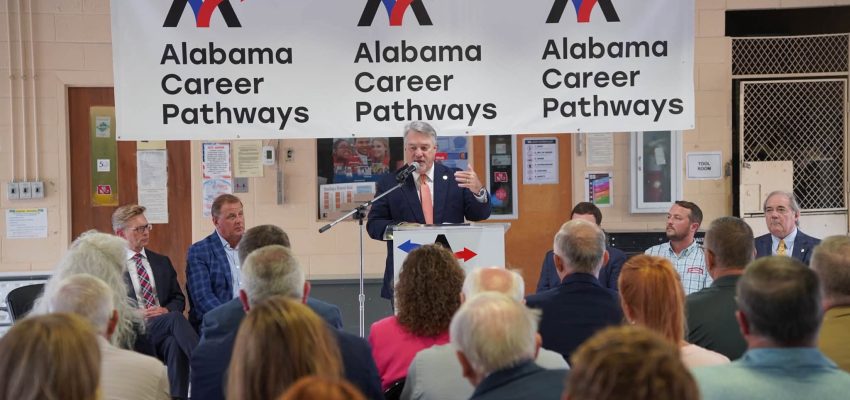

In an era defined by rapid technological advancement and unprecedented global connectivity, the bedrock of any thriving economy remains remarkably consistent: a skilled and adaptable workforce. As André Lacerda, an AI specialist and tech enthusiast, I’ve long observed that while the tools and methods evolve, the fundamental human drive for progress, powered by talent, endures. This sentiment was eloquently encapsulated by House Speaker Nathaniel Ledbetter, who noted, “Every major economic development win begins with a skilled workforce.” His observation underscores a profound truth, now more critical than ever, as states like Alabama invest strategically in initiatives designed to cultivate the talent pipeline of tomorrow. The recent launch of Alabama’s Career Pathways website and the ambitious plans for a $40 million DeKalb Career Technical Education (CTE) center are not merely local headlines; they are potent indicators of a nationwide, even global, recognition that nurturing human potential is the ultimate long-term investment.
The convergence of advanced technology, particularly artificial intelligence, with traditional industries is fundamentally reshaping the landscape of employment. What we consider ‘skilled labor’ today may be radically different tomorrow. Therefore, proactive investment in robust educational and training frameworks, like those championed in Alabama, becomes not just beneficial but essential. These initiatives aim to bridge the ever-widening skills gap, ensuring that individuals are equipped not only for current market demands but also for the emerging roles that AI and other exponential technologies will inevitably create. It’s about building resilience, fostering innovation, and empowering communities to thrive amidst relentless change.
Career Pathways: Building Tomorrow’s Workforce Today
The concept of Career Pathways is a strategic approach designed to guide individuals through a structured sequence of education and training, leading to recognized postsecondary credentials and employment. It’s far more comprehensive than traditional vocational training, often integrating academic and technical instruction with work-based learning opportunities. For states like Alabama, facing the dual challenge of attracting new industries and retaining existing ones, a robust system of Career Pathways is a cornerstone of economic strategy. Speaker Ledbetter’s leadership in expanding CTE is a testament to this understanding, recognizing that economic development isn’t solely about attracting companies; it’s about cultivating the human capital those companies need to succeed.
The newly launched Alabama Career Pathways website is a digital front door to this expansive vision. In an increasingly digital world, accessibility is key. This platform serves as a centralized hub, allowing students, parents, educators, and employers to explore diverse career options, understand the educational requirements, and connect with relevant training programs. Imagine a high school student in rural Alabama, curious about a career in advanced manufacturing or cybersecurity. Previously, finding comprehensive, localized information might have been a daunting task. Now, with a few clicks, they can map out potential educational routes, identify necessary certifications, and even discover potential employers. This level of transparency and guidance is invaluable, especially in an era where the sheer volume of information can be overwhelming.
Beyond the digital infrastructure, the physical investment in facilities like the planned $40 million DeKalb CTE center signifies a tangible commitment to hands-on learning. This isn’t just about classrooms; it’s about state-of-the-art workshops, laboratories, and simulation environments that mirror real-world industrial settings. Such centers become incubators for innovation, allowing students to gain practical experience with the tools and technologies they will encounter in their professional lives. For instance, a student aspiring to work in advanced robotics will gain invaluable experience operating and maintaining sophisticated machinery, rather than just reading about it in a textbook. These facilities are designed to be dynamic, adaptable to changing industry needs, ensuring that the skills taught remain relevant and in demand.
Historically, CTE has sometimes been mistakenly viewed as a secondary option to traditional four-year college degrees. However, the modern iteration of CTE, exemplified by Alabama’s initiatives, shatters this misconception. Today’s CTE programs are sophisticated, often leading to lucrative careers in high-demand fields such as health sciences, information technology, advanced manufacturing, and engineering. These pathways frequently include opportunities for dual enrollment, allowing students to earn college credit while still in high school, thereby accelerating their progress toward degrees or certifications. This integrated approach ensures that students are not forced to choose between academic rigor and practical skills but can instead pursue a holistic educational journey that prepares them for immediate employment or further higher education, or both. The goal is not just employment, but meaningful, sustainable employment that contributes to individual prosperity and regional economic vitality.
Navigating the AI Frontier: Future-Proofing Skills and Education
As an AI specialist, I recognize that the discussions around workforce development today would be incomplete without a deep dive into the transformative impact of artificial intelligence. AI is not merely a tool; it’s a paradigm shift, fundamentally altering how industries operate, how jobs are performed, and what skills are deemed valuable. The critical question for any robust system of Career Pathways becomes: how do we prepare individuals for a world increasingly powered by intelligent machines?
The immediate implication is a shift from purely manual or repetitive tasks, which are susceptible to automation, towards roles that emphasize uniquely human capabilities: critical thinking, problem-solving, creativity, emotional intelligence, and complex communication. Future-ready Career Pathways must therefore integrate these ‘soft skills’ alongside technical proficiencies. For example, while AI can analyze vast datasets to identify patterns, it’s human analysts who formulate the right questions, interpret nuanced results, and make ethical decisions based on that information. The same holds true for manufacturing: while robots perform precise assembly, human technicians program, maintain, and troubleshoot these sophisticated systems, requiring a blend of technical acumen and adaptive problem-solving.
Consider the explosion in demand for data scientists, AI engineers, machine learning specialists, and even ‘prompt engineers’ – individuals skilled at crafting effective queries for generative AI models. These roles barely existed a decade ago. Education systems, particularly CTE programs, must be agile enough to incorporate training in these nascent fields. This could mean introducing modules on data literacy, computational thinking, ethical AI use, and even basic programming into diverse Career Pathways, from healthcare to agriculture. For instance, an aspiring agricultural technician might learn to use AI-powered sensors to optimize crop yield, while a future healthcare professional could be trained to interpret AI-assisted diagnostic tools.
The investment in facilities like the DeKalb CTE center becomes even more impactful when viewed through an AI lens. These centers can be equipped with AI training labs, robotics simulation platforms, and virtual reality environments where students can practice complex tasks with AI integration. Furthermore, collaborations with local industries that are already leveraging AI can provide invaluable work-based learning opportunities, allowing students to see AI in action and contribute to real-world projects. This practical exposure is crucial for demystifying AI and demonstrating its practical applications across various sectors, preparing students for roles that will undoubtedly evolve with technology.
Investing in Talent: Alabama’s Vision for Economic Growth
Alabama’s proactive stance on workforce development, epitomized by the new website and the DeKalb CTE center, reflects a strategic understanding of modern economic imperatives. The $40 million investment in DeKalb County is not just an expenditure; it’s an investment in human capital, infrastructure, and regional competitiveness. Such significant funding enables the construction of cutting-edge facilities, the acquisition of advanced equipment, and the recruitment of highly qualified instructors who can deliver industry-relevant curricula.
This type of investment creates a positive feedback loop: a highly skilled workforce attracts more businesses, which in turn creates more job opportunities, further stimulating the economy. It helps states move beyond reliance on low-wage industries, fostering an environment where innovation and high-value production can flourish. Moreover, by providing clear Career Pathways, states can address issues like brain drain, encouraging young talent to remain within the state, contribute to its economy, and build their lives there. This local retention of talent is critical for sustained growth, as it ensures a continuous supply of skilled individuals for emerging and expanding industries.
Beyond the immediate economic benefits, these initiatives also foster social mobility and equity. By providing accessible and high-quality vocational education, they offer individuals from all backgrounds a clear path to meaningful employment and economic independence. For many, a traditional four-year degree may not be the ideal or most accessible route. CTE programs, with their focus on practical skills and direct employment opportunities, provide an equally valid and often more direct route to a prosperous career. This democratizes access to high-demand professions, reducing barriers to entry and ensuring that economic growth is inclusive.
Ultimately, the success of initiatives like Alabama’s hinges on continuous adaptation and collaboration. The dynamic nature of technology, particularly AI, demands that Career Pathways are not static. They must be regularly reviewed and updated in consultation with industry leaders to ensure alignment with current and future job market needs. Partnerships between educational institutions, local businesses, and government agencies are vital for identifying emerging skill gaps, developing relevant curricula, and providing students with real-world experience. This synergistic approach ensures that the investment in workforce development yields maximum returns, creating a resilient, innovative, and prosperous future for all stakeholders.
In conclusion, Alabama’s dedication to strengthening its workforce through enhanced Career Pathways and substantial investment in CTE infrastructure is a forward-thinking model for other regions. It acknowledges the fundamental truth that human talent, when properly nurtured and directed, remains the most powerful engine of economic development. As an AI specialist, I see this as an essential component of preparing society for an intelligent future—a future where human ingenuity, enhanced by AI, continues to drive progress.
The ongoing commitment to these programs will undoubtedly play a pivotal role in shaping Alabama’s economic landscape for decades to come, ensuring that its citizens are not just participants in the global economy but leaders and innovators within it. By integrating accessible digital resources with cutting-edge physical training centers, and critically, by acknowledging the transformative power of AI in shaping future skill sets, initiatives like these are laying the groundwork for a truly future-ready workforce, capable of navigating and thriving in the complex, technology-driven world ahead.










