
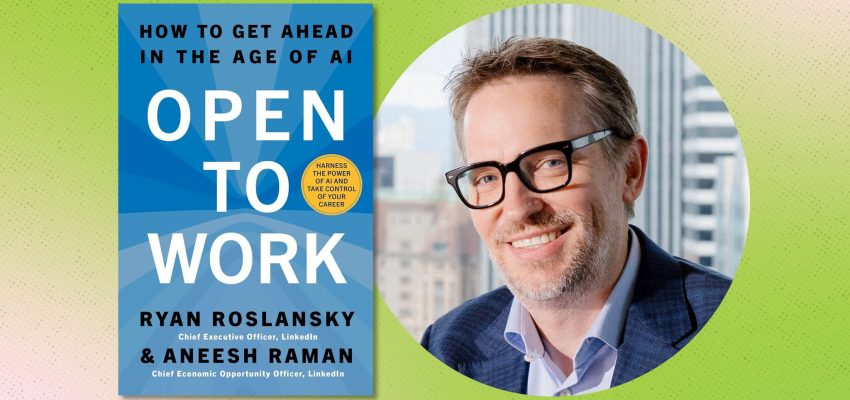

In an age where technological advancements often outpace our ability to fully comprehend their implications, artificial intelligence stands as perhaps the most transformative force of our time. From automating mundane tasks to revolutionizing entire industries, AI‘s influence is undeniable. Yet, amidst the fervent discussions about job displacement and the rise of intelligent machines, a crucial message emerges: the future of your career isn’t merely happening to you; it’s waiting for you to actively shape it. This sentiment, powerfully articulated by LinkedIn CEO Ryan Roslansky, serves as a rallying cry for professionals everywhere: ‘No one is taking care of your career for you.’
Roslansky, a co-author of LinkedIn’s widely recognized ‘Open to Work’ initiative, posits that the advent of AI will usher in unprecedented opportunities. However, seizing these opportunities demands a specific quality from the workforce: bravery – the courage to take initiative. As an AI specialist, writer, and tech enthusiast, I, André Lacerda, find this perspective not only refreshing but profoundly accurate. It shifts the narrative from one of passive anxiety to active empowerment, urging individuals to become architects of their own professional destiny in an increasingly intelligent world. The core challenge, and indeed the core opportunity, lies in understanding how to navigate this evolving landscape with foresight and agility.
AI and the Future of Work: Why Proactivity is Your Greatest Asset
The conversation around AI‘s impact on the job market has, at times, been dominated by fear. Images of robots replacing human workers in factories and algorithms taking over complex cognitive tasks fuel anxieties about widespread unemployment. While it’s undeniable that some roles will evolve or diminish, history teaches us that technological revolutions, from the Industrial Revolution to the Digital Age, have consistently created more jobs than they destroyed, albeit different ones. The key differentiator for individuals is adaptability. Roslansky’s message is a stark reminder that in this new paradigm, professional agency is paramount.
Consider the ‘Open to Work’ feature on LinkedIn. Launched during a period of significant economic uncertainty, it empowered millions of professionals to signal their availability and interest in new roles. This seemingly simple feature is a tangible example of the initiative Roslansky advocates. It’s about taking control, making your aspirations known, and actively engaging with the market, rather than passively waiting for opportunities to appear. This mindset is even more critical in an AI-driven economy where change is not just constant, but accelerating.
The potential of AI is not merely in automation but in augmentation. Rather than solely replacing human effort, AI tools can amplify human capabilities, allowing professionals to achieve more with greater efficiency and insight. For instance, generative AI models can assist writers in drafting content, designers in generating concepts, and software developers in writing code. This shifts the focus from rote task execution to strategic thinking, critical evaluation, and creative problem-solving. A recent report by PwC projected that AI could contribute up to $15.7 trillion to the global economy by 2030, a figure that underscores the immense growth and new value creation potential. This economic expansion naturally translates into new roles and demands for specific skills.
The World Economic Forum’s ‘Future of Jobs Report’ consistently highlights a growing demand for roles that interact with advanced technologies, such as AI and Machine Learning Specialists, Data Scientists, and Robotics Engineers. Beyond these specialized technical roles, however, the report also emphasizes the increasing importance of ‘human skills’ – attributes that AI currently struggles to replicate. These include critical thinking, creativity, complex problem-solving, emotional intelligence, and leadership. The proactive professional will not only seek to understand and leverage AI tools but also cultivate and strengthen these uniquely human competencies. This dual approach ensures relevance and resilience in a rapidly changing labor market.
From Automation to Opportunity: Reshaping Skills for an Intelligent Era
The landscape of professional skills is undergoing a seismic shift. What was once considered a niche technical skill is quickly becoming a foundational competency across various sectors. Understanding how AI works, even at a conceptual level, and knowing how to utilize AI-powered tools effectively, are becoming as important as digital literacy once became for the internet age. This doesn’t mean everyone needs to become an AI developer; it means everyone needs to become an AI-empowered professional.
Take, for example, the legal profession. While AI cannot yet replicate the nuanced judgment of a human lawyer, it can dramatically accelerate research, document review, and even predict case outcomes based on vast datasets. Lawyers who embrace these tools will be more efficient, deliver better results, and therefore be more competitive. Similarly, in marketing, AI algorithms can personalize customer experiences, analyze market trends, and optimize campaign performance. Marketing professionals who master these intelligent systems will unlock new levels of insight and effectiveness.
The concept of ‘reskilling’ and ‘upskilling’ is no longer a buzzword; it’s an essential survival strategy. Companies like Amazon, Google, and IBM have invested heavily in programs to retrain their workforce for AI-related roles, recognizing that the talent needed for the future often lies within their existing employee base. This trend extends to individual professionals who must actively seek out learning opportunities. Online platforms offer myriad courses in data science, machine learning, prompt engineering, and ethical AI development. Universities are expanding their curricula to include interdisciplinary programs that blend traditional fields with AI applications.
Embracing the shift from automation to opportunity also involves recognizing emerging roles that didn’t exist a decade ago. ‘Prompt engineering,’ for instance, is a rapidly growing field focused on crafting effective queries for generative AI models to produce desired outputs. ‘AI ethicists’ are crucial for ensuring fair, unbiased, and responsible deployment of intelligent systems. These are not merely technical roles; they require a blend of creativity, critical thinking, and a deep understanding of human values and societal impact. Professionals brave enough to pivot and learn these new skills will find themselves at the forefront of innovation and demand.
Cultivating a Growth Mindset: Strategies for Navigating the AI Landscape
The sheer pace of technological change can be daunting. What is cutting-edge today might be commonplace tomorrow. Therefore, the most critical skill for navigating the AI landscape is perhaps not a specific technical proficiency, but rather a robust growth mindset. This involves a willingness to continuously learn, unlearn, and relearn; to view challenges as opportunities for growth; and to embrace uncertainty as a fertile ground for innovation.
Ryan Roslansky’s emphasis on taking initiative perfectly aligns with this mindset. It means actively seeking knowledge about AI, even if it’s outside your immediate job description. It means experimenting with new AI tools in your daily work to understand their capabilities and limitations. It means networking with peers and experts who are also grappling with these changes, sharing insights, and collaborating on solutions. It means being ‘open to work’ not just in the sense of finding a new job, but in being open to new ideas, new skills, and new ways of working.
Practical strategies for cultivating this proactive approach include:
- Dedicated Learning Time: Set aside regular time each week for learning about AI, whether through online courses, industry reports, or webinars. LinkedIn Learning, for example, offers a vast library of courses on AI literacy and specific tools.
- Experimentation: Don’t be afraid to experiment with AI tools in your own domain. Use generative AI for brainstorming, data analysis tools for insights, or automation platforms for repetitive tasks. Understanding through doing is powerful.
- Networking and Community: Engage with AI communities, both online and offline. Attend industry conferences, join professional groups, and participate in discussions to stay abreast of trends and build valuable connections.
- Focus on Human-Centric Skills: While technical skills are vital, never underestimate the enduring value of human skills like empathy, ethical reasoning, cross-cultural communication, and creative ideation. These are the areas where human advantage will persist.
- Strategic Self-Assessment: Regularly assess your current skills against future demands. Identify gaps and proactively seek to fill them. Think critically about how AI might transform your industry in the next 5-10 years and prepare accordingly.
The shift isn’t just about adapting to AI; it’s about leveraging AI to elevate our work and careers. It’s about recognizing that while AI can process information, humans provide context, judgment, and purpose. The most successful professionals in this new era will be those who can effectively collaborate with intelligent systems, guiding them to achieve human-centric goals. They will be the ones brave enough to continually redefine their value proposition.
As we stand at the precipice of an intelligence revolution, the message from thought leaders like Ryan Roslansky resonates with particular force. The future of work is not a predetermined path laid out by algorithms or corporate strategies; it is a dynamic landscape shaped by individual choices and collective action. The opportunities presented by AI are immense, but they are not automatically granted. They must be seized with courage, curiosity, and an unwavering commitment to personal growth. Your career is, and always has been, your responsibility. In the age of AI, taking that responsibility means actively engaging with the technology, cultivating new skills, and continuously adapting to remain relevant and thrive.
The journey ahead promises to be exhilarating, challenging, and profoundly rewarding for those willing to take the reins. Embrace the learning, embrace the change, and empower yourself to be a proactive force in shaping not just your own professional journey, but the broader trajectory of our intelligent future. The future isn’t just coming; it’s being built, and your initiative is a crucial part of its foundation.










