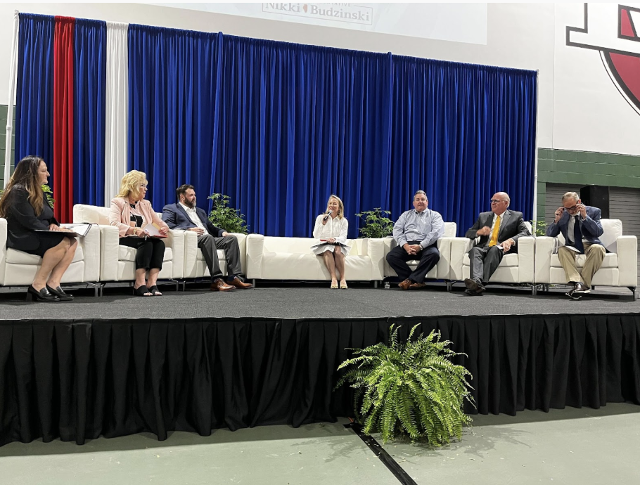
In a world increasingly shaped by algorithms and intelligent machines, the foundations of future careers are being laid in unexpected places. Take, for instance, the recent news from Rochester, New York. Northwest and Andrew Langston Middle Schools, sharing a campus, recently orchestrated their largest career day ever. This seemingly local event, born from a collaborative spirit, serves as a powerful reminder of the universal importance of exposing young minds to the vast possibilities that lie ahead. But what truly awaits these students? As an AI specialist and tech enthusiast, I see a future utterly transformed by artificial intelligence, demanding a proactive approach to education that transcends traditional boundaries. The real question isn’t just about showing students *what* jobs exist, but preparing them for jobs that don’t yet exist, equipping them with the skills to thrive in a landscape profoundly reshaped by AI.
The swift ascent of artificial intelligence from the realm of science fiction to a pervasive force in our daily lives has sent ripples across every industry. From automating repetitive tasks to powering complex decision-making, AI’s influence is undeniable. This paradigm shift means that understanding and navigating the evolving professional landscape is no longer a luxury but a necessity for today’s youth. Events like Rochester’s career day are more critical than ever, not merely as an annual exhibition, but as a crucial touchpoint for guiding students toward meaningful and sustainable futures. It’s about planting the seeds of curiosity, fostering a growth mindset, and demonstrating that the future of work, while complex, is also brimming with unprecedented opportunities for those who are prepared to embrace innovation. My aim is to explore how we can better prepare the next generation to not just adapt to, but to lead within, the exciting new world of artificial intelligence.
AI career pathways: Charting a Course for the Next Generation
The notion of a stable, predictable career trajectory is rapidly becoming a relic of the past, especially with the accelerated evolution of artificial intelligence. We are witnessing a monumental shift, often compared to the Industrial Revolution, where machines are fundamentally altering how work is done, what skills are valued, and indeed, what professions even exist. This necessitates a proactive and forward-thinking approach to exploring **AI career pathways** for students who are still years away from entering the workforce. The career day at Northwest and Andrew Langston Middle Schools, by its very scale and collaborative nature, offers a glimpse into the comprehensive approach needed to address this future.
Gone are the days when ‘tech jobs’ were synonymous solely with coding or hardware engineering. Today, AI permeates nearly every sector, creating a diverse spectrum of roles that demand a blend of technical acumen, creative problem-solving, and robust ethical consideration. For instance, an understanding of machine learning is becoming as crucial in biological research as it is in financial analysis. Similarly, data literacy, the ability to interpret and manipulate vast datasets, is now a cornerstone skill across fields ranging from marketing to urban planning. This breadth means that future generations aren’t necessarily funnelled into a single, narrow ‘AI’ profession, but rather empowered to integrate AI tools and principles into a multitude of existing and emerging careers.
Consider the rapid advancements in generative AI, which can create text, images, and even code from simple prompts. This development alone has led to the emergence of roles like ‘Prompt Engineer,’ a profession that barely existed a few years ago, focusing on crafting effective inputs for AI models. This highlights a critical truth: the most impactful **AI career pathways** of tomorrow might not even be conceived today. Therefore, our educational strategies must pivot from simply teaching existing knowledge to fostering adaptability, critical thinking, and a lifelong learning mindset. Early exposure, through engaging and diverse career day experiences, provides an invaluable initial window into this dynamic landscape. It allows students to envision themselves in roles they might otherwise never encounter, sparking an interest that can shape their academic and professional journeys for years to come.
The Shifting Sands of Employment: How AI Reshapes Industries
The impact of AI extends far beyond the tech sector, acting as a disruptive and transformative force across virtually all industries. Understanding these broader implications is vital when guiding students toward viable **AI career pathways**. Let’s explore some key sectors where AI is not just a tool, but a fundamental driver of change:
* **Healthcare:** AI is revolutionizing diagnostics, drug discovery, and personalized medicine. Roles like AI-powered medical imaging specialists, bioinformatics engineers, and predictive analytics experts in patient care are rapidly expanding. AI algorithms can analyze vast amounts of patient data to identify patterns, predict disease outbreaks, and even assist in complex surgeries, requiring professionals who can design, implement, and ethically manage these sophisticated systems.
* **Finance:** Algorithmic trading, fraud detection, and personalized financial advice are all powered by AI. This creates demand for quantitative analysts with machine learning skills, AI risk management specialists, and regulatory compliance experts who understand AI’s nuances. The ability to build and interpret complex AI models that navigate market fluctuations and detect anomalies is highly prized.
* **Creative Arts and Media:** From AI-generated music and art to intelligent content recommendation systems and automated news reporting, AI is both a creative partner and a production engine. This opens up opportunities for AI-assisted artists, content strategists who leverage AI analytics, and ethical AI designers focusing on intellectual property and bias in creative outputs. The intersection of human creativity and AI augmentation is a fertile ground for new professional development.
* **Manufacturing and Robotics:** AI is at the heart of smart factories, predictive maintenance, and advanced robotics. Roles include robotics engineers, AI-driven supply chain optimization specialists, and human-robot interaction designers. The ability to program and manage autonomous systems, ensuring efficiency and safety, is paramount in modern industrial settings.
* **Education:** Even the field of education itself is being reshaped, with AI-powered tutoring systems, personalized learning platforms, and adaptive assessment tools. This necessitates educational technologists with AI expertise, learning analytics specialists, and curriculum developers who can integrate AI literacy into core subjects. These roles focus on using AI to enhance learning outcomes and provide more tailored educational experiences.
Beyond these sector-specific roles, a new class of multidisciplinary professions is emerging. **AI career pathways** often demand a fusion of technical skills with critical soft skills. For example, ‘AI Ethicists’ are crucial for ensuring that AI systems are developed and deployed responsibly, minimizing bias and maximizing fairness. ‘AI Product Managers’ combine business acumen with technical understanding to guide the development of AI-powered products. ‘Data Scientists’ collect, clean, and interpret massive datasets, forming the backbone of any AI initiative. And ‘Machine Learning Engineers’ are the architects who build and deploy the algorithms that power these intelligent systems.
These roles underscore that success in an AI-driven world isn’t solely about coding; it’s about understanding complex systems, thinking critically, collaborating across diverse teams, and constantly adapting to new technologies. The skills needed are not just technical proficiency in Python or TensorFlow, but also strong communication, creativity, problem-solving, and a profound sense of responsibility for the societal impact of AI.
Education’s Pivotal Role: Nurturing Future AI Innovators
Given the unprecedented pace of technological change and the complex demands of emerging **AI career pathways**, the role of education becomes more critical than ever. Schools, from primary to tertiary levels, bear the immense responsibility of preparing students not just for current job market needs but for a future that is still being written. The cooperative spirit demonstrated by Northwest and Andrew Langston Middle Schools in hosting their combined career day offers a valuable lesson in how educational institutions can leverage collaboration to broaden opportunities and amplify their impact.
Traditionally, career days might feature a doctor, a police officer, or a carpenter – vital professions, to be sure. However, in today’s context, such events must expand to include a wider array of professionals from the AI and technology sectors. Imagine a middle school career day where students can interact with a Data Scientist explaining how they predict weather patterns, a Robotics Engineer showcasing a collaborative robot, or an AI Ethicist discussing the importance of fairness in algorithms. These interactions can demystify complex fields and ignite passions that might otherwise remain dormant.
The curriculum itself needs significant rethinking. While a strong foundation in STEM (Science, Technology, Engineering, and Mathematics) is undeniably crucial, it’s no longer sufficient. We need to move towards STEAM, integrating Arts to foster creativity, critical thinking, and design principles, which are essential for developing user-friendly and innovative AI solutions. Moreover, interdisciplinary learning must become the norm, rather than the exception. Teaching history alongside the societal impact of past technological revolutions, or linking literature with discussions on AI’s ethical dilemmas, can provide a richer, more holistic understanding.
Developing a ‘digital literacy’ that extends beyond basic computer skills is paramount. Students need to understand how AI works at a conceptual level, its capabilities, and its limitations. They should be encouraged to question, experiment, and even critically evaluate AI tools rather than simply consume them. This means fostering skills in computational thinking, data analysis, and perhaps even introductory programming, presented in an accessible and engaging manner that emphasizes problem-solving over rote memorization.
Furthermore, the curriculum should actively promote critical thinking about the ethical dimensions of AI. Discussions around data privacy, algorithmic bias, job displacement, and the responsible use of AI should be integrated into various subjects. Equipping students with an ethical compass will be as important as teaching them to code. After all, the AI systems of tomorrow will be designed by the students of today, and their values will be embedded in these technologies.
The Rochester example, where two schools on a shared campus collaborated to create a larger, more impactful event, highlights a powerful model. Educational institutions can achieve more by pooling resources, expertise, and networks. Imagine regional hubs where schools collaborate to bring in AI professionals, host workshops, or even develop joint projects that expose students to real-world AI challenges. This collaborative approach can ensure that even schools with limited individual resources can provide comprehensive exposure to emerging **AI career pathways**.
In addition to formal education, extracurricular activities play a vital role. Robotics clubs, coding camps, AI ethics debate teams, and hackathons can provide practical, hands-on experience and foster a community of aspiring innovators. These environments allow students to experiment, fail, learn, and build confidence outside the traditional classroom setting, preparing them for the dynamic and often iterative nature of work in AI.
Ultimately, nurturing future AI innovators isn’t just about teaching technical skills; it’s about cultivating a mindset of curiosity, resilience, and ethical responsibility. It’s about empowering students to become creators and critical users of technology, rather than passive consumers. By adapting our educational frameworks and embracing collaborative models, we can ensure that the next generation is not merely ready for the future, but actively shaping it.
The journey toward understanding and navigating the future of work, profoundly reshaped by artificial intelligence, is one that requires foresight, collaboration, and an unwavering commitment to education. The simple yet profound act of two middle schools in Rochester coming together for their largest career day ever underscores a universal truth: preparing the next generation for what lies ahead is a collective responsibility, and early exposure is a cornerstone of that preparation. As AI continues its inexorable march into every facet of our lives, the imperative to equip our students with the right skills, knowledge, and ethical frameworks has never been greater.
It is through innovative educational approaches, a focus on interdisciplinary learning, and the cultivation of both technical and critical thinking skills that we can truly empower students to forge successful **AI career pathways**. By embracing collaboration, fostering a lifelong love for learning, and instilling a strong ethical compass, we can ensure that the architects of tomorrow’s AI systems are not only technically proficient but also socially conscious and responsible leaders. The future is exciting, complex, and full of potential, and it is our duty to prepare our youth to confidently step into it, ready to innovate, adapt, and make a positive impact on the world.