
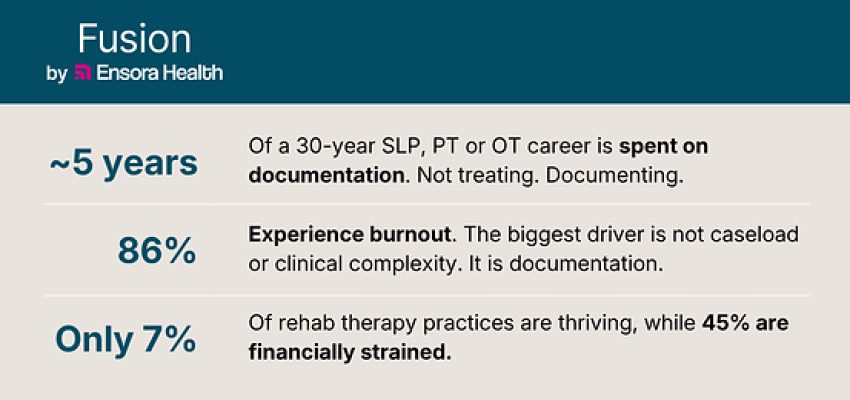

In the demanding world of healthcare, every moment counts. For rehabilitation therapists, this adage holds a profound and often disheartening truth. While their passion lies in empowering patients to regain mobility, function, and independence, a significant portion of their professional lives is spent away from the treatment room, engrossed in administrative tasks. New research from Ensora Health casts a stark light on this issue, revealing a statistic that should give every healthcare professional pause: over a 30-year career, the average rehab therapist dedicates the equivalent of nearly five full years to documentation. That’s five years not treating patients, not guiding recovery, and not directly impacting lives. As an AI specialist, writer, and tech enthusiast, I see this not just as an inefficiency but as a profound opportunity for transformative change.
This staggering figure underscores a critical challenge facing the rehabilitation sector today. It highlights a systemic drain on precious resources—human capital, time, and ultimately, patient outcomes. Imagine the cumulative impact if those years could be redirected towards direct patient care, professional development, or even simply a healthier work-life balance for dedicated therapists. The question then becomes: in an era of rapid technological advancement, particularly in artificial intelligence, why are we still allowing such a significant portion of a highly skilled professional’s career to be consumed by paperwork? The answer, I believe, lies in embracing intelligent automation to free our therapists to do what they do best: heal and empower.
AI in Rehabilitation Documentation: Reclaiming Precious Time
The Ensora Health study isn’t just a number; it’s a clarion call. It quantifies a long-standing frustration within the rehabilitation community. Five years—that’s roughly one-sixth of an entire professional career—spent meticulously logging notes, tracking progress, fulfilling compliance requirements, and navigating complex electronic health record (EHR) systems. This isn’t merely an inconvenience; it’s a significant barrier to quality care, a contributor to therapist burnout, and a silent driver of rising healthcare costs. When therapists are tethered to keyboards and clipboards, their capacity to engage deeply with patients, adapt treatment plans in real-time, and truly focus on the human element of rehabilitation is diminished. The sheer volume of data required for billing, legal compliance, and continuum of care planning has exploded over the past decades, transforming documentation from a supportive task into an overwhelming primary responsibility.
Consider the broader implications. The demand for rehabilitation services is growing exponentially, fueled by an aging global population, an increase in chronic diseases, and advancements in medical interventions that allow more people to survive and recover from serious conditions. Physical, occupational, and speech therapy are vital components of recovery from strokes, traumatic injuries, surgeries, and countless other health challenges. If the current model of documentation persists, we face a future where the supply of skilled therapists is increasingly constrained by administrative burdens, rather than their capacity to treat. This not only impacts individual patient journeys but strains healthcare systems already under immense pressure. The promise of AI in rehabilitation documentation, therefore, isn’t just about efficiency; it’s about safeguarding the future of patient care and ensuring that every therapist’s invaluable expertise is utilized where it matters most.
The Burden of Bureaucracy: Why Documentation Drains Therapists
To truly appreciate the potential of artificial intelligence, we must first understand the intricate nature of the problem it seeks to solve. Documentation in healthcare is far from simple data entry. It’s a complex, multi-faceted process driven by a confluence of clinical, legal, and financial imperatives. Therapists must record every aspect of a patient’s journey: initial assessments, daily progress notes, treatment plans, interventions performed, patient responses, goals achieved, and future recommendations. Each entry must adhere to specific formatting, terminology, and coding standards set by insurance providers, regulatory bodies like HIPAA, and institutional policies. The level of detail required is often exhaustive, demanding precise language that accurately reflects the medical necessity of services provided.
The transition from paper charts to electronic health records (EHRs) was intended to streamline this process, and in many ways, it has. EHRs offer better data accessibility, interoperability, and the potential for analytics. However, they’ve also introduced new complexities. Therapists often spend significant time navigating clunky interfaces, clicking through numerous screens, and entering data into structured fields that don’t always align with the narrative flow of a clinical encounter. The ‘click fatigue’ is real, and it detracts from the clinician’s ability to engage fully with the patient. Furthermore, the pressure to document in real-time, often during or immediately after a session, can lead to a fragmented focus, dividing attention between the patient and the computer screen. This administrative overhead is not unique to rehabilitation, but given the hands-on, interactive nature of therapy, its impact feels particularly acute, stealing valuable moments that could be spent on direct therapeutic engagement or empathetic connection.
The cumulative effect is a pervasive sense of administrative burden. Therapists report spending hours outside of patient contact time completing documentation, leading to longer workdays, increased stress, and a higher risk of burnout. This not only impacts individual well-being but can also contribute to therapist shortages, as talented professionals seek less administratively intensive roles or leave the field entirely. The current system, while necessary for accountability and quality assurance, has inadvertently created a barrier between therapists and their core mission. It’s a system ripe for disruption, and this is precisely where the power of modern artificial intelligence comes into play, offering a pathway to reclaim those lost years and refocus the therapist’s energy where it truly belongs.
Ethical AI and the Future of Rehab Practice
The integration of advanced AI technologies into rehabilitation documentation is not a distant futuristic concept; it’s already beginning to reshape workflows and redefine efficiency. Imagine a scenario where a therapist can focus entirely on their patient, knowing that an intelligent assistant is seamlessly capturing and structuring the conversation and observations in the background. This is the promise of AI in rehabilitation documentation. Technologies such as natural language processing (NLP), speech-to-text transcription, and machine learning algorithms are the core components driving this revolution.
Here’s how AI can fundamentally transform the documentation process:
- Automated Transcription and Summarization: Therapists can use voice commands or simply speak naturally during or after a session, and AI-powered tools can transcribe the conversation, identify key clinical terms, and even generate a draft progress note. NLP can then summarize these verbose notes into concise, structured entries, saving hours of manual typing and rephrasing.
- Smart Data Extraction and Populating: AI can analyze unstructured text from therapist notes and automatically extract relevant data points—such as range of motion measurements, pain levels, functional improvements, or specific interventions—and populate corresponding fields in the EHR system. This reduces manual data entry and minimizes errors.
- Compliance and Billing Assistance: AI algorithms can be trained on vast datasets of compliance regulations and billing codes. They can flag potential documentation gaps, suggest appropriate codes based on the recorded interventions, and ensure that all necessary information for reimbursement is present, thereby reducing denials and administrative rework.
- Predictive Analytics and Clinical Insights: Beyond mere documentation, AI can analyze aggregated patient data to identify trends, predict patient outcomes based on specific treatment plans, and even suggest personalized therapy adjustments. This transforms documentation from a retrospective record-keeping task into a proactive tool for enhancing care.
- Reduction of Cognitive Load: By automating repetitive and time-consuming tasks, AI frees up therapists’ cognitive resources, allowing them to focus on clinical reasoning, critical thinking, and providing truly patient-centered care. This directly combats burnout and enhances job satisfaction.
Of course, the ethical implementation of AI is paramount. Concerns around data privacy, security, algorithmic bias, and the need for human oversight must be diligently addressed. AI should serve as an intelligent assistant, augmenting the therapist’s capabilities, not replacing their professional judgment. Robust security protocols, adherence to HIPAA and other data protection regulations, and transparent algorithms are non-negotiable. Therapists must always have the final review and approval of any AI-generated documentation, ensuring accuracy and accountability. The goal is to empower therapists, providing them with more time to connect with their patients and elevate the quality of care, while ensuring the integrity and ethical boundaries of healthcare practice are maintained. This careful balance ensures that as we embrace the efficiencies of AI, we do so responsibly, putting patient welfare and professional integrity at the forefront.
The potential for AI to dramatically reduce the documentation burden is undeniable. Imagine a future where rehabilitation therapists can dedicate those precious five years, currently lost to administrative tasks, back to their patients. This isn’t just about saving time; it’s about enhancing the human element of healthcare, fostering deeper connections, and ultimately, improving the lives of countless individuals on their path to recovery. By leveraging intelligent automation responsibly and ethically, we can redefine the role of the rehabilitation therapist, allowing them to fully embrace their calling and lead the charge in a more efficient, patient-focused, and sustainable healthcare ecosystem. The journey to a more intelligent and empathetic rehabilitation system is well underway, and AI is proving to be an indispensable co-pilot.
The statistics from Ensora Health serve as a powerful reminder of the administrative challenges that weigh heavily on our dedicated rehabilitation therapists. Five years—an astonishing period of professional life—spent on documentation, not on direct patient care, is a luxury our healthcare system can no longer afford. The integration of advanced artificial intelligence into rehabilitation workflows offers a compelling and ethical solution, promising to transform this burden into an opportunity for growth, efficiency, and enhanced patient outcomes. By automating repetitive tasks, providing smart insights, and ensuring compliance, AI liberates therapists to focus on their core mission: healing, educating, and empowering individuals to reclaim their lives.
As an AI specialist, I am convinced that the future of rehabilitation will be one where technology acts as a force multiplier for human expertise. It’s a future where therapists are supported by intelligent systems, allowing them to dedicate their invaluable skills and compassion to where they are most needed. Embracing AI in rehabilitation documentation is not merely about adopting new tools; it’s about fundamentally rethinking how we support our healthcare heroes, fostering an environment where innovation empowers professionals and ultimately delivers superior care for everyone. The time to transition from administrative overhead to clinical excellence, fueled by intelligent automation, is now.










