

The world of work is in constant flux, a dynamic landscape perpetually reshaped by innovation. From the agricultural revolution to the industrial age, and then the digital transformation, humanity has consistently found new ways to amplify its capabilities and redefine labor. Today, we stand at the precipice of yet another monumental shift, one powered by algorithms, data, and machine learning: the era of Artificial Intelligence. While much of the popular discourse around AI focuses on its impact on white-collar jobs or the dizzying advancements in research labs, a crucial, often overlooked, transformation is unfolding in the very bedrock of our economy: the skilled trades.
For generations, vocational training centers have been the engines driving economic stability, preparing students for well-respected, high-demand professions ranging from welding and automotive repair to culinary arts and healthcare support. These are the hands-on careers that build our infrastructure, keep our machines running, and care for our communities. But what happens when these deeply practical fields meet the abstract power of AI? Far from being immune to this technological tide, the skilled trades are experiencing a profound evolution, one that is not only enhancing efficiency and safety but also unlocking unprecedented opportunities for higher wages and more sophisticated roles. As an AI specialist and tech enthusiast, I’m fascinated by this convergence, witnessing firsthand how the integration of AI is not just changing *how* these jobs are done, but fundamentally *what* they entail, creating a new generation of **Artificial Intelligence in Skilled Trades** experts.
### Artificial Intelligence in Skilled Trades: Reshaping the Foundation of Work
The notion that AI is exclusively the domain of software engineers and data scientists is quickly becoming obsolete. In reality, **Artificial Intelligence in Skilled Trades** is rapidly becoming an indispensable tool, augmenting human capabilities and streamlining processes across a spectrum of professions. Consider manufacturing, where traditional manual labor is increasingly supported, and sometimes even superseded, by robotic arms that perform repetitive tasks with unmatched precision and speed. These aren’t just dumb machines; they are often integrated into AI-driven systems that can learn, adapt, and optimize production lines in real-time, predicting equipment failures before they occur through sophisticated predictive maintenance algorithms. This shifts the role of the human worker from purely operative to supervisory, requiring skills in robotics programming, data interpretation, and system diagnostics.
The automotive industry offers another compelling example. Modern vehicles are essentially computers on wheels, brimming with sensors and complex electronic systems. Automotive technicians today are not just wrench-turners; they are diagnosticians who often interface with AI-powered diagnostic tools that can pinpoint issues faster and more accurately than ever before. As electric and autonomous vehicles become mainstream, the demand for technicians skilled in high-voltage systems, advanced sensor calibration, and even software updates will skyrocket. Similar transformations are evident in construction, where AI-powered drones conduct topographical surveys, robotic bricklayers increase efficiency, and project management software leverages machine learning to optimize schedules and material procurement. These advancements contribute to safer work environments, reduced waste, and significantly faster project completion, creating a higher demand for workers who understand and can operate these intelligent systems. For those with traditional skills, adding AI literacy means moving into supervisory or specialist roles, commanding higher salaries and greater job security. This isn’t just about automation; it’s about intelligent augmentation, making the human worker more powerful and productive.
### Bridging the Skills Gap: Education’s Crucial Role in the AI Era
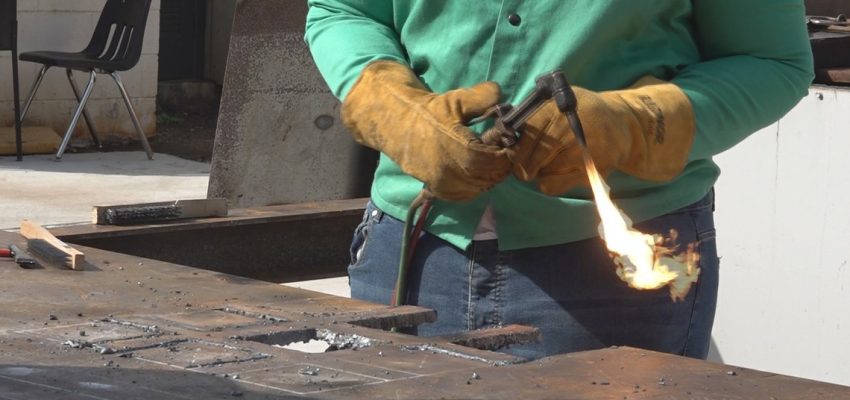
The rapid integration of **Artificial Intelligence in Skilled Trades** brings with it both immense opportunity and a critical challenge: the widening skills gap. The workforce of tomorrow needs more than just traditional craft proficiency; it demands digital literacy, analytical thinking, and the ability to interact seamlessly with AI systems. This places an unprecedented responsibility on vocational training centers and educational institutions. Historically, these centers have been agile in adapting their curricula to meet industry demands, but the pace of AI evolution requires an even more proactive approach. Imagine a welding program that not only teaches traditional arc welding but also incorporates training on robotic welding systems, using virtual reality (VR) simulations for practice and AI-powered quality control systems for immediate feedback. Or a culinary arts program that explores how AI can optimize inventory, predict customer preferences, or even assist in recipe development, giving chefs powerful new tools for innovation and efficiency.
Programs must evolve to teach students not just *how* to use AI tools, but *why* and *when* to use them, fostering a problem-solving mindset that leverages technology. This means integrating modules on data analytics, basic programming logic, sensor technology, and human-machine interface design into established trade curricula. Collaborative projects with industry partners can ensure that students gain hands-on experience with the latest AI technologies being deployed in real-world scenarios. The goal isn’t to turn every trade worker into an AI developer, but to equip them with the foundational knowledge and adaptability to thrive in an AI-augmented environment. Lifelong learning initiatives will also be crucial, providing upskilling and reskilling opportunities for existing professionals to remain competitive. By bridging this skills gap, we not only secure the future for individual workers but also ensure that industries can continue to innovate and grow, preventing a talent shortage that could otherwise hinder progress.
### The Economic Imperative: High-Paying Careers in an AI-Augmented World
The most compelling argument for embracing **Artificial Intelligence in Skilled Trades** lies in its economic imperative. As AI technologies enhance productivity, precision, and safety, they fundamentally increase the value of the work performed. Workers who possess both traditional trade skills and AI literacy are becoming highly sought after, commanding premium wages. Consider the advanced manufacturing technician who can program collaborative robots, interpret data from smart sensors to prevent machine downtime, and troubleshoot AI-driven automation systems. This individual is far more valuable than one who can only perform manual operations, leading to significantly higher earning potential.
Data increasingly supports this trend. Reports from organizations like the World Economic Forum consistently highlight that jobs requiring a blend of technical and digital skills, including AI proficiency, are among the fastest-growing and highest-paying. For example, a specialized HVAC technician who can install and maintain smart building management systems, leveraging AI for optimal energy efficiency and predictive maintenance, provides a much higher value proposition than a traditional technician. Similarly, a medical assistant trained to operate AI-powered diagnostic equipment or manage patient data within intelligent health systems performs a more complex and critical role. The integration of AI also often elevates the nature of work, moving it away from repetitive, physically demanding tasks towards more analytical, problem-solving roles, which are inherently more engaging and professionally rewarding. This translates not only into higher individual incomes but also into stronger, more innovative local economies. Investing in AI-focused trade education is therefore not just about technological advancement; it’s a strategic investment in economic resilience and upward mobility for the workforce.
In conclusion, the narrative around AI’s impact on employment often leans towards dystopian fears of job displacement. However, a closer look at the evolution of **Artificial Intelligence in Skilled Trades** reveals a more nuanced and ultimately optimistic picture. AI is not here to replace human ingenuity and craftsmanship; rather, it is poised to amplify it, transforming traditional roles into sophisticated, high-tech careers that demand a new blend of practical skills and digital acumen. This convergence creates an exciting frontier for individuals seeking stable, well-paying jobs, and for industries striving for greater efficiency, innovation, and safety.
The future of skilled labor is bright, but it is unequivocally an AI-powered future. Educational institutions, industry leaders, and policymakers must collaborate to ensure that the next generation of tradespeople is equipped with the knowledge and tools to navigate this evolving landscape. By embracing AI, we empower workers, strengthen industries, and build a more robust, technologically advanced society where human potential is augmented, not diminished, by intelligent machines. The blueprint for tomorrow’s workforce is being drawn today, and it’s one where the synergy between human skill and artificial intelligence will define success.










