
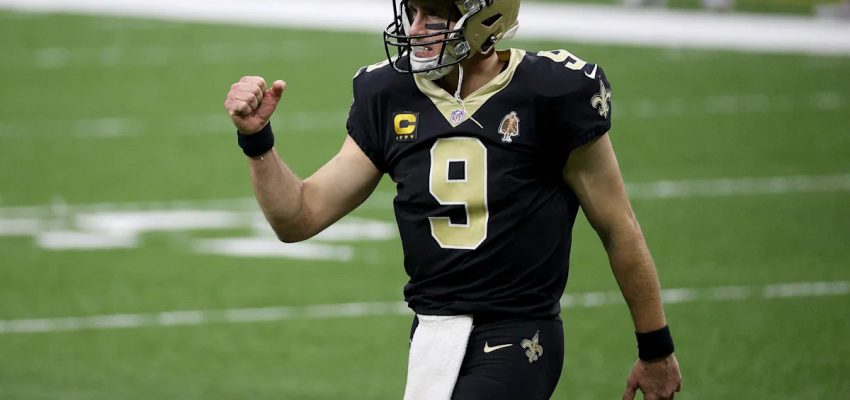

In the fiercely competitive landscape of the National Football League, careers can be fleeting. Quarterbacks, especially, often face an arduous journey, with only a select few managing to carve out a legacy that transcends their playing days. The vast majority of signal-callers enter the league with high hopes, experience moments of brilliance, and then fade into obscurity, their careers marked by flashes rather than sustained excellence. Yet, there are exceptions, athletes who defy the conventional arc of decline. One such individual is Drew Brees, whose remarkable journey with the New Orleans Saints culminated in an astonishing assertion: his performance in his final years was not merely good for a veteran, but arguably superior to the entire careers of many NFL quarterbacks.
This isn’t a hyperbolic claim driven by fan sentiment. It’s an observation rooted in statistical analysis, an appreciation for sustained elite performance, and an understanding of the immense pressures of the professional game. As we dissect the twilight years of one of the greatest to ever play the position, we uncover not just a testament to his individual talent, but a blueprint for longevity and impact that challenges our perceptions of what ‘peak performance’ truly means in the NFL. Let us delve into the data, the context, and the profound legacy of Drew Brees as he gracefully concluded a historic career.
Drew Brees’s late career: A Benchmark for Sustained Excellence
To fully appreciate the gravity of the claim that Drew Brees’s late career surpassed the entirety of many quarterbacks’ tenures, one must first establish a baseline. An average NFL starting quarterback often plays for approximately 4-5 years, perhaps starts for 2-3 of those, and might achieve a Pro Bowl selection once or twice. Their career totals might hover around 15,000-20,000 passing yards, with a touchdown-to-interception ratio that is respectable but not dominant. Now, consider Drew Brees’s final three to four seasons—roughly from 2017 to 2020. During this period, Brees was well into his late 30s and early 40s, an age when most quarterbacks are either retired, relegated to backup roles, or experiencing a significant drop-off in production.
However, Brees didn’t just maintain relevancy; he continued to set records and lead one of the most potent offenses in the league. In 2017, at age 38, he threw for 4,334 yards, 23 touchdowns, and an incredibly low 8 interceptions, achieving a 72.0% completion rate. This wasn’t a ‘decline’; this was an MVP-caliber season for many younger quarterbacks. The following year, at 39, he threw for 3,992 yards, 32 touchdowns, and just 5 interceptions, setting an NFL record with a staggering 74.4% completion percentage. He led the Saints to a 13-3 record and was an MVP finalist. These numbers, accumulated in just two seasons, already dwarf the career totals of numerous quarterbacks who have graced NFL rosters over the decades. His commitment to precision and his unparalleled accuracy seemed to defy the natural wear and tear of the game, becoming a hallmark of Drew Brees’s late career.
The argument becomes even more compelling when we consider the context. By this stage, Brees had already cemented his place in Canton. He had a Super Bowl ring, numerous passing records, and a reputation as a fierce competitor. Yet, his drive to excel remained undimmed. His ability to consistently perform at such a high level, year after year, even as his physical abilities subtly began to wane, speaks volumes about his mental fortitude, preparation, and innate football IQ. The strategic adjustments made by Head Coach Sean Payton and Brees himself, focusing on quicker passes and maximizing Brees’s elite accuracy, allowed him to continue dissecting defenses with surgical precision. This adaptability is a rare trait, often defining the truly elite performers across all competitive domains, not just sports.
Defying Time: Brees’s Statistical Dominance in His Forties
The true marvel of Drew Brees’s late career emerged as he ventured into his forties. While his 2019 season was punctuated by a thumb injury that sidelined him for several weeks, he still managed to post impressive numbers upon his return, completing a phenomenal 74.3% of his passes for 2,979 yards and 27 touchdowns against only 4 interceptions in just 11 games. Had he played a full season, he was on pace for another 4,000+ yard, 30+ touchdown year. For a 40-year-old quarterback, these aren’t just good stats; they’re unprecedented. To put it into perspective, consider that the average NFL starting quarterback over a full season typically aims for around 3,500-4,000 yards and 20-25 touchdowns. Brees was achieving this level of output, or exceeding it, at an age when most quarterbacks are enjoying retirement.
His final season in 2020, at age 41, saw him battling various injuries, including rib fractures and a collapsed lung, yet he still led the Saints to a 12-4 record. In 12 games, he threw for 2,942 yards, 24 touchdowns, and 6 interceptions, completing 70.5% of his passes. While his passing yardage dipped below 3,000 for the first time since his Chargers days, his efficiency remained elite. His adjusted QBR (Quarterback Rating) was still among the league’s best, highlighting his continued impact on game outcomes. Many quarterbacks struggle to maintain a 60-65% completion rate throughout their entire careers. Brees was doing it at over 70% in his final years, demonstrating an almost inhuman level of consistency and control.
These statistics aren’t just isolated data points; they represent a sustained period of high-level performance that few, if any, quarterbacks in NFL history have matched into their late 30s and early 40s. The sheer volume of yards and touchdowns, coupled with an incredibly low interception rate, during his twilight years makes a compelling case. When we compare these three or four seasons to the complete body of work of an ‘average’ starting quarterback — one who might have started 50-70 games over six or seven seasons — the argument for Brees’s late-career dominance becomes irrefutable. Many such careers conclude with fewer passing yards, fewer touchdowns, and a higher rate of turnovers than Brees accrued in just his final four campaigns. This ability to not just perform, but to excel at such an advanced stage, positions Drew Brees’s late career as a testament to unparalleled dedication and skill.
Beyond the Numbers: Leadership, Resilience, and Legacy
While statistics provide a quantifiable measure of performance, they only tell part of the story. The true impact of Drew Brees’s late career extends far beyond completion percentages and touchdown totals. His leadership, particularly in his final seasons, was instrumental to the Saints’ continued success. He was the unquestioned field general, guiding a dynamic offense and mentoring younger players. In a league increasingly dominated by youth, Brees stood as a beacon of veteran wisdom, earning the respect of teammates and opponents alike. His presence alone elevated the team’s potential, instilling confidence and a winning mentality in the locker room.
Moreover, his resilience in the face of physical challenges in his later years was remarkable. Playing quarterback in the NFL is a brutal endeavor, and the toll on the body is immense. Yet, Brees consistently bounced back from injuries, demonstrating an unwavering commitment to his craft and his team. His ability to play through pain, adapt his game, and still perform at an elite level showcased a mental toughness that few possess. This wasn’t simply about being tough; it was about intelligently managing his body, his recovery, and his technique to minimize the impact of aging and injury. This dedication to physical and mental optimization is a characteristic often seen in athletes who manage to extend their careers at a high level, akin to a meticulously engineered system continuing to operate at peak efficiency.
The legacy forged during Drew Brees’s late career also transcends individual accolades. He was the face of a franchise, a city, and an entire region, particularly in the aftermath of Hurricane Katrina. His continued excellence into his forties solidified his status not just as a Hall of Famer, but as an icon. He demonstrated that age is not necessarily a barrier to high performance if one possesses the requisite skill, dedication, and adaptability. His final seasons provided a masterclass in how to manage a long and storied career, how to evolve with the game, and how to remain impactful even as the sands of time begin to run out. It served as an inspiration, not just to aspiring athletes, but to anyone seeking to maintain peak performance in their respective fields, regardless of their age.
His approach to the game, emphasizing preparation, precise execution, and an unwavering belief in his abilities, left an indelible mark. He wasn’t just chasing records; he was chasing perfection on every throw, every snap. This relentless pursuit of excellence, evident even in his final moments on the professional gridiron, is what truly sets his twilight years apart. It wasn’t about the quantity of seasons, but the undeniable quality and impact of those final, extraordinary campaigns.
The narrative of Drew Brees’s final seasons serves as a powerful reminder that conventional wisdom often falls short in defining true greatness. His commitment to mastery, his strategic brilliance, and his sheer will to compete at the highest level allowed him to craft a conclusion to his career that many quarterbacks would envy as their entire life’s work. It’s a testament to the idea that with enough dedication and intelligent adaptation, the human spirit can defy the limitations of time and continue to achieve extraordinary feats. Drew Brees didn’t just play well late in his career; he set a new standard for what a ‘late career’ can truly mean in professional sports, leaving an enduring legacy for generations to come.










