

In an era defined by exponential technological advancement and an ever-shifting global landscape, the traditional models of education often struggle to keep pace. The familiar classroom, designed for an industrial age, now faces the formidable challenge of preparing students for a future that is, in many ways, unknowable. As an AI specialist, writer, and tech enthusiast, I’ve observed firsthand the profound impact of artificial intelligence and digital innovation across industries. This transformation isn’t just reshaping jobs; it’s fundamentally altering the skills and mindsets required to thrive.
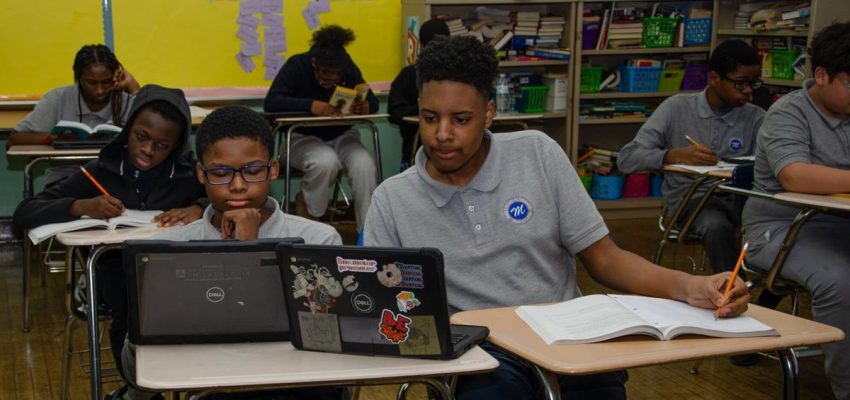
It is within this context that institutions daring to rethink their approach become beacons of progress. Consider Middle Years Alternative (MYA) in West Philadelphia, a remarkable school serving grades five through eight. MYA is not merely teaching subjects; it is actively forging a direct link between what students learn today and the careers they might pursue tomorrow. By blending career exploration with innovative technology, MYA is cultivating a generation of learners equipped not just with knowledge, but with an understanding of its practical application in the real world. This proactive approach to education is not just commendable; it’s absolutely essential for navigating the complexities of the 21st century. It underscores a crucial paradigm shift: from simply imparting information to actively preparing students for meaningful participation in the future economy.
Integrating Career Education: A Paradigm Shift for the 21st Century
The imperative for modernizing education has never been more pressing. For decades, the curriculum largely remained static, focusing on foundational subjects without explicitly connecting them to vocational pathways. However, with the rapid acceleration of technological change, particularly the rise of artificial intelligence, many traditional jobs are being automated or transformed, while entirely new roles are emerging. According to reports from the World Economic Forum, an estimated 85 million jobs may be displaced by automation by 2025, but 97 million new roles may also emerge, necessitating a significant reskilling and upskilling of the global workforce. This fluidity demands that educational institutions move beyond rote memorization and embrace a more dynamic, forward-looking strategy.
The concept of integrating career education is not simply about vocational training; it’s about empowering students with the awareness, skills, and adaptability to navigate a constantly evolving job market. It means showing them the ‘why’ behind their learning – why mathematics is critical for engineering or data science, why strong communication skills are vital in any profession, or why understanding technology is foundational for almost every career path imaginable. Schools like MYA are at the forefront of this movement, demonstrating that middle school is not too early to plant the seeds of career curiosity and exploration. By introducing students to various industries, roles, and the technological tools that drive them, they help young minds visualize their potential futures and understand the relevance of their current studies.
This early exposure is crucial because it helps demystify professions that might otherwise seem abstract or out of reach. It allows students to discover their interests, strengths, and even weaknesses in a supportive, educational environment, rather than facing these realizations much later in life. Furthermore, by embedding career exploration directly into the curriculum, rather than treating it as an extracurricular add-on, schools legitimize its importance and make it an integral part of the learning journey. This proactive stance helps bridge the notorious skills gap – the disconnect between the competencies employers need and those graduates possess. As technology continues to accelerate, this gap only widens, making the role of innovative educational models even more critical in preparing students for productive and fulfilling careers.
AI and Technology as Catalysts for Career Exploration
The power of technology, particularly artificial intelligence, offers unprecedented opportunities to revolutionize how we approach career education. Imagine a learning environment where students can virtually visit a bustling design studio, shadow a surgeon during a complex procedure, or troubleshoot a robotic system – all from their classroom. AI and related technologies such as virtual reality (VR), augmented reality (AR), and data analytics are transforming these futuristic scenarios into present-day realities, making career exploration more immersive, personalized, and insightful than ever before.
AI-driven platforms, for instance, can analyze a student’s learning patterns, interests, and aptitudes to suggest potential career paths tailored to their individual profile. These intelligent systems can go beyond simple quizzes, leveraging vast databases of job market trends, required skills, and educational pathways to offer dynamic recommendations. For a middle schooler, this could mean interactive modules that let them explore a ‘day in the life’ of a software engineer, an environmental scientist, or a digital artist, complete with mini-challenges and problem-solving scenarios. These simulations not only introduce students to diverse professions but also allow them to test-drive various skills, helping them understand what excites them and where their natural talents lie.
Moreover, AI can facilitate personalized learning journeys, adapting content and pace to each student’s needs. If a student shows an inclination towards engineering, an AI tutor could recommend specific STEM activities, online courses, or even virtual mentorship opportunities. This level of personalization ensures that career guidance is not a one-size-fits-all approach but a finely tuned experience that resonates with each individual. Virtual and augmented reality also play a transformative role, offering immersive experiences that traditional field trips simply cannot match. Students can don a VR headset and perform a simulated medical procedure, design a building in a virtual environment, or navigate complex data visualizations. These experiences provide a visceral understanding of various professions, making abstract concepts tangible and exciting.
Schools like MYA, by integrating career education with innovative technology, are instinctively laying the groundwork for these advanced applications. While they may not yet have full-blown AI-powered virtual mentors, their commitment to using technology to broaden horizons and connect learning to real-world applications aligns perfectly with this vision. It’s about empowering students with digital literacy, critical thinking, and the ability to interact with and understand the very technologies that will shape their professional lives. By embracing these tools, educators are not just teaching about the future; they are actively helping students build it for themselves.
Cultivating Future-Ready Skills: Beyond Technical Prowess
While the allure of cutting-edge technology and AI is undeniable, a truly future-proof education extends far beyond technical proficiency. In an increasingly automated world, the skills that differentiate humans from machines – the so-called ‘soft skills’ or ‘human skills’ – become paramount. These include critical thinking, creativity, problem-solving, collaboration, communication, adaptability, and emotional intelligence. These are the competencies that AI struggles to replicate, making them indispensable for complex tasks, innovative solutions, and effective human interaction in any professional setting.
Consider the role of critical thinking. As information becomes abundant and often contradictory, the ability to analyze, evaluate, and synthesize data is more vital than ever. Schools that prioritize project-based learning, inquiry-based approaches, and open-ended challenges are effectively training students to think critically and solve real-world problems. Similarly, creativity is not just for artists; it’s essential for innovators, entrepreneurs, and anyone seeking novel solutions in science, business, or technology. Providing students with opportunities to design, experiment, and express original ideas, even at a young age, nurtures this crucial skill.
Collaboration and communication are another cornerstone. Modern workplaces are rarely solitary endeavors; they thrive on teamwork, interdisciplinary exchange, and effective conveyance of ideas. By fostering group projects, peer learning, and presentation skills, educators prepare students for dynamic team environments. Adaptability, perhaps the most critical skill in a rapidly changing world, involves embracing uncertainty, learning new tools, and adjusting strategies as circumstances evolve. An educational system that encourages experimentation, resilience in the face of failure, and a growth mindset instills this invaluable trait.
Furthermore, an education focused on future readiness must also encompass digital citizenship and ethical reasoning, especially concerning AI. As young people grow up surrounded by intelligent systems, understanding the societal implications of AI, data privacy, algorithmic bias, and responsible technology use is crucial. Schools have a unique opportunity to instill these ethical frameworks early, ensuring that the next generation not only understands how to use technology but also how to use it wisely and responsibly. By focusing on a holistic skill set – a blend of technical understanding and robust human capabilities – institutions like MYA are not just preparing students for specific jobs, but for a lifetime of learning, adapting, and contributing meaningfully to society.
The journey of preparing students for the future demands a visionary approach, one that recognizes the dynamic interplay between human potential and technological innovation. Schools like Middle Years Alternative in West Philadelphia offer a compelling blueprint, demonstrating how a deliberate strategy of integrating career education with cutting-edge technology can empower young learners. By fostering early career exploration, leveraging AI and immersive tech for personalized guidance, and cultivating a robust suite of human-centric skills, we can equip the next generation not just to cope with change, but to actively shape it. This paradigm shift in education is more than an upgrade; it’s an investment in a future where every student has the awareness, skills, and adaptability to thrive in an increasingly complex and exciting world.
As we look ahead, the collaboration between educators, policymakers, parents, and technology innovators like myself will be paramount. We must continue to champion and expand models that prioritize relevance, engagement, and foresight in our curricula. The goal is not merely to prepare students for existing jobs, but to foster critical thinkers, creative problem-solvers, and empathetic leaders who can invent the jobs of tomorrow and navigate unforeseen challenges with confidence and ingenuity. The future of work is here, and by reimagining education today, we ensure that our students are not just participants, but architects of that future.










