
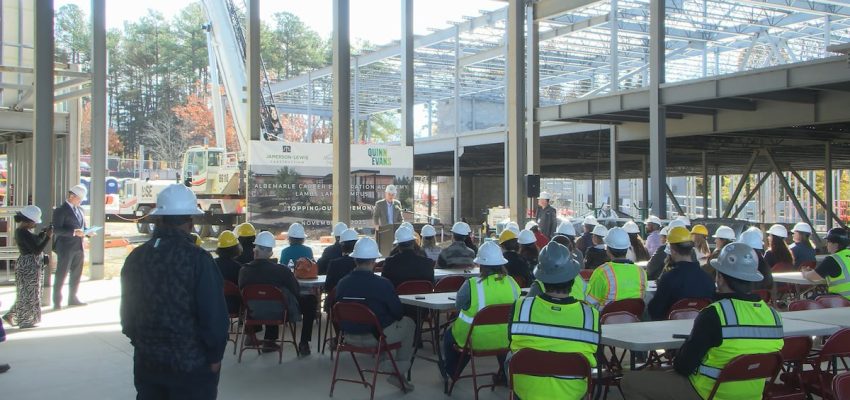

The air was abuzz with a sense of accomplishment and future promise recently, as a significant construction milestone was reached at the new Albemarle Career Exploration Academy. The ‘topping out’ ceremony, marking the placement of the final structural beam, isn’t merely an architectural feat; it’s a profound symbol of the foundations being laid for an entirely new generation of learners and innovators. As an AI specialist and a keen observer of technological evolution, I see this development not just as the construction of a building, but as the deliberate assembly of a launchpad for human potential in an era increasingly defined by artificial intelligence.
In a world accelerating at an unprecedented pace, driven by algorithms and data, the traditional models of education often struggle to keep up. The Albemarle Career Exploration Academy emerges as a beacon of foresight, recognizing that today’s students require more than just academic knowledge; they need adaptable skills, critical thinking, and a deep understanding of the technological currents shaping their professional destinies. This academy, poised to open its doors and welcome eager minds, represents a crucial investment in human capital, designed to equip individuals with the tools they need not just to navigate, but to actively shape the future, especially as AI continues to redefine industries and job roles. It’s an exciting time to witness such strategic educational development, as it directly impacts our collective journey into a more technologically integrated society.
Future-Ready Careers: Forging Pathways in an AI-Transformed World
The construction of the Albemarle Career Exploration Academy is a tangible commitment to fostering **future-ready careers**. This isn’t just about building a school; it’s about engineering an environment where young minds can explore, experiment, and develop competencies directly relevant to the dynamic demands of the 21st-century workforce. The concept of a career exploration academy itself is a modern response to an evolving global economy, one where specialization often needs to be balanced with broad interdisciplinary understanding. These institutions are designed to bridge the gap between academic theory and practical application, allowing students to gain hands-on experience in various vocational and technical fields before committing to a specific path.
Consider the landscape of employment today and what it will likely become in the next five to ten years. Reports from organizations like the World Economic Forum consistently highlight that a significant portion of future jobs do not yet exist, and many current roles will be fundamentally transformed by automation and artificial intelligence. This makes the ‘exploration’ aspect of such an academy incredibly vital. Students won’t just learn about existing jobs; they will be encouraged to envision and create future opportunities, to understand the underlying principles of emerging technologies, and to cultivate problem-solving skills that are universally applicable. From advanced manufacturing and healthcare technology to sustainable energy and digital media, the academy aims to offer diverse pathways, each infused with a recognition of technology’s pervasive influence.
From my perspective as an AI specialist, the true power of an institution like the Albemarle Career Exploration Academy lies in its potential to integrate AI literacy into its core curriculum across all disciplines. Imagine students in an engineering track learning about AI-driven design tools or predictive maintenance algorithms. Or healthcare students exploring AI applications in diagnostics and personalized medicine. Even within creative arts or business administration, understanding how AI can augment human capabilities – from generating content to analyzing market trends – becomes indispensable. This proactive approach to education is what differentiates mere vocational training from genuine preparation for **future-ready careers** in an AI-first world. The academy will not just respond to industry needs but actively help shape the local talent pipeline, ensuring that students are not merely consumers of technology but informed creators and ethical innovators.
The emphasis here is not on replacing human jobs with AI, but on teaching humans how to effectively collaborate with AI. This requires a curriculum that fosters both technical proficiency and uniquely human skills like critical thinking, creativity, emotional intelligence, and complex problem-solving. By providing early exposure and hands-on experience, the academy will empower students to make informed decisions about their academic and professional trajectories, ensuring they are not only skilled but also passionate about their chosen fields. This holistic approach to development is key to nurturing individuals who can thrive and contribute meaningfully in an increasingly automated and interconnected global society, cultivating genuinely **future-ready careers**.
Navigating the AI Revolution: Essential Skills for the 21st Century Workforce
The ongoing AI revolution is reshaping every sector imaginable, from finance and logistics to entertainment and scientific research. For students entering the workforce in the coming years, a foundational understanding of AI principles and their applications will transition from a niche skill to a universal necessity. The Albemarle Career Exploration Academy is strategically positioned to be a hub for cultivating these essential skills, moving beyond rote memorization to fostering deep conceptual understanding and practical application that pave the way for successful **future-ready careers**.
What exactly are these essential skills? First and foremost, data literacy is paramount. AI models are trained on vast datasets, and the ability to understand, interpret, and ethically manage data will be a critical skill across virtually all professions. This includes not just technical data scientists but also professionals in marketing, healthcare, and public service who need to make data-driven decisions. Computational thinking, the ability to break down complex problems into manageable steps that a computer could solve, is another foundational skill that transcends specific programming languages or tools. It’s a way of thinking that empowers individuals to approach challenges systematically and logically.
Beyond the technical, the human element becomes even more critical in an AI-driven world. Creativity, for instance, remains a distinctly human advantage. While AI can generate novel content, the ability to conceptualize, innovate, and infuse human empathy into creations is irreplaceable. Ethical reasoning is another cornerstone; as AI systems become more autonomous, understanding the societal implications, biases, and ethical responsibilities of AI deployment becomes crucial for every professional, not just AI developers. Collaborative skills, especially human-AI collaboration, are also gaining prominence. Learning to effectively leverage AI tools to augment human capabilities – whether it’s using AI for research, design, or analysis – will define productivity in the future.
Educational institutions like the Albemarle Career Exploration Academy can play a pivotal role in demystifying AI and making it accessible. Instead of presenting AI as a daunting, abstract concept, they can integrate it into project-based learning. Students could, for example, develop simple AI models to solve local community problems, analyze environmental data with machine learning algorithms, or design user interfaces for AI-powered applications. This hands-on approach cultivates curiosity and removes the intimidation factor often associated with advanced technology, fostering a generation that views AI as a powerful tool for good, not a threat. By emphasizing these multifaceted skills, the academy ensures that its graduates are not just ready for the jobs of today, but for the unforeseen challenges and opportunities of tomorrow’s AI landscape. They will be equipped to adapt, learn, and lead in a world that is continuously reinventing itself through technological innovation.
Beyond the Classroom Walls: Experiential Learning and Industry Integration
One of the most compelling features of career exploration academies, and certainly a driving force behind the Albemarle Career Exploration Academy, is their commitment to experiential learning and robust industry integration. Unlike traditional schooling that often relies heavily on theoretical instruction within classroom walls, these academies are designed to provide real-world insights and practical application, giving students a tangible connection to their potential **future-ready careers**.
The ‘exploration’ in its name is key. Students won’t just be told about careers; they’ll get to experience them. This often involves state-of-the-art labs that simulate professional environments, offering opportunities to work with industry-standard equipment and software. Imagine students in a robotics program designing and programming AI-powered automated systems, or those in a media production track utilizing machine learning tools for video editing or animation. These aren’t just academic exercises; they are precursors to real-world projects.
Crucially, these academies forge strong partnerships with local and regional businesses, tech companies, and higher education institutions. This collaboration can manifest in various forms: mentorship programs where industry professionals guide students, internships that provide invaluable on-the-job training, and guest speakers who share contemporary challenges and opportunities in their respective fields. For an academy focused on the future, these partnerships are vital for ensuring the curriculum remains relevant and responsive to the latest technological advancements, particularly in AI and related digital fields.
For instance, an AI specialist might partner with the academy to help design a module on ethical AI development, or a local manufacturing firm could offer students insights into how AI and automation are transforming their production lines. These direct interactions demystify complex industries and provide students with networking opportunities that are often inaccessible in conventional educational settings. This blend of academic rigor, hands-on learning, and direct industry exposure creates a powerful learning ecosystem that prepares students not just academically, but professionally and socially for their chosen paths. It also allows for continuous feedback loops, ensuring that what is taught within the academy directly aligns with the skills and knowledge demanded by employers in the rapidly evolving technological landscape, setting them on a path toward **future-ready careers**.
In essence, the Albemarle Career Exploration Academy is more than just a new building; it’s a strategic investment in human potential, designed to foster a generation of adaptable, skilled, and ethically conscious individuals ready to thrive in an AI-transformed world. The final beam raised is a testament to the community’s commitment to innovation and foresight in education.
As we look ahead to the academy’s opening, it serves as a powerful reminder that preparing for the future means embracing technological evolution, particularly AI, as an integral part of learning and career development. It’s about empowering students not to fear the future, but to build it – with intelligence, creativity, and a deep understanding of their role in an increasingly interconnected world, securing their place in **future-ready careers**. The journey ahead promises to be transformative, and institutions like the Albemarle Career Exploration Academy are at the forefront of shaping this exciting new educational frontier.










