
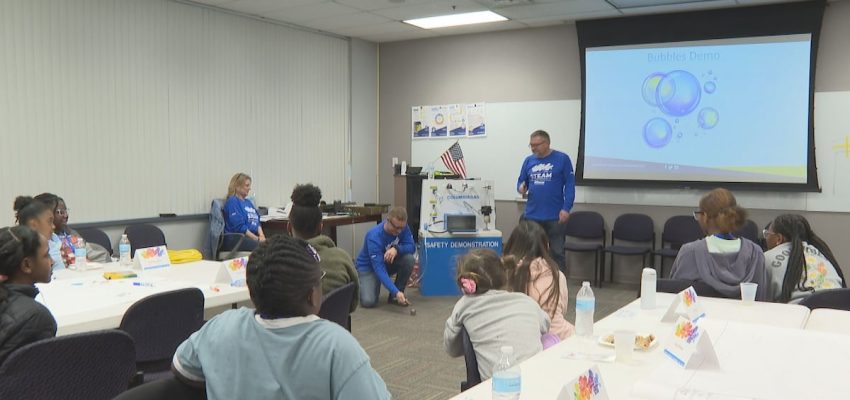

In a world increasingly defined by rapid technological advancements and complex global challenges, the foundational skills of Science, Technology, Engineering, Arts, and Mathematics, collectively known as STEAM, have never been more critical. Recently, an inspiring initiative at Columbia Gas in Lexington, the second annual “Introduce a Girl to STEAM” event, underscored this very point. While seemingly a local event, its broader implications resonate deeply with the global imperative to foster innovation, bridge critical skills gaps, and prepare the next generation, particularly young women, for a future where artificial intelligence reshapes nearly every facet of our lives. As an AI specialist and tech enthusiast, I see such programs not just as educational opportunities, but as vital catalysts for societal progress.
The simple act of exposing students to potential career paths in hands-on, engaging ways can spark a lifelong passion. The laughter and focused curiosity witnessed at events like the one in Lexington are the seeds from which future scientists, engineers, artists, and mathematicians will grow. It’s about demystifying fields that might otherwise seem abstract or inaccessible, and crucially, showing young girls that these domains are not only welcoming but also brimming with opportunities for them to make a tangible impact. In an era where AI is rapidly moving from niche labs to everyday applications, ensuring a diverse and well-equipped talent pool is paramount. Our ability to navigate and shape this AI-driven future depends directly on the quality and inclusivity of our STEAM education today.
STEAM Education: Paving the Way for Future Innovators
What exactly constitutes STEAM, and why is its interdisciplinary approach so vital? At its core, STEAM expands upon the traditional STEM (Science, Technology, Engineering, Mathematics) framework by integrating the Arts. This addition is not merely cosmetic; it recognizes that creativity, design thinking, communication, and human-centered problem-solving are indispensable alongside scientific rigor and technical prowess. Science teaches us to observe, hypothesize, and experiment; Technology empowers us to create tools and solutions; Engineering challenges us to design and build; Mathematics provides the language and logic for analysis; and the Arts infuse innovation with imagination, ethics, and empathy.
Historically, the emphasis on STEM has propelled industrial and technological revolutions. From the invention of the printing press to the internet, scientific discovery and engineering marvels have continuously reshaped human civilization. Today, we stand at the precipice of another paradigm shift driven by AI, big data, and automation. To thrive in this evolving landscape, our workforce needs more than just specialized knowledge; it requires adaptability, critical thinking, and the ability to integrate diverse perspectives. This is precisely what a robust STEAM education aims to cultivate. It moves beyond rote memorization, encouraging students to ask ‘why,’ to experiment, to fail fast, and to iterate, all essential skills for innovation.
For instance, consider the development of a self-driving car. It demands profound knowledge in computer science (AI algorithms, machine learning), engineering (sensor technology, mechanical systems), mathematics (data analysis, predictive modeling), and physics (understanding motion, optics). But it also requires significant input from the Arts: user interface design (UX/UI), ethical considerations regarding autonomous decision-making, aesthetic integration into urban environments, and compelling narrative creation to build public trust. Without the ‘A’ in STEAM, we risk creating powerful technologies that are disconnected from human needs, values, or simply aren’t user-friendly. Events like ‘Introduce a Girl to STEAM’ are crucial because they offer a glimpse into these complex, real-world applications, showing students not just *what* they can learn, but *why* it matters, connecting classroom theory to practical impact.
Bridging the Gender Gap: The Imperative for Inclusivity in Tech
While the importance of STEAM education for all children is undeniable, there remains a persistent and concerning gender gap in many critical fields. According to the U.S. Census Bureau, women make up nearly half of the U.S. workforce but hold only 27% of STEM jobs. In specific areas like engineering, this figure drops even lower. This disparity isn’t merely a matter of fairness; it represents a significant untapped potential for innovation and economic growth. Diverse teams, including those with balanced gender representation, have repeatedly been shown to be more creative, better at problem-solving, and ultimately more successful. They bring a wider range of perspectives to the table, leading to more robust solutions and a reduced risk of ‘blind spots’ in design and implementation.
So, what contributes to this gap, and what can we do to bridge it? Research indicates a combination of factors, including societal stereotypes that often discourage girls from pursuing STEM subjects from a young age, a lack of visible female role models in these fields, and sometimes, a perceived lack of belonging or confidence. Events such as the “Introduce a Girl to STEAM” day at Columbia Gas directly address these challenges by providing early exposure and positive role models. Seeing women thriving in technical roles at a company like Columbia Gas can be incredibly powerful for a young girl contemplating her future.
Beyond early exposure, sustained mentorship programs, accessible educational resources, and curricula that actively combat gender bias are vital. Imagine a young girl, perhaps from Lexington, attending such an event, meeting a female engineer, and suddenly seeing a path for herself that she hadn’t considered before. This initial spark needs to be nurtured through middle school, high school, and into higher education. Schools and communities must actively cultivate environments where curiosity in science and technology is celebrated for all students, regardless of gender. Furthermore, parents and educators play a critical role in encouraging girls to pursue challenging subjects, celebrating their achievements in math and science, and providing them with opportunities to engage in hands-on learning experiences.
The global competitiveness of nations increasingly hinges on their ability to foster a robust and diverse workforce in advanced technological fields. By neglecting half of our population’s potential in STEAM, we are not only failing individuals but also hindering our collective capacity to innovate and lead. The next generation of groundbreaking AI technologies, sustainable energy solutions, and medical breakthroughs will require the minds of *everyone*, and proactive initiatives to ensure inclusivity are not just desirable, but essential.
The AI Revolution: Why STEAM Skills are Non-Negotiable for Tomorrow’s Workforce
The advent of artificial intelligence is arguably the most transformative technological shift of our time, comparable in scope to the industrial revolution or the rise of the internet. AI is no longer a futuristic concept; it’s here, reshaping industries from healthcare and finance to transportation and entertainment. Machine learning algorithms power everything from our social media feeds to medical diagnostics, while robotics and automation are redefining manufacturing and logistics. This profound transformation necessitates a workforce equipped with advanced skills, and at the heart of these skills lies a strong foundation in STEAM education.
Consider the multifaceted requirements for developing and deploying AI systems. Data scientists, who are at the forefront of this revolution, need profound mathematical and statistical understanding to build models, scientific rigor to formulate hypotheses, and technological expertise to implement solutions. Engineers are required to build the hardware and software infrastructure that supports AI, from high-performance computing clusters to robust software platforms. The ethical implications of AI – bias in algorithms, privacy concerns, the impact on employment – demand critical thinking and a multidisciplinary approach that integrates philosophy, social sciences, and design thinking, all components fostered within a holistic STEAM education.
Furthermore, the “Arts” component of STEAM plays an increasingly critical role in the AI landscape. As AI systems become more powerful, the focus shifts from merely making them *work* to making them *human-centric*. This involves intuitive user interfaces, ethical design principles, and an understanding of human psychology to ensure AI tools augment, rather than detract from, human capabilities. For example, designing an AI assistant requires not just natural language processing (a technology skill), but also an understanding of conversational flow, tone, and empathy (an arts skill). The development of AI-powered creative tools, such as those generating art or music, further blurs the lines, demanding individuals who are fluent in both algorithmic logic and aesthetic principles.
For André Lacerda, the author of this article, the convergence of STEAM and AI is not just a theoretical concept but a daily reality. Building AI solutions, writing about their implications, and advocating for their responsible development all draw heavily on the interconnected disciplines of STEAM. The insights gained from scientific research, the methodical approach of engineering, the analytical power of mathematics, the practical application of technology, and the creative problem-solving inherent in the arts are all indispensable for navigating the complexities of AI. The demand for professionals skilled in these areas is skyrocketing, with reports consistently projecting exponential growth in AI-related jobs over the next decade. Those with a strong STEAM education are uniquely positioned to seize these opportunities, becoming the architects and ethical stewards of our AI future.
This isn’t just about coding; it’s about computational thinking – the ability to break down complex problems, understand algorithms, and design solutions that can be implemented by computers. It’s about AI literacy, which empowers citizens to understand how AI impacts their lives, evaluate its claims, and participate in discussions about its societal governance. Early exposure, like that offered at the Columbia Gas event, can introduce these fundamental concepts in an accessible way, sparking interest long before students reach advanced academic levels.
Conclusion
The inspiring initiative at Columbia Gas in Lexington, bringing young girls closer to the world of STEAM, is far more than just a local event; it’s a microcosm of a larger, global necessity. Fostering a robust and inclusive STEAM education is not merely an educational goal but an economic and societal imperative. By actively encouraging young women to explore and pursue careers in these critical fields, we are not only empowering individuals but also enriching our collective capacity for innovation, ensuring that the next wave of technological breakthroughs is shaped by a diverse array of voices and perspectives. The benefits extend beyond individual career success, contributing to a more equitable and capable society.
As we stand at the threshold of an unprecedented era driven by artificial intelligence, the skills instilled through STEAM become the bedrock upon which our future prosperity and problem-solving capabilities will rest. Events designed to introduce and engage students, particularly girls, in these vital disciplines are critical investments in tomorrow. They plant the seeds of curiosity, build confidence, and demystify pathways to impactful careers. It is through sustained commitment to such initiatives, combined with supportive educational environments and positive role models, that we can truly empower the next generation to not only adapt to the AI revolution but to lead it, creating a future that is intelligent, equitable, and profoundly human.










