
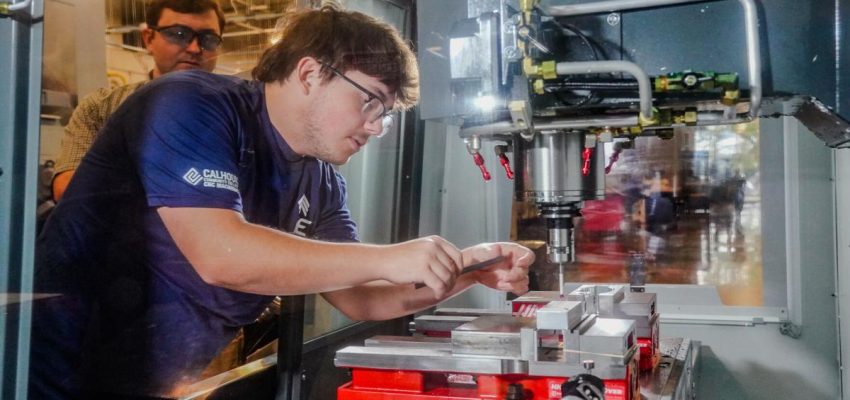

The hum of sophisticated machinery, the scent of metal, and the meticulous crafting of components that will power everything from spacecraft to life-saving medical devices – this is the intricate world of modern manufacturing. In an era increasingly dominated by digital advancements, the foundational skills of producing physical goods remain paramount. Yet, there’s a quiet but persistent challenge facing industries worldwide: a growing skills gap in skilled trades, particularly in advanced manufacturing. How do we inspire the next generation to embrace these critical, rewarding, and technologically evolving careers? The answer, often, lies in hands-on experiences and visionary educational initiatives.
Programs like the recent machining camp at Calhoun Community College are not just teaching a trade; they are igniting passion, fostering innovation, and laying the groundwork for future industries. These vital opportunities offer rising high school juniors and seniors a crucial glimpse into dynamic career paths, helping them decide if a future producing parts for aerospace, automotive, medical, and other high-tech sectors is for them. As André Lacerda, an AI specialist and tech enthusiast, I’m particularly fascinated by how these traditional skills are now merging with cutting-edge artificial intelligence, creating opportunities more dynamic and complex than ever before.
### Precision Machining: The Backbone of Modern Industry
At its core, **precision machining** is the art and science of shaping raw materials into highly accurate and functional parts. It’s a field where tolerances are measured in microns – often thinner than a human hair – and the slightest deviation can mean the difference between success and failure in critical applications. From the microscopic gears in a sophisticated watch to the massive components of a jet engine, precision-machined parts are the unseen heroes that enable our modern world to function. Historically, this involved highly skilled artisans using manual lathes and mills, relying on years of experience and an almost intuitive understanding of materials. Today, while the fundamental principles of material removal and shaping remain, the tools and techniques have been revolutionized.
The evolution of machining has been exponential, especially with the advent of Computer Numerical Control (CNC) machines. These intelligent behemoths, guided by intricate digital designs from Computer-Aided Design (CAD) and Computer-Aided Manufacturing (CAM) software, can perform complex operations with unparalleled speed and accuracy. They transform blocks of metal, plastic, or composite materials into components that meet exacting specifications for industries like aerospace, automotive, medical, and defense. Consider the aerospace sector, where components must withstand extreme temperatures, pressures, and stresses. A single faulty part, perhaps a turbine blade or a structural bracket, could have catastrophic consequences. This is where **precision machining** shines, ensuring every piece meets rigorous quality standards. The automotive industry relies on precision for engine blocks, transmission components, and even the intricate parts of advanced safety systems. In medicine, implants, surgical instruments, and prosthetic devices demand the highest levels of precision and biocompatibility, often requiring specialized machining techniques.
The demand for professionals skilled in these areas is consistently high. According to the U.S. Bureau of Labor Statistics, the manufacturing sector, while continuously evolving, continues to offer robust career paths for machinists, tool and die makers, and related technicians. While the sheer volume of entry-level manufacturing jobs might fluctuate, the *complexity* and *value* of these roles are increasing. The skills required go beyond simply operating a machine; they encompass understanding engineering drawings, material properties, quality control protocols, programming CNC machines, and increasingly, interacting with sophisticated automation systems. Camps like the one at Calhoun Community College offer high school juniors and seniors a crucial early look into this vibrant field, debunking misconceptions and showcasing the sophisticated, high-tech nature of these careers. They allow students to experience the satisfaction of creating something tangible, something that has a real-world application, fueling an early interest in STEM and technical vocations.
### Bridging the Skills Gap with Experiential Learning and STEM Pathways
One of the most pressing challenges facing the modern manufacturing sector isn’t merely about finding workers; it’s about finding *skilled* workers. A significant portion of the current manufacturing workforce is approaching retirement, and a new generation isn’t entering these fields quickly enough to fill the void. This “skills gap” is a global issue, often cited by industry leaders as a major impediment to growth, innovation, and economic competitiveness. The National Association of Manufacturers (NAM) projects that 2.1 million manufacturing jobs could go unfilled by 2030, potentially costing the U.S. economy trillions of dollars in lost output. This isn’t due to a lack of jobs, but a scarcity of individuals with the specific, highly technical competencies required for modern production environments.
Community colleges, vocational schools, and specialized camps are at the forefront of addressing this critical need. They serve as vital bridges between academic theory and practical application, providing hands-on training that traditional high school curricula often can’t fully deliver. The machining camp at Calhoun Community College is a prime example of this proactive approach. By offering immersive experiences to rising high school juniors and seniors, these programs demystify complex processes and showcase the dynamic, rewarding nature of advanced manufacturing careers. Students aren’t just reading about gears; they’re designing, programming, and producing them using industrial-grade equipment. They learn about material science, computer-aided design (CAD), computer-aided manufacturing (CAM), and the intricacies of CNC operation, often under the guidance of experienced instructors and industry professionals. This direct exposure is invaluable. It helps students connect abstract STEM concepts (Science, Technology, Engineering, Mathematics) to tangible outcomes, fostering a deeper understanding and appreciation for how these subjects are applied in the real world.
Furthermore, these camps play a crucial role in economic development. A strong local workforce in advanced manufacturing attracts businesses, encourages investment, creates jobs, and stimulates local economies. It ensures that regions can continue to produce vital components for national defense, cutting-edge medical devices, and innovative consumer products, maintaining a competitive edge in global markets. Beyond the immediate economic benefits, these educational pathways cultivate a culture of innovation. Students exposed to these technologies early are more likely to pursue further education in engineering, robotics, or industrial design, contributing to a continuous pipeline of talent. The integration of modern technologies, including collaborative robotics and nascent artificial intelligence tools, into these curricula ensures that graduates are not just ready for today’s factory floor but are also equipped for the factories of tomorrow. They learn not only to operate machinery but also to troubleshoot, optimize, and eventually, innovate with intelligent systems. This blend of traditional craft and future-forward technology is precisely what makes these careers so appealing and vital.
### The Future Factory: Where AI Meets Human Ingenuity
Much of the popular dialogue around Artificial Intelligence (AI) often centers on automation replacing human jobs. While AI and robotics certainly automate repetitive and hazardous tasks, the reality in advanced manufacturing is more nuanced and often involves a powerful synergy between human expertise and artificial intelligence. The future of manufacturing isn’t about machines entirely replacing people; it’s about intelligent machines *empowering* people to achieve unprecedented levels of efficiency, precision, and innovation. This is where the skills learned in programs emphasizing **precision machining** become even more critical, but with an added layer of technological literacy.
Imagine a smart factory where AI algorithms analyze vast datasets from production lines in real-time, predicting equipment failures before they occur through predictive maintenance, optimizing tool paths for maximum material efficiency, and even suggesting design improvements based on real-time performance data. This is not science fiction; it’s increasingly becoming a reality in facilities adopting Industry 4.0 principles. AI-driven vision systems in quality control can inspect parts with incredible speed and accuracy, identifying microscopic defects that might be missed by the human eye or would require extensive manual effort. Generative design, a subfield of AI, allows engineers to input design constraints, and the AI then explores thousands of design options, often producing highly optimized and innovative structures that human designers might not conceive of on their own.
For the aspiring machinist, this means an evolving role. Instead of merely operating a machine, they become an AI-assisted technician, a supervisor of automated processes, a data interpreter, and a problem-solver for complex scenarios that AI alone cannot address. They need to understand how to program and interact with AI systems, how to interpret the data these systems generate, and how to maintain the sophisticated robotics and machinery that comprise a modern production line. These are not merely “blue-collar” jobs in the traditional sense; they are highly technical, intellectually stimulating careers that combine mechanical aptitude with digital fluency. The human element of critical thinking, adaptability, and creativity remains indispensable. When an unexpected issue arises, or when a new, custom component is required with exacting specifications, human ingenuity, informed by deep knowledge of materials and processes (like **precision machining**), is what drives the solution. AI provides the data and the tools, but human intellect provides the vision and the ultimate direction.
Moreover, the manufacturing sector is becoming more agile and responsive thanks to AI. Customization and rapid prototyping are easier than ever, allowing companies to meet niche market demands and accelerate product development cycles. This means machinists and manufacturing specialists are no longer just making a standard product; they are often involved in the creation of unique, specialized components, requiring an even higher degree of skill and problem-solving ability. Education initiatives that recognize this convergence of traditional skills and emerging AI technologies are essential for preparing a workforce that can thrive in Industry 4.0 and beyond. They are cultivating the next generation of innovators who will not only build the future but also help design the intelligent systems that will shape it.
The journey from a raw block of material to a highly functional component through **precision machining** is a testament to human ingenuity and technological advancement. As explored through the lens of programs like the Calhoun Community College camp, the foundational skills taught today are not relics of the past but gateways to the future. These immersive experiences are critical for inspiring high school students, bridging the persistent skills gap, and ensuring a robust pipeline of talent for industries that are indispensable to our global society. By providing early exposure to sophisticated machinery and the fundamental principles of manufacturing, these initiatives empower young minds to consider dynamic and fulfilling careers that offer both stability and continuous innovation.
As we look ahead, the synergy between human expertise and artificial intelligence will define the next era of manufacturing. The rise of AI doesn’t diminish the need for skilled trades; rather, it elevates them, demanding a workforce that is not only proficient in traditional techniques but also adept at leveraging intelligent systems. The future factory will be a place where human creativity and problem-solving merge seamlessly with AI-driven efficiency and precision. By investing in practical, hands-on education that embraces this technological evolution, we are not just training machinists; we are cultivating the architects of tomorrow’s intelligent industries, ensuring that the spirit of innovation continues to shape our world.










