
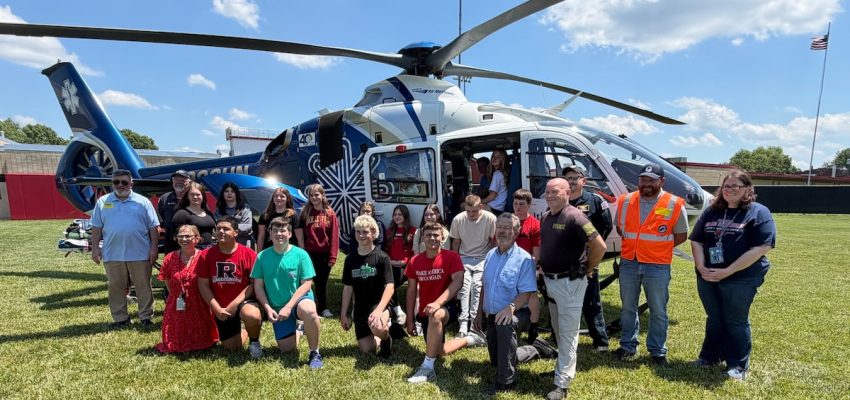

Imagine the roar of a helicopter, not on a screen, but right outside your classroom window, landing with a powerful whoosh that vibrates through the very ground beneath your feet. For the eighth-grade students at Ravenswood Middle School, this wasn’t just imagination; it was a vivid, hands-on reality. A HealthNet helicopter recently touched down on their school grounds, offering these curious young minds a firsthand, unforgettable glimpse into the thrilling world of aviation and aerospace. This wasn’t merely a show-and-tell; it was an invitation, a tangible demonstration of the incredible paths available in the skies above us. Such moments are crucial, igniting sparks of interest that can lead to lifelong passions and groundbreaking professions. But while the allure of flight remains timeless, the landscape of the aviation industry is anything but static. As an AI specialist and tech enthusiast, I’m captivated by how rapidly artificial intelligence is not just enhancing, but fundamentally redefining, the very fabric of aviation careers, paving the way for a future where human ingenuity and machine intelligence soar in unprecedented harmony.
### Aviation Careers: A Legacy of Innovation and Skill
For over a century, the dream of flight has captivated humanity, propelling us from the pioneering spirit of the Wright brothers to the marvels of supersonic travel and global air networks. At the heart of this incredible journey are the dedicated professionals who build, maintain, navigate, and fly these sophisticated machines. Traditional aviation careers encompass a wide array of specialized roles, each critical to the safety, efficiency, and comfort of air travel.
Consider the pilot, the iconic figure in the cockpit, whose rigorous training and split-second decision-making ensure passengers reach their destinations safely. Their expertise extends beyond simply controlling an aircraft; it involves deep understanding of aerodynamics, meteorology, navigation, and complex systems. Then there are the air traffic controllers, the unseen maestros coordinating the intricate dance of thousands of aircraft in the sky, preventing collisions and optimizing flow with an almost superhuman level of focus and foresight. Aircraft maintenance technicians, the unsung heroes, work tirelessly on the ground, ensuring every bolt, wire, and engine component functions flawlessly. Aerospace engineers are the visionaries who design and test new aircraft, pushing the boundaries of what’s possible, while cabin crew ensure passenger safety and comfort, acting as frontline ambassadors for airlines.
These professions demand immense technical skill, unwavering discipline, and a profound commitment to safety. For generations, individuals drawn to the aerospace sector have pursued these paths, contributing to an industry that shrinks the world and connects cultures. The Ravenswood students’ excitement upon seeing the HealthNet helicopter land underscores the enduring appeal of these essential roles. It’s a powerful reminder that while technology advances, the foundational principles of safe and efficient flight remain paramount, requiring skilled individuals at every level. However, to truly understand the future of these exciting fields, we must acknowledge the transformative force that is rapidly integrating itself into every facet of aerospace: artificial intelligence. The evolution of flight is now inextricably linked to the evolution of AI.
### AI’s Ascent: Redefining the Skies and Aviation Careers
The integration of Artificial Intelligence into the aviation sector is not a futuristic concept; it is happening now, reshaping existing roles and creating entirely new avenues within aviation careers. AI is not merely a tool; it’s becoming an indispensable partner, enhancing safety, optimizing operations, and boosting efficiency across the board. From the moment an aircraft is designed to its final landing, AI algorithms are at work, making decisions, predicting outcomes, and learning from vast datasets.
One of the most impactful applications of AI is in predictive maintenance. Traditionally, aircraft maintenance followed strict schedules or relied on reactive repairs after a malfunction occurred. Today, AI-powered systems analyze real-time data from thousands of sensors embedded within an aircraft’s engines, landing gear, avionics, and structural components. Machine learning algorithms can detect subtle anomalies and patterns that indicate potential failures long before they become critical. This allows airlines to perform maintenance proactively, minimizing unscheduled downtime, reducing repair costs, and significantly enhancing safety. For maintenance technicians, this means a shift from purely mechanical tasks to more analytical roles, interpreting data, overseeing AI diagnostics, and executing targeted repairs based on intelligent insights. The global market for AI in aviation maintenance alone is projected to reach billions, highlighting its profound economic and operational impact, and reshaping the day-to-day realities of numerous aerospace jobs.
Beyond maintenance, AI is revolutionizing flight operations. Consider flight path optimization. Modern flight management systems already calculate efficient routes, but AI takes this to a new level. Algorithms can process an unprecedented volume of data — real-time weather patterns, air traffic congestion, geopolitical no-fly zones, and fuel prices — to dynamically adjust flight paths for maximum efficiency, minimizing fuel consumption and carbon emissions. This not only reduces operational costs but also contributes to environmental sustainability, a growing imperative for the industry. Pilots, supported by AI co-pilots and advanced decision-support systems, can make more informed choices faster, enhancing situational awareness and reducing workload, especially during critical phases of flight. These systems don’t replace human judgment but augment it, turning vast quantities of raw data into actionable intelligence.
Furthermore, air traffic management (ATM) is experiencing an AI-driven overhaul. AI algorithms are being developed to predict potential congestion, identify optimal spacing between aircraft, and even manage drone traffic in increasingly complex lower airspaces. This allows human air traffic controllers to manage more aircraft safely and efficiently, moving from reactive problem-solving to proactive strategic planning. The European Union’s SESAR initiative, for instance, actively explores AI to create a more integrated and automated air traffic network, promising substantial benefits in capacity and fluidity for future aviation careers.
The rise of autonomous systems, particularly drones, also exemplifies AI’s impact. Drones, powered by advanced AI for navigation, obstacle avoidance, and mission execution, are no longer just military tools. They are used for inspecting aircraft and infrastructure, delivering cargo in remote areas, and even mapping vast terrains. This rapidly expanding sector is creating demand for drone pilots, AI specialists for unmanned aerial vehicles (UAVs), and regulatory experts, fundamentally diversifying the scope of aviation careers. From supervising drone fleets to developing the AI that guides them, new professional pathways are opening up, promising dynamic and technically sophisticated roles within the air transport sector.
### Navigating the Future: Skills for Tomorrow’s Aviation Careers
As AI continues its transformative ascent, the skills required for success in the aerospace industry are evolving. The future of aviation careers will be defined not by a choice between humans or machines, but by the synergistic collaboration between them. This means that while traditional aerospace knowledge remains vital, a new set of digital and analytical competencies is becoming equally crucial.
For aspiring pilots, engineers, and technicians, a foundational understanding of data science, artificial intelligence, and machine learning will be invaluable. This doesn’t necessarily mean becoming a full-fledged AI developer, but rather possessing data literacy – the ability to interpret data, understand algorithmic outputs, and work effectively with AI-powered tools. Future pilots, for instance, will increasingly rely on AI co-pilots and advanced decision-support systems, requiring them to understand the logic behind these systems and to critically evaluate their suggestions. Maintenance technicians will need to be adept at utilizing AI diagnostics and engaging with augmented reality tools to troubleshoot complex issues, shifting their focus from purely mechanical repair to intelligent system management.
New specializations are also emerging rapidly. We are seeing a growing demand for roles such as AI system architects for aerospace, who design the intelligent frameworks that govern aircraft operations; data scientists specializing in aviation analytics, extracting insights from flight data recorders and sensor networks; and machine learning engineers focused on developing predictive models for engine health or optimized logistics. Furthermore, as autonomous systems become more prevalent, there will be an increasing need for specialists in human-AI interaction, ensuring that these advanced systems are intuitive, reliable, and integrate seamlessly into human workflows. Ethical AI strategists will also play a crucial role in ensuring that AI deployment in aviation adheres to strict safety standards, regulatory compliance, and public trust.
To prepare for these exciting and challenging new aviation careers, educational institutions and industry training programs must adapt. STEM education (Science, Technology, Engineering, and Mathematics) will continue to be paramount, but with an increased emphasis on computational thinking, programming fundamentals, and specific AI concepts relevant to aerospace. Lifelong learning will not be an option but a necessity, as technological advancements will require continuous skill development and adaptation. The capacity for critical thinking, complex problem-solving, and adaptability — core human attributes — will remain indispensable, allowing professionals to navigate unforeseen challenges and leverage AI as a tool for innovation. Ultimately, the successful professionals of tomorrow’s aviation sector will be those who can blend deep domain expertise with a strong grasp of intelligent technologies, becoming skilled navigators of both the physical and digital skies.
### Conclusion
The thrilling sight of a helicopter landing at Ravenswood Middle School serves as a potent reminder of the enduring fascination with flight and the incredible potential within the aerospace industry. It’s a field that stands at the cusp of its next great transformation, propelled forward by the accelerating capabilities of artificial intelligence. Far from diminishing human roles, AI is augmenting them, creating more sophisticated, safer, and efficient ways to explore our skies and connect our world.
For the young students inspired by that powerful landing, and for anyone considering a future in this dynamic sector, the message is clear: the path to fulfilling aviation careers is more exciting and diverse than ever before. It demands a blend of traditional expertise, a keen embrace of technological innovation, and an unwavering commitment to continuous learning. As AI continues to integrate into every facet of aviation, it opens doors to new possibilities, challenges us to rethink our approaches, and ultimately, promises a future where the human dream of flight reaches unprecedented heights, guided by intelligence both human and artificial. The sky is no longer the limit; it’s just the beginning.










