
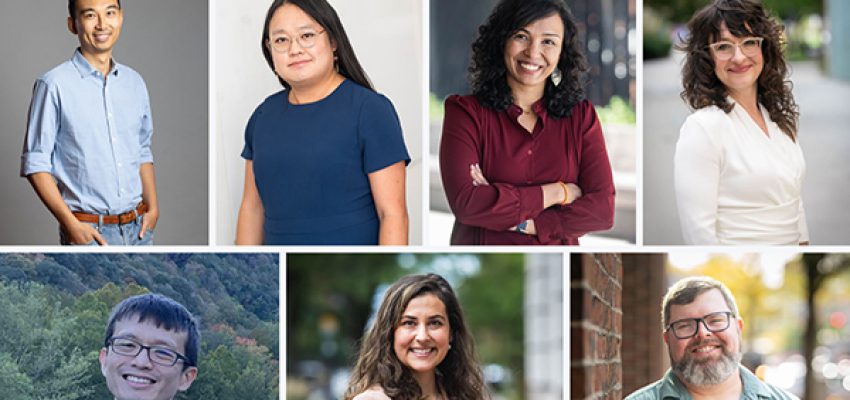

The relentless march of human inquiry is a testament to our innate curiosity, a drive to understand the world around us and the universe beyond. At the heart of this progress are institutions of higher learning, serving as crucibles for groundbreaking discoveries and incubators for the brightest minds. Recently, Boston University celebrated this spirit of innovation by naming seven junior faculty members as recipients of prestigious Career Development Professorships. This recognition is not merely an accolade; it’s a vital investment in the future, empowering emerging scholars whose work spans the monumental breadth of human knowledge—from the intricacies of artificial intelligence to the foundational structure of the universe.
As an AI specialist and enthusiast, I find this announcement particularly compelling. It underscores the profound and diverse impact that academic institutions have on our collective future. These junior faculty members represent the next generation of thought leaders, poised to unravel mysteries, build new technologies, and redefine our understanding of existence. Their recognition highlights a crucial aspect of scientific progress: the necessity of nurturing talent at its nascent stages, providing the resources and freedom for bold ideas to flourish. It’s a powerful reminder that the journey of discovery is long, often arduous, but ultimately deeply rewarding, with each new insight building upon the last to create a richer tapestry of knowledge.
### AI Research: Reshaping Our World and Expanding Scientific Frontiers
Among the diverse fields represented by these exceptional scholars, **AI research** stands out as a particularly dynamic and transformative area. Artificial intelligence is no longer a futuristic concept confined to science fiction; it is a palpable force reshaping industries, revolutionizing healthcare, optimizing logistics, and enhancing our daily lives in myriad ways. From sophisticated machine learning algorithms that predict climate patterns to generative models that create art and literature, AI’s applications are virtually limitless. Universities are at the forefront of this revolution, serving as vital hubs where foundational theories are developed and cutting-edge applications are forged.
Junior faculty engaged in **AI research** are exploring some of the most challenging and impactful questions of our time. This includes developing more robust and ethical AI systems, understanding the cognitive processes behind machine learning, and pushing the boundaries of what AI can achieve in complex, real-world scenarios. For instance, some researchers might be focused on advancing explainable AI, a critical subfield that aims to make AI decisions transparent and understandable to humans, fostering trust and enabling better accountability. Others might be delving into federated learning, a privacy-preserving technique that allows AI models to learn from decentralized data without sharing the raw information itself. These areas are not just academically interesting; they have profound societal implications, influencing everything from data privacy to the reliability of autonomous systems.
The scope of **AI research** is truly interdisciplinary. It touches upon computer science, mathematics, engineering, cognitive science, philosophy, and even the social sciences. Consider the application of AI in medicine: AI-powered diagnostics can analyze medical images with incredible precision, often identifying early signs of disease that might be missed by the human eye. In drug discovery, AI accelerates the process by predicting molecular interactions and optimizing experimental parameters, drastically reducing the time and cost associated with bringing new treatments to market. Furthermore, AI is becoming an indispensable tool for environmental scientists, helping to model complex ecological systems, monitor biodiversity, and forecast extreme weather events with greater accuracy. This vast integration demonstrates AI’s role not just as a standalone discipline, but as a pervasive enabler across almost every scientific endeavor.
### Unveiling the Cosmos: From Particle Physics to Galactic Frontiers
While **AI research** propels us into a technologically advanced future, other esteemed junior faculty members are gazing outwards, addressing questions that have fascinated humanity for millennia: the fundamental structure of the universe. This realm of inquiry spans astrophysics, cosmology, and particle physics, fields that seek to understand the very fabric of reality, from the smallest subatomic particles to the grandest galactic structures.
The universe is a vast and enigmatic laboratory, offering unparalleled opportunities for discovery. Researchers in this domain might be exploring the mysteries of dark matter and dark energy, the invisible components that constitute roughly 95% of the universe’s mass and energy, yet remain largely elusive. Their work often involves analyzing vast datasets from powerful telescopes, simulating cosmic events, or even designing experiments that probe the quantum realm here on Earth to infer properties of the early universe. This kind of research requires monumental patience, sophisticated theoretical frameworks, and often, international collaboration on an epic scale, such as with projects like the Large Hadron Collider or the James Webb Space Telescope.
Consider the intricate dance of galaxies, the formation of stars, or the cataclysmic events of black holes. Each phenomenon offers clues to the universe’s origin, evolution, and ultimate fate. Scientists in this area are not just observing; they are building models, testing hypotheses, and often challenging existing paradigms. Their discoveries push the boundaries of our understanding of space-time, gravity, and the very laws of physics. It’s a field where the questions are as boundless as the cosmos itself, requiring immense intellectual rigor and a persistent quest for fundamental truths. Moreover, it’s worth noting that even in these seemingly distant fields, advanced computational techniques, including machine learning – an offshoot of **AI research** – are increasingly vital for processing petabytes of astronomical data and running complex simulations, blurring the lines between disparate scientific disciplines.
### Nurturing Tomorrow’s Visionaries: The Crucial Role of Career Development Awards
The recognition of these seven junior faculty members through Career Development Professorships is more than just a ceremonial gesture; it’s a strategic investment in the future of scientific and technological advancement. These awards are specifically designed to support early-career academics, providing them with the necessary resources and protected time to establish their independent research programs. Starting an academic career is notoriously challenging, often requiring substantial startup funds for lab equipment, research assistants, and data infrastructure, alongside the demands of teaching and service.
Career development awards act as a critical bridge, allowing promising young scholars to translate their innovative ideas into tangible research projects. They empower faculty to pursue high-risk, high-reward endeavors that might not immediately attract conventional funding but hold the potential for paradigm-shifting breakthroughs. This seed funding can be instrumental in generating preliminary data, which is often a prerequisite for securing larger, more competitive grants from national agencies like the National Science Foundation (NSF) or the National Institutes of Health (NIH).
Beyond financial support, these professorships convey a vote of confidence from the institution, signaling to the academic community and potential collaborators that these individuals are recognized leaders in their respective fields. This recognition can enhance their visibility, foster collaborations, and attract talented graduate students and post-doctoral researchers to their labs. By investing in these rising stars, Boston University is not only contributing to the individual success of these faculty members but also strengthening its overall research enterprise, ensuring a continuous pipeline of innovation and discovery that will benefit society for generations to come. It’s an acknowledgment that true progress stems from the sustained cultivation of intellectual curiosity and the unwavering support for those daring enough to ask the biggest questions.
The diverse research interests of Boston University’s newly appointed Career Development Professors – from the intricate code of **AI research** to the grand narrative of the universe’s evolution – underscore the expansive and interconnected nature of modern scientific inquiry. Their work embodies the spirit of discovery, pushing the boundaries of what is known and challenging us to reconsider our understanding of the world. These young scholars, empowered by institutional support, are poised to make significant contributions that will resonate across various disciplines and societal sectors.
As we look to the future, the impact of these investments in junior faculty becomes increasingly clear. The breakthroughs stemming from their labs today will shape the technologies, medicines, and fundamental knowledge of tomorrow. Their passion and intellect fuel the continuous quest for understanding, reminding us that the pursuit of knowledge is an unending journey, constantly revealing new wonders and inspiring the next generation of explorers. It is through supporting such diverse and ambitious research that we truly unlock the full potential of human ingenuity, ensuring that the light of discovery shines ever brighter.










