
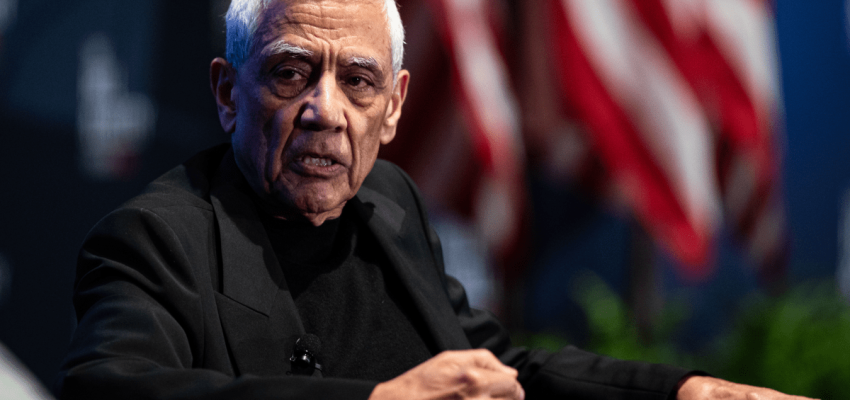

In an era defined by accelerating technological advancement, the age-old wisdom of “follow your passion” has often been a beacon for young people charting their professional paths. Yet, for Generation Alpha—the children born into a world already teeming with artificial intelligence—this cherished piece of guidance might be a strategic misstep, at least for now. This is the provocative stance of Vinod Khosla, the visionary co-founder of Sun Microsystems and a prominent figure in the venture capital world, known for his bold predictions about AI’s transformative power. Khosla posits that while “follow your passion” might be detrimental counsel today, it could very well become the *best* career advice within the next 15 years, as AI continues to reshape the very fabric of our professional lives.
Khosla, a billionaire investor whose firm, Khosla Ventures, has been at the forefront of funding revolutionary AI startups, is no stranger to challenging conventional wisdom. His insights often cut against the grain, urging us to reconsider established norms in light of impending technological shifts. He argues that the traditional educational trajectory, aimed at securing what are perceived as “safe” jobs, is increasingly precarious for Gen Alpha. These are individuals growing up with AI as an ambient, integrated part of their daily existence, from smart devices to personalized learning tools. Unlike previous generations, they are digital natives in a truer sense, their world intrinsically linked with advanced algorithms and machine learning systems.
His core assertion hinges on the idea that artificial intelligence will rapidly automate a vast spectrum of tasks and roles currently considered stable. This isn’t merely about blue-collar jobs; AI’s reach extends deep into white-collar professions, impacting everything from legal research and financial analysis to customer service and even creative endeavors. In such a rapidly evolving landscape, the pursuit of a passion that might not immediately translate into a robust, AI-proof career could lead to disillusionment and economic instability. The question then becomes: If traditional safety nets are eroding, what kind of guidance truly prepares the next generation for an uncertain, yet opportunity-rich, future?
AI career advice: The immediate shift away from “safe” jobs
Khosla’s perspective challenges parents and educators to rethink the long-term viability of careers currently deemed secure. Consider professions that heavily rely on data processing, repetitive tasks, or rule-based decision-making. These are precisely the areas where modern AI, particularly large language models and sophisticated automation, excels. For example, legal assistants sifting through countless documents, financial analysts crunching numbers, or radiologists interpreting medical images are roles that are already seeing significant disruption. According to a 2023 report by Goldman Sachs, generative AI alone could expose 300 million full-time jobs to automation, suggesting a seismic shift that transcends industry boundaries. AI doesn’t just assist; it increasingly performs these tasks with greater speed, accuracy, and efficiency than humans.
This immediate threat to “safe” jobs means that pushing children towards degrees and careers solely because they promise stability or a clear pathway to employment might be a disservice. A degree in accounting, traditionally a cornerstone of economic security, could see its core functions largely automated within a decade. Similarly, many aspects of software development, data entry, and even journalism are now being augmented or, in some cases, fully performed by AI. The market demand for purely functional, highly specialized roles that don’t require uniquely human attributes is shrinking. This impending reality necessitates a radical shift in our understanding of valuable skills and professions, moving away from purely cognitive, information-processing tasks toward something more inherently human.
The implications for higher education are profound. Universities, often slow to adapt, are still largely structured around preparing students for a job market that is rapidly becoming obsolete. The value proposition of a four-year degree, with its escalating costs, comes under intense scrutiny when the skills it imparts might have a short shelf-life due to technological advancements. This isn’t to say education is irrelevant, but rather that its focus must evolve dramatically. Instead of churning out specialists in fields susceptible to automation, institutions need to cultivate critical thinking, adaptability, creativity, and interdisciplinary problem-solving—skills that are far more resilient to AI’s encroachment. The World Economic Forum’s ‘Future of Jobs’ report consistently highlights ‘cognitive flexibility’ and ‘creativity’ as top skills for the coming decade, precisely what Khosla alludes to.
Redefining value: When passion becomes paramount
While the current outlook might seem bleak for those clinging to traditional career paths, Khosla’s full argument offers a surprisingly optimistic twist for the future. He believes that within 15 years, when AI has largely absorbed the repetitive and analytical tasks, the human role in the economy will fundamentally change. In this future, what becomes truly valuable are the uniquely human qualities: creativity, emotional intelligence, critical thinking, complex problem-solving, ethical reasoning, and the ability to innovate at the fringes of known knowledge. It is precisely in this landscape that following one’s passion will not only be viable but essential.
Imagine a world where AI handles the drudgery, the calculations, the mundane data analysis, and even generates initial creative drafts. What remains for humans is the spark—the intuitive leap, the empathetic connection, the novel idea, the artistic vision, the philosophical inquiry, the ability to lead and inspire. Jobs will shift from execution to conceptualization, from processing to synthesizing, from doing to being. A musician’s passion for creating new sounds, a writer’s love for storytelling, a scientist’s curiosity about the universe, or an artist’s drive to express—these are the pursuits that AI cannot replicate and will, in fact, empower. The **AI career advice** of the future won’t be about conforming to existing job categories but about pioneering new forms of human contribution that leverage AI as a powerful tool. The emerging roles of AI prompt engineers, ethical AI designers, and human-AI collaboration specialists are early indicators of this paradigm shift.
This shift implies that vocational guidance needs to move away from prescriptive career paths and towards fostering intrinsic motivations and cultivating diverse skill sets. Encouraging curiosity, resilience, and a lifelong learning mindset will be far more important than narrowly specializing in a field that might be automated. Gen Alpha, growing up with AI, will be uniquely positioned to thrive in this new paradigm if they are encouraged to explore their innate talents and interests, understanding how to partner with AI to amplify their human capabilities. Their careers will not be about competing *against* AI, but about collaborating *with* it to achieve unprecedented levels of innovation and impact.
The broader societal implications and educational revolution
The profound changes Khosla describes will necessitate not only a reevaluation of individual career choices but also a comprehensive overhaul of our educational systems and societal structures. The current model, largely designed for the industrial age and refined for the information age, is inadequate for the AI age. We need schools and universities that prioritize adaptive learning, project-based work, ethical discussions around technology, and the development of ‘soft skills’ that are robust against automation. This includes communication, collaboration, adaptability, and critical thinking—faculties that often flourish when individuals are genuinely engaged in their interests. Practical vocational training and apprenticeship models, blended with digital literacy, could also see a resurgence in relevance.
Furthermore, governments and policymakers will need to grapple with the economic and social consequences of widespread automation. Debates around universal basic income, retraining programs, and new social safety nets will intensify as the nature of work transforms. The goal won’t simply be to mitigate job losses but to foster a society where human potential is unleashed, freed from the necessity of repetitive labor. This future envisions a symbiotic relationship between humans and AI, where AI enhances human capabilities, allowing us to pursue more fulfilling and creative endeavors. The challenge lies in navigating this transition equitably and ensuring that the benefits of AI are broadly distributed, rather than concentrated in the hands of a few. Companies like Google and Microsoft are already investing billions in AI skills training, recognizing the urgent need to bridge the gap between current workforces and future demands.
In conclusion, Vinod Khosla’s seemingly paradoxical assertion about “follow your passion” provides a crucial lens through which to view the future of work for Generation Alpha. It highlights the immediate need to move beyond outdated notions of career security and embrace a future where adaptability and uniquely human attributes are paramount. While the initial phase of AI integration may render many traditional jobs obsolete, it simultaneously paves the way for a more human-centric economy where creativity, empathy, and genuine passion will be not just desirable, but indispensable.
As André Lacerda, an AI specialist and tech enthusiast, I believe this vision, though challenging, offers immense hope. It urges us to prepare the next generation not for the jobs of yesterday or even today, but for the yet-to-be-invented roles of tomorrow. The journey will demand continuous learning, a willingness to reinvent ourselves, and a profound understanding of how to leverage AI as a partner. Ultimately, the best **AI career advice** for Gen Alpha might indeed be to cultivate an insatiable curiosity and a deep connection to what truly excites them, knowing that in a world augmented by intelligence, human ingenuity and heart will always be irreplaceable.










