
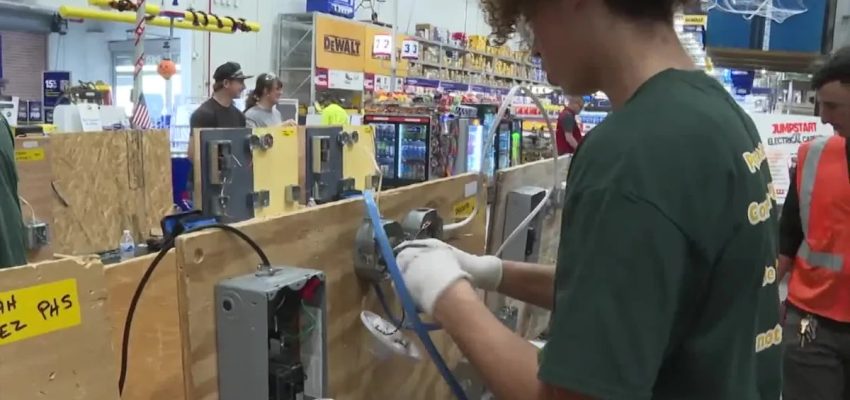

In an era increasingly dominated by algorithms, data streams, and artificial intelligence, one might be forgiven for thinking that the future belongs exclusively to coders, data scientists, and digital innovators. Indeed, the pace of technological advancement is breathtaking, reshaping industries and creating entirely new paradigms. Yet, beneath the digital surface, an equally profound and indispensable transformation is underway, one that underscores the enduring value of human ingenuity, craftsmanship, and hands-on expertise. We are talking, of course, about the **skilled trades** – the electricians, welders, plumbers, HVAC technicians, and countless other professionals who build, maintain, and innovate the physical infrastructure that makes our digital world possible. As an AI specialist and tech enthusiast, I find myself deeply fascinated by this dichotomy: the simultaneous explosion of AI capabilities and the quiet, yet powerful, resurgence of practical vocations. Events like the recent electrical skills challenge for students in Peoria, highlighted in the news, serve as potent reminders of the critical importance of nurturing these essential abilities, preparing a new generation for careers that are not just high-demand, but also remarkably future-proof.
### Skilled Trades: Igniting the Future of Work
The narrative around career paths often prioritizes university degrees in fields like computer science, engineering, or business. While these academic pursuits are undeniably valuable, they sometimes overshadow the equally vital, and often more immediately impactful, pathway of the **skilled trades**. Today, a significant and growing gap exists between the demand for these professionals and the available workforce. The U.S. Bureau of Labor Statistics, for instance, projects strong growth in many trade occupations over the next decade. Electricians, for example, are projected to see a 6% growth, adding over 40,000 jobs, while HVAC technicians are expected to grow by 5%, adding nearly 21,000 jobs, all at a time when a large portion of the current trade workforce is nearing retirement. This demographic shift, coupled with an increased focus on infrastructure development, energy efficiency, and renewable energy installations, creates a perfect storm of opportunity for those entering these fields.
The demand isn’t just about replacing an aging workforce; it’s also about meeting the evolving needs of a complex, modern society. From installing intricate smart home systems to maintaining sophisticated industrial machinery, from building sustainable energy solutions to ensuring our critical digital infrastructure remains powered, the practical application of expertise is irreplaceable. These aren’t just jobs; they are fundamental pillars of economic stability and societal progress. Unlike some purely cognitive tasks that AI can now perform with remarkable efficiency, the physical manipulation of tools, the on-site problem-solving, and the tactile understanding of materials inherent in the **skilled trades** often require human presence and nuanced judgment that artificial intelligence, for now, can only augment, not replace. This makes these careers inherently resilient and critical in a world increasingly shaped by both digital and physical demands.
### Beyond the Blueprint: The Modern Tradesperson
The perception of vocational careers has undergone a significant transformation. Gone are the days when trades were seen as a fallback for those not academically inclined. Today’s tradesperson is a highly trained, technically proficient professional who often operates at the intersection of traditional craft and cutting-edge technology. Consider the modern electrician, who must not only understand complex wiring diagrams but also program smart home systems, integrate solar panels, or troubleshoot advanced industrial control circuits. HVAC technicians now grapple with sophisticated building management systems and energy-efficient heat pumps, requiring an understanding of thermodynamics, digital controls, and even data analytics.
This evolution demands a new kind of expertise – one that combines practical dexterity with critical thinking, problem-solving, and continuous learning. Many **skilled trades** now incorporate elements of CAD (Computer-Aided Design), IoT (Internet of Things) for predictive maintenance, and even augmented reality (AR) for on-site diagnostics and training. The ability to read blueprints is still essential, but so is the capacity to interpret digital data streams and interface with smart equipment. These roles require individuals who are not afraid to get their hands dirty, but also possess the mental agility to master new technologies. The competitive electrical skills challenge in Peoria, where students showcase their abilities, beautifully illustrates this modern reality. Participants aren’t just twisting wires; they’re demonstrating an understanding of complex electrical systems, safety protocols, and efficient problem-solving under pressure – all hallmarks of the modern, highly competent tradesperson.
### Nurturing Talent: The Value of Hands-On Learning and Competition
How do we cultivate this new generation of technically adept professionals? The answer lies in robust vocational training programs, apprenticeship models, and invaluable hands-on learning experiences, often culminating in competitions like the one in Peoria. These events are more than just contests; they are crucibles for skill development, confidence building, and peer recognition. They provide a practical, high-stakes environment where theoretical knowledge is put to the test against real-world scenarios.
Participation in such challenges fosters qualities beyond mere technical proficiency. Students learn teamwork, time management, precision, and the critical importance of safety protocols. They gain exposure to industry standards and connect with mentors and potential employers, creating invaluable networking opportunities that can jumpstart their careers. Moreover, these competitions elevate the visibility and prestige of the **skilled trades**, inspiring other young people to consider these rewarding paths. They demonstrate that excellence in a trade is as commendable and vital as excellence in any other field. Schools and communities that invest in these programs are not just teaching a craft; they are investing in the economic resilience of their region and empowering individuals with tangible, in-demand skills that promise stable and fulfilling careers.
### The Augmented Artisan: AI and the Future of Skilled Trades
My primary field, artificial intelligence, naturally leads to questions about its impact on these traditional roles. Will AI replace the hands-on professional? My answer, based on current trajectories, is a resounding no – rather, AI will augment the artisan. Far from being a threat, AI represents a powerful suite of tools that can enhance safety, efficiency, and precision in the **skilled trades**.
Imagine an AI system that analyzes sensor data from an HVAC unit to predict component failure before it happens, allowing for proactive maintenance rather than reactive repairs. Or an AI-powered drone that inspects hard-to-reach electrical lines, identifying potential faults with greater accuracy and speed than a human eye. AI can assist with complex design calculations, optimize material usage, and even provide real-time diagnostic support to technicians on the field via augmented reality headsets. Robotics can handle repetitive or dangerous tasks, freeing up human workers for more complex problem-solving and critical decision-making. The future tradesperson will likely be a digitally fluent individual, adept not only with wrenches and meters but also with tablets and diagnostic software. The integration of AI means that tomorrow’s **skilled trades** professional will be more productive, safer, and capable of tackling even more intricate challenges, elevating the cognitive demands of the role while leveraging technology for optimization. This symbiotic relationship between human expertise and intelligent systems ensures that the human element remains at the core, while technology serves as a powerful enabler.
In conclusion, the narrative around the future of work must expand to fully embrace the indispensable role of the **skilled trades**. As we navigate an increasingly complex world, these hands-on professions provide the essential backbone for our infrastructure, our technology, and our daily lives. From the foundational work of constructing our cities to the intricate maintenance of our digital networks, the expertise of electricians, plumbers, welders, and many others is not just relevant; it is absolutely critical.
Investing in vocational training, fostering competitive learning environments, and celebrating the achievements of young professionals in these fields is paramount. As an AI specialist, I firmly believe that the convergence of human skill and artificial intelligence will not diminish the trades, but rather elevate them, creating new opportunities and enhancing the capabilities of the modern artisan. Let us recognize and champion these unsung architects of tomorrow, ensuring that the **skilled trades** continue to power innovation, stability, and progress for generations to come.










