
In an era defined by rapid technological obsolescence, where the lifespan of digital devices is often measured in mere months, there’s a certain profound beauty in systems built to endure. My fascination, as an AI specialist and tech enthusiast, often extends beyond algorithms and neural networks to the enduring marvels of engineering that power our world. One such testament to robust design and relentless operational efficiency can be found plying the vast, freshwater expanses of North America: the Great Lakes freighters. These magnificent vessels are not just ships; they are a living, breathing testament to industrial strength, economic backbone, and the ingenuity that allows machines to serve for generations.
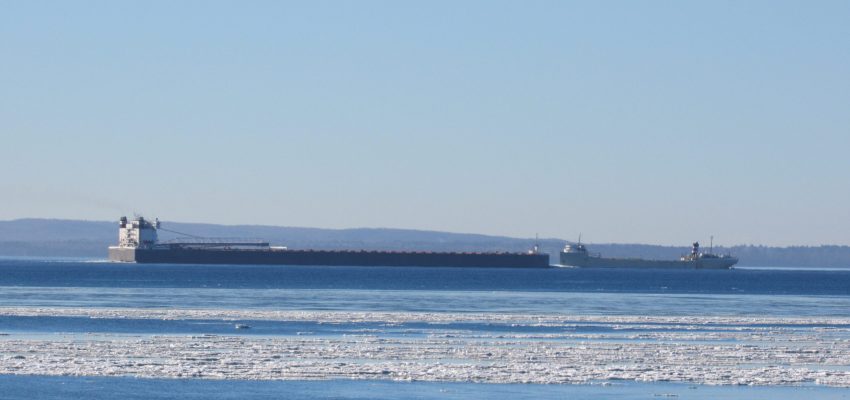
The image of the historic 519-foot SS Alpena, dwarfed yet still formidable, meeting the colossal 1,000-foot MV American Century in the icy grip of a December morning at the Straits of Mackinac, encapsulates this legacy perfectly. It’s a snapshot across time, highlighting both the evolution of maritime engineering and the continuous, tireless work these vessels perform. While one ship represents an earlier epoch of steel and steam, the other embodies the zenith of modern bulk carriage, yet both share a common purpose: to keep the heartland of North America moving, one precious cargo at a time.
Great Lakes Freighters: Giants of Inland Seas
The term ‘laker’ evokes a distinct image among maritime enthusiasts. These aren’t your typical ocean-going cargo ships. Great Lakes freighters are custom-built for the unique challenges and opportunities presented by the five interconnected lakes and their intricate network of locks, particularly the formidable Soo Locks connecting Lake Superior and Lake Huron. Their design is a masterclass in compromise and optimization: maximum length and breadth to navigate narrow channels and locks, a shallow draft to clear lake bottoms, and a unique self-unloading capability that makes them highly efficient for their specific cargo.
The Great Lakes system itself is a marvel, stretching over 244,000 square kilometers, holding 21% of the world’s surface fresh water. It’s a natural highway for industry, connecting resource-rich regions with manufacturing hubs. These vessels transport an incredible volume of raw materials essential for North American industry: iron ore from Minnesota and Michigan’s Upper Peninsula to steel mills in Indiana and Ohio, limestone for construction and steel production, coal for power generation (though this cargo is declining with shifts in energy policy), and grains from the agricultural heartland to processing centers and ports for export. Annually, these ships move over 160 million tons of cargo, a staggering figure that underscores their irreplaceable role in the regional and national economy. Without these specialized bulk carriers, the logistical and economic landscape of the continent would be fundamentally different, far more reliant on less efficient and more environmentally impactful road and rail transport for many commodities.
The operational demands on these ships are immense. They navigate through fierce storms, dense fog, and, during the extended shipping season, through significant ice fields. The engineers and crew who operate these complex machines are highly skilled, working in some of the most challenging maritime conditions. Their ability to maintain precise schedules and deliver massive payloads, often 24/7 for months on end, is a testament to human and mechanical resilience. The sheer scale of these operations, unseen by most who benefit from the goods they carry, is truly humbling.
Engineering Longevity: The Stories of Alpena and Wilfred Sykes
The SS Alpena and the MV Wilfred Sykes are two shining examples of this enduring legacy. The SS Alpena, launched in 1942 as the SS Leon Fraser, is a relatively smaller Great Lakes freighter by today’s standards at 519 feet, yet her longevity is remarkable. Built during the fervor of World War II, she was part of a fleet of 16 identical vessels designed to bolster the Allied war effort by moving critical raw materials. Her original design was as a traditional bulk carrier, later converted to a self-unloader, a crucial upgrade that extended her operational life dramatically. She has changed hands and names several times, eventually becoming the Alpena in 1990, serving as a cement carrier. Her nearly 80 years of continuous service are a stark reminder of a bygone era of shipbuilding, where vessels were constructed with an expectation of decades of utility, a philosophy that many modern industries could learn from. Her enduring presence demonstrates that with proper maintenance, modernization, and a robust original design, industrial assets can remain viable for astonishingly long periods.
The MV Wilfred Sykes, launched in 1949, represents another pivotal moment in the history of Great Lakes freighters. At 678 feet, she was the first post-World War II laker and, for a time, the largest vessel on the Great Lakes. She was also the first self-unloader designed from the keel up as such, setting a new standard for efficiency and speed in cargo discharge. The Sykes broke numerous cargo records in her early years, becoming a symbol of American industrial might and innovation. Her construction marked a shift towards larger, more specialized vessels, paving the way for the 1,000-foot giants that would follow. Her sleek design and powerful engines were revolutionary for her time, allowing her to make faster trips and carry more cargo than her predecessors. The Sykes has also undergone numerous modernizations over the decades, ensuring her continued relevance and operational capacity well into the 21st century. Her nearly three-quarters of a century of service is a testament not just to her initial groundbreaking design but also to the foresight in her construction and the continuous investment in her upkeep.
These vessels are more than just steel and engines; they are complex, integrated systems. Their operational success relies on sophisticated navigation equipment, robust propulsion systems, and constant, meticulous maintenance. Just like the advanced AI systems I work with, these ships are optimized for specific tasks, and their efficiency is a product of continuous refinement and adaptation. The engineering challenges of keeping such large machinery operational for decades, enduring harsh environments and constant stress, are immense. From hull integrity to engine overhauls, the crews and support teams perform miracles of preventative maintenance and reactive repair, often far from port.
The MV American Century, mentioned in the original context, represents the pinnacle of modern lake vessel design. At 1,000 feet long and 105 feet wide, these ‘superlakers’ maximize the dimensions of the Soo Locks, carrying up to 70,000 tons of cargo in a single trip. They are titans, designed for maximum economies of scale, often featuring advanced automation in their self-unloading systems and sophisticated bridge electronics. Their existence underscores the continuous drive for efficiency and capacity in the Great Lakes shipping industry, even as older, smaller vessels like the Alpena continue to prove their worth.
Beyond the Horizon: The Future of Great Lakes Shipping
The longevity of vessels like the Alpena and Wilfred Sykes raises pertinent questions about sustainability and resource utilization. In an age of ‘planned obsolescence,’ the ability of these machines to perform reliably for 70, 80, or even 90 years offers valuable lessons. It speaks to a manufacturing philosophy where durability and repairability are paramount, a principle that could perhaps be re-emphasized across various industries.
Looking ahead, the future of Great Lakes freighters is likely to blend tradition with innovation. Environmental regulations are becoming increasingly stringent, pushing operators to adopt cleaner fuels, more efficient engines, and advanced emissions control technologies. The conversation around electrification and hybrid propulsion, while challenging for vessels of this scale, is also emerging. Furthermore, the principles of AI and automation, central to my own field, are beginning to make inroads even in this venerable industry. Predictive maintenance, leveraging sensors and machine learning to anticipate equipment failures before they occur, is already being implemented to optimize operational uptime and reduce costs. Autonomous navigation, while still largely in its experimental phases for large vessels, could one day transform how these ships are crewed and operated, though human expertise will undoubtedly remain critical for the foreseeable future, especially in complex waterways.
The economic role of these vessels will remain critical. As global supply chains face increasing pressures, the reliability and cost-effectiveness of waterborne transport on the Great Lakes become even more pronounced. Infrastructure improvements, particularly upgrades to the Soo Locks system, are vital to ensure that these large vessels can continue to operate efficiently and safely, safeguarding the flow of essential goods for decades to come. The Great Lakes system is a testament to how natural geography can be harnessed and optimized to serve human endeavor, and the freighters that ply its waters are the indispensable conduits of that endeavor.
In conclusion, the enduring careers of vessels like the SS Alpena and MV Wilfred Sykes are far more than just maritime curiosities. They are powerful symbols of engineering excellence, economic resilience, and a testament to the long-term value of robust, well-maintained industrial assets. As an AI specialist, I often ponder the concept of ‘digital longevity’ and how we might design our software and hardware systems to be as resilient and adaptable as these magnificent ships. Their ability to transcend decades of technological change, economic shifts, and environmental challenges offers profound lessons in sustainability, efficiency, and the timeless value of strong foundations.
The legacy of these Great Lakes freighters will undoubtedly continue to shape the economic landscape of North America for many years to come. They remind us that true innovation isn’t always about building the newest, flashiest gadget, but sometimes about perfecting and preserving the foundational systems that quietly power our world, proving that some solutions, when built right, truly stand the test of time.