
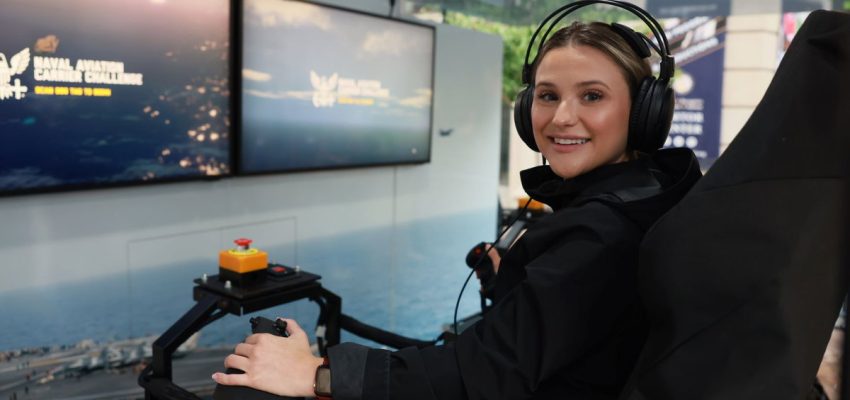

In an era defined by rapid technological advancement, the lines between the digital and physical worlds continue to blur, opening unprecedented avenues for innovation across every sector imaginable. From intricate surgical procedures to the complex logistics of global supply chains, technology, particularly artificial intelligence and extended reality (XR), is reshaping our capabilities. Among the most intriguing applications is its burgeoning role in high-stakes environments, where precision, teamwork, and critical decision-making are paramount. It’s in this fascinating intersection that we find the United States Navy, a force traditionally rooted in hardware and human grit, now embracing the ethereal yet profoundly impactful world of immersive digital experiences to train its next generation of sailors and officers. Recently, the Navy brought its traveling “Strike Group” mixed reality experience to students at Technical Careers High School, offering a powerful glimpse into how cutting-edge technology is transforming military recruitment and readiness. This isn’t just about showing off fancy gadgets; it’s about strategically preparing for future challenges by engaging young minds with the very tools that will define their careers.
### Mixed Reality: Immersive Frontiers in Military Engagement
To truly appreciate the significance of the Navy’s initiative, we must first understand what mixed reality (MR) entails. Unlike virtual reality (VR), which fully immerses users in a simulated world, or augmented reality (AR), which overlays digital information onto the real world, MR seamlessly blends both. It allows for interaction with virtual objects that are anchored to and responsive within the physical environment. Think of it as placing a digital blueprint onto a real table and being able to walk around it, manipulate its components, and even collaborate with others who see the same digital elements in their physical space. This unique capability makes MR an incredibly potent tool for training scenarios where contextual awareness of the real environment is crucial, alongside interaction with simulated systems.
The U.S. Navy’s adoption of MR is a calculated move to address several pressing needs. Firstly, recruitment. In an increasingly competitive job market, attracting tech-savvy youth to military service requires demonstrating that the Navy is not just about tradition, but also about pioneering technology. By showcasing experiences like the “Strike Group,” the Navy can capture the imagination of potential recruits, illustrating that a career in service can be at the forefront of innovation. The students at Technical Careers High School, for example, are inherently interested in practical, hands-on applications of technology. Providing them with an immersive experience that simulates the complex, high-pressure environment of a naval vessel directly speaks to their aspirations and skillset, offering a tangible link between their education and a potential career path. This is a far cry from traditional recruitment brochures; it’s an experiential invitation to the future of naval operations.
Beyond recruitment, the tactical advantages of MR for training are immense. Traditional naval training often involves significant logistical challenges, high costs, and inherent risks. Running full-scale exercises with actual ships and aircraft is expensive, time-consuming, and environmentally impactful. Furthermore, certain high-risk scenarios, such as damage control in a compromised vessel or complex coordinated combat operations, are difficult and dangerous to replicate in real life. Here, mixed reality offers a safe, repeatable, and cost-effective alternative. Sailors can practice intricate procedures, respond to simulated emergencies, and hone their teamwork in a controlled yet highly realistic digital environment, without placing themselves or valuable assets in harm’s way. This allows for rapid iteration, immediate feedback, and the ability to train for an almost infinite number of contingencies, from engine room fires to advanced threat detection, all within a fraction of the cost and risk of live exercises.
### Beyond the Screen: The Anatomy of a Virtual Navy Experience
The “Strike Group” experience is designed to immerse participants directly into the heart of naval operations. Imagine stepping onto a physical platform that represents a ship’s bridge, a flight deck, or even a submarine control room. Through a high-fidelity MR headset, the physical space around you transforms. Virtual consoles appear on real surfaces, digital screens display critical data, and holographic avatars of your teammates (or AI-driven opponents) interact with you in real-time. The goal is to simulate the intricate teamwork and rapid decision-making required to operate a complex naval vessel as part of a larger strike group.
Participants might be tasked with coordinating air traffic on a virtual aircraft carrier, navigating through simulated hostile waters, or managing a crisis scenario in an engine room. The experience isn’t just visual; it incorporates haptic feedback, allowing users to ‘feel’ the vibrations of machinery or the recoil of a simulated weapon. Audio cues enhance immersion, from the roar of jet engines to the quiet tension of a sonar room. Crucially, these simulations are not static. They are often powered by sophisticated AI algorithms that adapt to user input, creating dynamic and unpredictable challenges that mirror the complexities of real-world naval engagements. This adaptive learning environment ensures that training remains relevant and challenging, constantly pushing participants to refine their skills and decision-making processes under pressure.
The underlying technology powering these experiences is a marvel in itself. It leverages high-performance computing, advanced graphics rendering, and sophisticated spatial mapping to create seamless digital overlays. Companies specializing in defense simulation and XR technology are at the forefront of developing these platforms, often integrating existing military-grade training models into new MR frameworks. The data gathered from these simulations is invaluable, providing detailed analytics on individual and team performance, identifying areas for improvement, and informing curriculum development. This data-driven approach ensures that training is not only engaging but also highly effective, directly contributing to enhanced operational readiness across the fleet.
### Shaping Tomorrow’s Workforce: The Broader Impact of XR Training
The U.S. Navy’s embrace of mixed reality is not an isolated phenomenon but rather a prominent example of a broader trend across military branches and indeed, across various industries. The global market for XR technologies, encompassing VR, AR, and MR, is projected to grow exponentially, reaching hundreds of billions of dollars in the coming years. This growth is driven by the demonstrable benefits of immersive experiences in fields as diverse as healthcare (surgical training, therapy), manufacturing (assembly line training, remote assistance), and even retail (virtual try-ons, interactive product displays).
For the military, the implications extend beyond mere cost savings and safety. It’s about fundamentally redefining how personnel are educated and prepared. The rapid pace of technological change in modern warfare necessitates equally rapid and adaptable training methods. Future sailors will not only need to operate physical machinery but also master complex digital interfaces, data analysis, and cyber warfare protocols. Immersive training platforms, especially those leveraging advanced AI, can integrate these diverse skill sets into holistic scenarios, preparing personnel for the multi-domain challenges of 21st-century conflict. This holistic approach ensures that recruits are not just proficient in individual tasks but are also adept at integrating their skills within a larger, interconnected operational framework.
Furthermore, the collaboration capabilities offered by mixed reality are transforming team-based training. Geographically dispersed teams can train together in a shared virtual environment, fostering seamless communication and coordination irrespective of physical location. This is particularly vital for naval operations, which often involve multinational forces and intricate command structures spanning vast distances. The ability to conduct joint exercises in MR environments can significantly enhance interoperability and preparedness for real-world coalition operations.
Looking ahead, the integration of advanced AI with MR will unlock even more sophisticated training possibilities. AI agents could serve as dynamic adversaries, intelligent instructors providing real-time feedback, or even as virtual crewmates filling in for absent personnel. The potential for personalized learning paths, where AI tailors the difficulty and content of a simulation to an individual’s progress and learning style, is immense. This level of adaptive training promises to accelerate skill acquisition and mastery, creating a more highly skilled and adaptable naval force.
In conclusion, the U.S. Navy’s “Strike Group” mixed reality experience is far more than just a recruitment gimmick; it is a profound statement about the future of military training and readiness. By leveraging cutting-edge immersive technology, the Navy is not only attracting a new generation of talent but also fundamentally reshaping how it prepares its personnel for the complex demands of modern warfare. This initiative underscores a commitment to innovation, recognizing that the battlefields of tomorrow will be fought not just with steel and force, but with information, intelligence, and the seamless integration of human and artificial capabilities.
As we continue to witness the breathtaking pace of AI and XR development, we can expect these immersive training solutions to become even more sophisticated, realistic, and ubiquitous. The lessons learned from military applications of mixed reality will undoubtedly cascade into civilian sectors, revolutionizing education, vocational training, and collaborative work environments globally. The future is here, and it’s strikingly immersive, preparing us for a world where the boundaries of what’s possible are constantly being redrawn by the convergence of human ingenuity and technological prowess.










