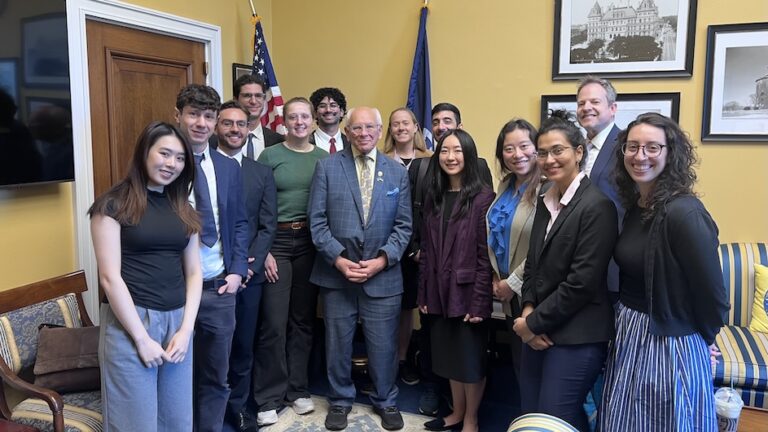

In the intricate dance between scientific discovery and public policy, few elements are as pivotal as the allocation of resources. Every year, researchers, innovators, and thought leaders turn their gaze towards Capitol Hill, understanding that the decisions made within its hallowed halls will reverberate through laboratories, universities, and industries across the nation. Recently, a delegation of early-career researchers from Columbia University embarked on this very journey to Washington, D.C., engaging directly with lawmakers as Congress deliberates on the crucial 2027 budget. Their mission was clear: to underscore the indispensable value of sustained federal research funding for the advancement of science, technology, and ultimately, the prosperity and security of the United States. This isn’t merely about securing grants; it’s about investing in the very fabric of our future.
The journey of these emerging scientific minds to the nation’s capital serves as a powerful reminder of how vital direct engagement is in the policymaking process. While groundbreaking discoveries often captivate headlines, the steady, often unsung, support that makes these breakthroughs possible begins with robust public investment. As an AI specialist and enthusiast, I’ve seen firsthand how essential robust funding streams are for nurturing cutting-edge fields. The implications of congressional decisions on the 2027 budget extend far beyond the immediate fiscal year; they will shape the trajectory of American innovation for decades to come, impacting everything from our capacity to combat future pandemics to our leadership in artificial intelligence and sustainable energy solutions.
Federal Research Funding: A Cornerstone of National Progress
The history of scientific progress in the United States is inextricably linked to strategic government investment. From the Manhattan Project and the space race to the Human Genome Project and the internet’s genesis, federal research funding has repeatedly acted as the catalyst for transformative breakthroughs. Institutions like the National Institutes of Health (NIH), the National Science Foundation (NSF), the Department of Energy (DOE), and the Department of Defense (DoD) collectively distribute billions of dollars annually, supporting a vast ecosystem of scientific inquiry. These investments are not handouts; they are strategic bets on intellectual capital, designed to yield dividends in health, economic growth, and national security.
Consider the economic ripple effect. A 2019 report by United for Medical Research estimated that every dollar of NIH funding generates $2.60 in local economic activity. This means jobs—not just for researchers, but for technicians, administrative staff, suppliers, and construction workers. It fosters new industries, drives commercialization of new technologies, and attracts global talent. For example, the early development of mRNA vaccine technology, which proved critical in the fight against COVID-19, received foundational support from various federal agencies over many years before it was ready for rapid deployment. Without sustained government investment in basic research, such critical preparedness would be impossible.
Moreover, the funding enables researchers to pursue high-risk, high-reward projects that the private sector might deem too speculative in their early stages. This ‘patient capital’ allows for fundamental discoveries that, while not immediately profitable, often form the bedrock for future applied technologies. Think of the pioneering work in quantum mechanics or advanced materials science – fields that now promise to redefine computing and manufacturing. The very infrastructure that supports this research, from cutting-edge particle accelerators to supercomputing clusters, often relies on substantial public investment.
The delegation from Columbia University, comprised of scientists at the nascent stages of their careers, represents the future pipeline of American innovation. Their advocacy highlights a crucial truth: without continuous investment in the next generation of researchers, the wellspring of discovery could dry up. These are the individuals who will lead the charge in developing cures for diseases, designing sustainable energy systems, and building the intelligent technologies that will define the 21st century. Their ability to secure grants and establish independent research programs is directly tied to the availability of robust federal research funding.
Beyond the Bench: The Broader Impact of Scientific Investment
The benefits of strong scientific funding extend far beyond the laboratory bench or the university campus. They permeate society in myriad ways, often silently shaping our daily lives. Take, for instance, environmental research funded by agencies like the EPA or NOAA. This work informs policy decisions on climate change, pollution control, and resource management, directly impacting public health and ecological stability. Similarly, agricultural research, supported by the USDA, underpins our food security, developing more resilient crops and sustainable farming practices that feed a growing global population.
In the realm of national security, investments in defense-related research and development ensure that the United States maintains a technological edge. This includes everything from advanced materials for aerospace to sophisticated cybersecurity protocols and artificial intelligence applications for defense. The symbiotic relationship between academic research and national security priorities is well-established, with university labs often serving as incubators for innovations that eventually protect our nation and its interests abroad. This collaborative model ensures that the brightest minds across the country are contributing to solving some of our most complex challenges.
The advocacy efforts of researchers like those from Columbia University are particularly impactful because they bring a direct, tangible perspective to policymakers. They can articulate not just the theoretical benefits of funding, but the practical realities of scientific work – the long hours, the collaborative efforts, the equipment needs, and the often-unforeseen paths to discovery. This human element is crucial in a legislative environment often dominated by abstract budgetary figures. For many lawmakers, hearing directly from the scientists who are on the front lines of discovery can be far more persuasive than reading a generalized report.
Furthermore, this engagement helps bridge the gap between scientific communities and the general public. When researchers speak to elected officials, they are, in effect, speaking for the potential beneficiaries of their work – patients awaiting new treatments, industries seeking competitive advantages, and citizens who rely on evidence-based policies. This broader communication effort helps to demystify science and reinforce its intrinsic value to society, fostering greater public support for government investment in research and development. It’s a reminder that science isn’t just for scientists; it’s for everyone.
The Voice of the Future: Why Early Career Researchers Matter
The specific focus on early-career researchers in the Columbia delegation is particularly noteworthy. These individuals are at a critical juncture in their professional development, often transitioning from postdoctoral positions to independent faculty roles. This period is often characterized by intense pressure to secure initial grants, establish their own labs, and build their research programs. Without access to adequate federal research funding, many talented scientists may face immense hurdles, potentially leading to attrition from the research pipeline.
Investing in early-career scientists ensures a continuous influx of fresh perspectives and innovative ideas. They are often less bound by conventional wisdom and more willing to explore novel, interdisciplinary approaches to complex problems. Their success is a direct indicator of the long-term health and vibrancy of the entire scientific enterprise. When funding opportunities are scarce, competition becomes fierce, often disproportionately affecting those without established track records or extensive professional networks. This can stifle innovation and create a significant brain drain, pushing promising minds towards other sectors or even other countries.
Moreover, these younger researchers are often at the forefront of emerging fields, such as artificial intelligence, quantum computing, advanced robotics, and personalized medicine. Their work is critical for maintaining America’s global leadership in science and technology. Countries like China and those in the European Union are significantly increasing their investments in R&D, underscoring the fierce international competition for scientific supremacy. If the U.S. falters in supporting its early-career researchers, it risks falling behind in these pivotal areas, with long-term consequences for economic competitiveness and geopolitical influence.
The opportunity for these researchers to advocate directly on Capitol Hill provides invaluable experience, not just in policy engagement, but in understanding the broader context of their work. It empowers them to become articulate spokespeople for science, capable of communicating its value to diverse audiences. This skill set is increasingly important in an era where scientific literacy and public trust in science are paramount. Their voices, representing the future of scientific discovery, carry a unique weight, reminding legislators that today’s investments are tomorrow’s breakthroughs.
The consideration of the 2027 budget, therefore, is not merely a bureaucratic exercise; it is a profound decision about national priorities and future potential. Supporting these nascent careers means fostering the intellectual curiosity and rigorous inquiry that drive all progress. It means ensuring that the next generation of Nobel laureates, medical pioneers, and technological visionaries have the resources they need to transform ambitious ideas into tangible realities, securing America’s place at the vanguard of global innovation.
The journey of Columbia’s early-career researchers to Washington, D.C., served as a crucial reminder that scientific progress is not an automatic outcome but a deliberate societal choice. The continued prosperity, health, and security of the United States are deeply intertwined with the sustained investment in its scientific enterprise. As Congress moves forward with its 2027 budget deliberations, the insights and advocacy of these researchers provide a powerful testament to the enduring value of robust federal research funding. It’s an investment in curiosity, in ingenuity, and in the limitless potential of the human mind.
As we navigate an increasingly complex world, from climate change to emerging infectious diseases and the ethical frontiers of artificial intelligence, the need for informed, evidence-based solutions has never been greater. By empowering the next generation of scientists through consistent and strategic funding, we ensure that our nation remains at the forefront of discovery, ready to tackle the challenges of tomorrow and harness the opportunities that scientific advancement inevitably creates. The future, in essence, is funded today.