
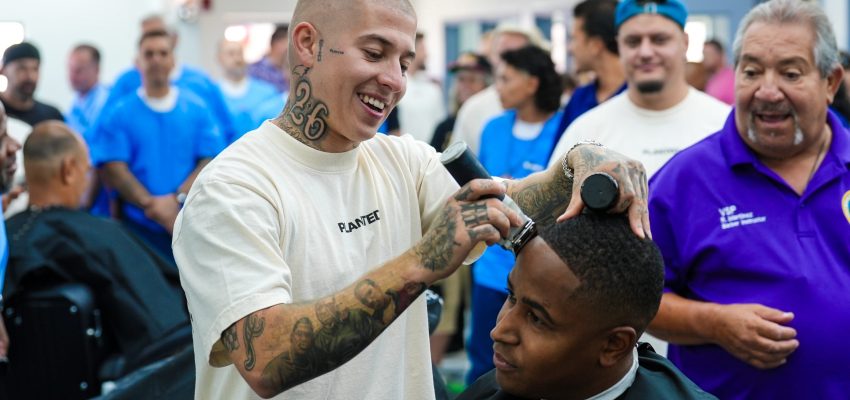

In an era increasingly defined by rapid technological advancement, particularly in the realm of artificial intelligence, our discourse often gravitates towards data, algorithms, and complex neural networks. Yet, at the heart of every technological pursuit lies a fundamental human aspiration: to solve problems, unlock potential, and improve the quality of life. Sometimes, the most profound innovations aren’t found in a laboratory or a server farm, but in unexpected partnerships that redefine what’s possible for individuals and communities. This sentiment rings true when we look at the groundbreaking initiative recently launched at Valley State Prison (VSP) in California: the VicBlends Academy.
This is not merely a story about haircuts; it’s a compelling narrative about opportunity, rehabilitation, and the inherent capacity for human transformation. It’s a testament to how creative collaborations, even those involving figures from the digital influencer sphere, can profoundly impact lives, offering tangible pathways to a better future. As an AI specialist and tech enthusiast, I find myself drawn to such initiatives because they mirror, in a very human way, the core principles we strive for in AI development: optimization, efficiency, and the amplification of human capabilities. While AI seeks to optimize processes and predict outcomes, programs like the VicBlends Academy directly optimize human potential and predict successful reintegration, albeit through profoundly human-centric methods. It’s a powerful reminder that while technology scales solutions, true progress often begins with a singular, impactful human connection.
Prison Barbering Program: A Cut Above in Rehabilitation
At its core, the initiative at Valley State Prison is a Prison Barbering Program, the VicBlends Academy, an endeavor born from a partnership with a renowned social media influencer, VicBlends himself. This isn’t just about teaching a trade; it’s about instilling hope, purpose, and a tangible skill set that can literally reshape futures. For too long, correctional facilities worldwide have grappled with the complex challenge of recidivism – the tendency of a convicted criminal to reoffend. Statistics paint a stark picture: within three years of release, nearly 68% of individuals released from state prisons are rearrested, and within five years, that number climbs to 79%. These figures represent not just abstract data points but shattered lives, continued societal costs, and cycles of despair that are incredibly difficult to break.
Vocational training within correctional settings has long been recognized as a crucial component in combating these trends. Unlike academic programs which might focus on theoretical knowledge, vocational training provides hands-on skills directly applicable to the job market. This practical approach significantly increases the likelihood of employment post-release, which is a primary determinant of successful reintegration into society. A steady job provides financial stability, reduces the temptation to return to criminal activity, and fosters a sense of self-worth and contribution. Studies have consistently shown that inmates who participate in correctional education programs have 43% lower odds of recidivating than those who do not. Moreover, for every dollar spent on prison education, four to five dollars are saved on re-incarceration costs, illustrating a clear economic benefit beyond the profound human one.
What makes the VicBlends Academy particularly noteworthy is the involvement of a modern social media personality. VicBlends, known for his incredible barbering skills and massive online following, brings not just technical expertise but also a powerful message of entrepreneurship, personal branding, and perseverance. This partnership elevates the program beyond a standard vocational course; it imbues it with a sense of aspirational possibility. It teaches participants not just how to cut hair, but how to build a business, manage clients, market themselves, and understand the value of their craft in a competitive market. It’s a holistic approach to rehabilitation that sees individuals not merely as inmates, but as future entrepreneurs, community members, and contributors.
The Mechanics of a Second Chance: Beyond the Clippers and Combs
The curriculum of the VicBlends Academy is meticulously designed to go beyond the mere mechanics of haircutting. Participants learn advanced barbering techniques, from classic cuts to contemporary styles, ensuring they are proficient in a diverse range of client needs. However, the program extends far beyond technical proficiency. Crucially, it integrates comprehensive training in soft skills that are indispensable for success in any client-facing profession. These include customer service excellence, effective communication, time management, and professional ethics. Imagine the transformation: individuals who may have previously lacked positive social interactions are now mastering the art of building rapport, understanding client needs, and providing a top-tier service experience.
Furthermore, the academy emphasizes the entrepreneurial spirit. Students are educated on the business aspects of barbering, including salon management, financial literacy, marketing strategies, and building a client base. This focus on self-sufficiency empowers participants to consider opening their own businesses or working as independent contractors, rather than simply seeking employment. This level of autonomy is vital for individuals re-entering society, as it provides them with greater control over their economic future and a clear path to legitimate success. The influence of VicBlends himself plays a pivotal role here; his journey from humble beginnings to social media stardom and a successful business empire serves as a powerful, tangible example of what dedication and skill can achieve.
Beyond the individual skills, such programs contribute significantly to the broader correctional reform movement. They exemplify a shift from purely punitive models to rehabilitative ones, recognizing that a more secure and prosperous society is built by empowering individuals to become productive citizens. These initiatives require a complex ecosystem of support, involving correctional staff, educators, community organizations, and potential employers. Post-release support, often overlooked, is critical. This includes job placement assistance, mentorship programs, and access to resources that help navigate the challenges of re-entry. The economic benefits ripple outwards: fewer re-arrests mean fewer burdens on the justice system, reduced costs for incarceration, and an increase in tax-paying citizens. Ultimately, investing in a robust Prison Barbering Program or any vocational training within prisons isn’t just an act of compassion; it’s a sound economic and social investment.
Forging Futures: The AI-Driven Lens on Human Transformation
From the perspective of an AI specialist, observing programs like the VicBlends Academy at VSP offers fascinating parallels and opportunities for future integration. While the academy’s success is rooted in human interaction and skill transfer, the broader field of human transformation and societal rehabilitation stands to gain immensely from intelligent systems. Imagine a future where AI could augment and scale these human-centric efforts.
For instance, AI-powered analytics could play a transformative role in understanding recidivism risk factors more granularly. By analyzing vast datasets—including socio-economic backgrounds, educational history, past offense patterns, and behavioral data within the correctional system—AI could develop more precise predictive models. These models wouldn’t just flag individuals at higher risk but could also suggest personalized intervention strategies, recommending specific vocational training programs, educational pathways, or therapeutic interventions tailored to an individual’s unique needs and learning style. This is akin to how AI customizes online learning experiences or product recommendations, but applied to a far more critical social challenge.
Furthermore, AI could enhance the learning experience within a Prison Barbering Program. Personalized learning platforms, powered by machine learning, could adapt curriculum difficulty and pacing based on an inmate’s progress, offering targeted exercises for areas where they struggle and accelerating learning in areas of proficiency. Virtual reality (VR) and augmented reality (AR) could create immersive training environments where aspiring barbers can practice complex techniques in a simulated salon, receiving real-time feedback from AI tutors. This reduces the need for expensive equipment and provides a safe, repeatable learning space.
Beyond the prison walls, AI could assist in post-release reintegration. AI-driven job matching platforms could connect individuals, who have completed programs like the VicBlends Academy, with employers actively seeking skilled barbers, based on not just qualifications but also personality traits and cultural fit, reducing biases that often plague traditional hiring processes. Natural Language Processing (NLP) could help analyze job market trends in real-time, allowing training programs to evolve and remain relevant, ensuring that the skills taught align with current and future industry demands. Moreover, AI could power support networks, providing automated check-ins, mental health resources, and crisis intervention suggestions, making the transition back into society smoother and more sustainable.
Of course, the integration of AI into such sensitive areas raises crucial ethical considerations. Data privacy, algorithmic bias (ensuring models don’t inadvertently penalize certain demographic groups), and the preservation of human agency must be paramount. AI should always serve as an assistive tool, amplifying human educators, counselors, and mentors, never replacing the irreplaceable human element of empathy, understanding, and personal connection. The goal isn’t to automate rehabilitation, but to intelligently support and scale human-led initiatives, ensuring that every individual, regardless of their past, has the optimal chance to rebuild their life.
In essence, what we see unfolding at Valley State Prison with the VicBlends Academy is a microcosm of a larger societal shift: a recognition that investing in human potential, even in the most challenging circumstances, yields profound dividends. This initiative, while not directly AI-driven, embodies the very principles of intelligent system design – identifying a problem, designing an efficient solution, and measuring its impact. It stands as a powerful reminder that technological progress and social innovation are not mutually exclusive; rather, they are two sides of the same coin, both aiming to carve out a better future.
The human spirit’s capacity for transformation is boundless, and when combined with thoughtful innovation, whether through a passionate social media influencer or the strategic application of AI, the results can be truly revolutionary. The VicBlends Academy at VSP is more than a barbering school; it’s a beacon of hope, a testament to the power of second chances, and a practical demonstration of how forward-thinking programs can shape a more inclusive and prosperous society for all. It inspires us to consider how we can continue to blend human ingenuity with technological advancements to unlock the full spectrum of human potential, even in the most overlooked corners of our society.










