
In an era defined by rapid technological advancement, from the accelerating capabilities of artificial intelligence to breakthroughs in quantum computing and biotechnology, the foundation of progress lies in human ingenuity. Yet, ingenuity alone is not enough; it requires strategic nurturing and an ecosystem that fosters innovation. At the heart of America’s scientific prowess, national laboratories stand as crucibles of discovery, pushing the boundaries of what’s possible. But their mission extends far beyond the lab bench; they are increasingly becoming vital engines for workforce development, forging the talent pipeline crucial for sustained leadership in science and technology. This endeavor is particularly evident in the critical partnerships these institutions cultivate with academic bodies, preparing the next generation to tackle the grand challenges of tomorrow.
One compelling illustration of this symbiotic relationship can be found in New Mexico, where the Los Alamos National Laboratory (LANL) is actively investing in the state’s educational infrastructure and its future scientists. Often seen as a nexus of high-stakes research, from national security to fundamental physics, LANL understands that the future of discovery depends on a continuous influx of well-prepared, skilled individuals. It’s a strategic imperative that directly impacts not only the lab’s operational capabilities but also the broader scientific and economic landscape of the nation.
Workforce Development at the Core: LANL’s Impact on STEM Education
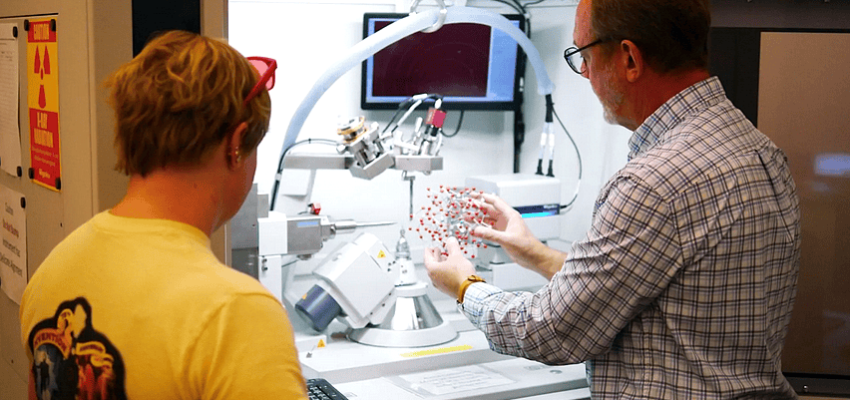
The commitment of national laboratories to education and training is exemplified by initiatives such as the partnership between LANL and the New Mexico Institute of Mining and Technology (New Mexico Tech). Through this collaboration, New Mexico Tech acquired a sophisticated single-crystal x-ray diffraction instrument. This isn’t merely a piece of equipment; it’s a gateway to advanced scientific understanding and a powerful tool for hands-on learning. Dr. John Rakovan, a mineralogist at New Mexico Tech, highlighted the instrument’s significance, underscoring its role in enhancing the school’s research capabilities and, more importantly, in providing students with invaluable, real-world experience.
So, what exactly does a single-crystal x-ray diffraction instrument do, and why is it so vital for modern science and workforce development? At its core, this technology allows scientists to determine the precise atomic and molecular structure of crystalline materials. By bombarding a crystal with X-rays and analyzing the resulting diffraction pattern, researchers can map out the arrangement of atoms in three dimensions. This fundamental understanding is critical across a vast spectrum of scientific disciplines:
- Materials Science: Designing new alloys, superconductors, and ceramics with specific properties for aerospace, energy, and electronics.
- Chemistry: Characterizing novel compounds, understanding reaction mechanisms, and developing new catalysts.
- Pharmacy and Drug Discovery: Determining the structure of active pharmaceutical ingredients, which is essential for drug design and development.
- Geology and Mineralogy: Unlocking the secrets of Earth’s formation and mineral resources.
- Biochemistry: Elucidating the structures of proteins and nucleic acids, crucial for understanding biological processes and disease.
For students at New Mexico Tech, access to such an advanced instrument provides an unparalleled educational advantage. They move beyond theoretical concepts taught in textbooks and engage directly with cutting-edge research. This practical experience not only hones their technical skills but also fosters critical thinking, problem-solving abilities, and an understanding of the scientific method in action. Furthermore, it exposes them to the rigorous demands and collaborative nature of professional scientific research, making them highly competitive candidates for future roles in industry, academia, or national laboratories like LANL itself. It’s a direct investment in the human capital that will drive future innovations, showcasing a forward-thinking approach to talent development.
The “win-win” aspect of this initiative cannot be overstated. For New Mexico Tech, it elevates their research capacity and attracts top-tier students. For LANL, it nurtures a local talent pool, creating a pipeline of skilled graduates who are already familiar with advanced scientific instrumentation and the culture of high-level research. This local engagement also strengthens community ties and ensures that the economic benefits of such a major institution ripple throughout the region, contributing significantly to regional workforce development and economic diversification. The vision is clear: to equip New Mexico’s next generation with the tools and knowledge necessary to contribute meaningfully to scientific and technological advancements, from fundamental research to applied solutions that impact daily life.
National Laboratories: Pillars of American Innovation and Talent Incubation
While the LANL-New Mexico Tech partnership provides a specific example, it reflects a broader, enduring legacy of national laboratories across the United States. These institutions, initially established out of wartime necessity or to address grand national challenges, have evolved into some of the world’s most sophisticated scientific enterprises. From the Manhattan Project, which gave birth to institutions like Los Alamos, to the development of the internet, GPS, and countless medical imaging techniques, national labs have consistently been at the forefront of transformative innovation.
Operated by the Department of Energy (DOE) and other federal agencies, these labs represent a unique model for research and development. They combine the intellectual freedom of academia with the mission-driven focus of government agencies, often operating at scales and with resources unavailable elsewhere. Their missions span a vast array of critical areas:
- National Security: Ensuring the safety and reliability of the nuclear deterrent, developing advanced cybersecurity measures, and counter-proliferation efforts.
- Energy Research: Pioneering sustainable energy solutions, from fusion power and advanced fission reactors to solar, wind, and battery technologies.
- Fundamental Science: Pushing the frontiers of physics, chemistry, biology, and materials science, often using unique large-scale user facilities like synchrotrons and neutron sources.
- Supercomputing and AI: Developing and deploying some of the world’s most powerful supercomputers, advancing AI algorithms for scientific discovery, and managing vast datasets.
- Environmental Science: Addressing climate change, developing remediation technologies, and understanding complex ecological systems.
Each of these areas requires a highly specialized and interdisciplinary workforce. National labs, by their very nature, are incubators of talent. They host thousands of scientists, engineers, postdocs, and students, providing unparalleled opportunities for collaboration, mentorship, and exposure to cutting-edge research. Internships, fellowships, and postdoctoral programs are not just supplementary activities; they are integral to the labs’ strategy for sustaining their intellectual capital and fulfilling their long-term missions. For many aspiring scientists and engineers, a stint at a national lab is a formative experience, shaping their careers and often leading to groundbreaking contributions.
The economic impact of these labs extends far beyond their immediate payrolls. They attract federal funding, foster local businesses that support their operations, and generate intellectual property that can lead to new industries and job creation. They act as magnets for skilled professionals and their families, enriching the local economy and contributing to a vibrant scientific culture. In essence, national labs are not just research centers; they are strategic national assets for innovation, security, and sustained workforce development, continuously cultivating the expertise required for future challenges.
Nurturing the Future: Creating a Robust STEM Pipeline for the AI Era
The imperative to invest in the next generation has never been more pressing. As we delve deeper into the 21st century, the demand for professionals skilled in science, technology, engineering, and mathematics (STEM) continues to outpace supply. Fields like artificial intelligence, quantum computing, advanced materials, and biotechnology are not just emerging; they are rapidly transforming every aspect of society, creating new industries and demanding new skill sets. A robust STEM pipeline is no longer a luxury but a national security and economic necessity.
Initiatives like the LANL-New Mexico Tech partnership are critical components of this larger national effort. By providing early access to advanced tools and real-world research environments, they inspire students, demystify complex scientific careers, and provide practical skills that are directly transferable to high-demand jobs. This isn’t just about training individuals; it’s about cultivating a culture of innovation and scientific inquiry that begins long before a student enters a professional lab.
Consider the connection between the single-crystal x-ray diffraction instrument and the future of AI. While seemingly distinct, materials science forms the bedrock for advancements in AI hardware. Developing more efficient, powerful, and sustainable computing architectures—from neuromorphic chips that mimic the human brain to quantum computing components—requires a deep understanding of new materials at the atomic level. The students trained today in advanced materials characterization using instruments like the x-ray diffractometer are precisely the individuals who will contribute to designing the next generation of AI-specific hardware, pushing the boundaries of what AI can achieve. Their expertise is a direct input to the future of AI.
Beyond specific instruments, the broader engagement strategies of national laboratories are vital. These include:
- Internships and Fellowships: Offering immersive experiences that bridge academic learning with practical research challenges.
- K-12 Outreach Programs: Sparking interest in STEM from an early age through interactive workshops, science fairs, and mentorship.
- University Partnerships: Collaborating on joint research projects, curriculum development, and faculty exchanges.
- Postdoctoral Research: Providing critical transition opportunities for recent Ph.D. graduates to gain independent research experience.
Moreover, building a diverse and inclusive talent pipeline is paramount. Innovation thrives on diverse perspectives, and ensuring that STEM education and career pathways are accessible to all segments of society is essential for maximizing the nation’s scientific potential. Efforts to engage underrepresented groups in STEM are not just about equity; they are about strengthening the overall capacity for innovation and ensuring a resilient workforce development strategy.
The challenge of creating a robust STEM pipeline is multifaceted, requiring sustained investment from government, industry, and academia. However, the returns on this investment are immense: a competitive economy, enhanced national security, and solutions to some of humanity’s most pressing problems. The role of national laboratories in this grand endeavor is irreplaceable, serving as anchors of advanced research and beacons for aspiring scientists and engineers, shaping not just careers, but the very future of technological progress.
The synergy between national laboratories and educational institutions is a cornerstone of American scientific and technological leadership. By providing state-of-the-art resources, fostering mentorship, and creating direct pathways into high-impact careers, institutions like Los Alamos National Laboratory are not merely conducting research; they are actively investing in the nation’s future. The acquisition of instruments like the single-crystal x-ray diffraction system at New Mexico Tech symbolizes a tangible commitment to practical education and advanced training, directly contributing to a robust workforce development pipeline in critical STEM fields. It highlights a proactive approach to addressing the evolving demands of a technologically complex world.
As we navigate an increasingly AI-driven landscape, the cultivation of skilled human talent becomes ever more critical. The partnerships forged today, connecting cutting-edge research facilities with ambitious students, are shaping the minds that will drive the next wave of innovation. Investing in this talent is an investment in national competitiveness, economic prosperity, and the capacity to solve the grand challenges of tomorrow. Through these strategic collaborations, national laboratories are ensuring that America remains at the forefront of scientific discovery and technological advancement, securing a brighter, more innovative future for generations to come.