
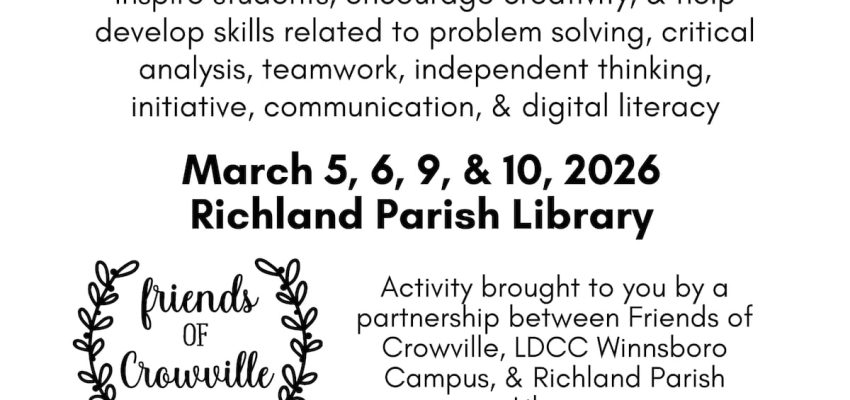

In an increasingly complex world shaped by rapid technological advancements, the seeds of future innovation are often sown in unexpected places. Sometimes, it’s a child’s fascination with a simple machine, a curious glance at a food label, or the mesmerizing dance of a robot controlled by small, eager hands. These moments, seemingly trivial, are often the sparks that ignite lifelong passions and career paths. The recent STEM Fest at the Richland Parish Library, where elementary students eagerly engaged with robotics and explored scientific concepts, stands as a testament to this profound truth.
It’s a powerful image: a fourth grader already articulating her dream of becoming a marine biologist, or a nutritionist tracing her professional journey back to an early childhood habit of deciphering ingredient lists. These anecdotes are not mere coincidences; they are vivid illustrations of how early exposure to science, technology, engineering, and mathematics – collectively known as STEM – can profoundly shape a child’s understanding of the world and their place within it. As an AI specialist and tech enthusiast, I consistently observe that the foundational principles of STEM are more vital than ever, serving as the bedrock upon which our AI-driven future will be built. This article delves into why nurturing curiosity and providing accessible STEM experiences from a young age isn’t just beneficial, but absolutely critical for empowering the next generation to thrive in an era defined by artificial intelligence and unprecedented innovation.
STEM Education: Igniting Curiosity from an Early Age
The journey toward a fulfilling and impactful career often begins with a spark of curiosity, fanned by opportunity and mentorship. For the fourth grader at Richland Parish, envisioning a life studying ocean ecosystems, that spark might have been a documentary, a book, or perhaps an interactive exhibit at a local event. Similarly, the nutritionist’s path, rooted in a childhood fascination with food labels, underscores how everyday observations, when encouraged, can blossom into profound professional callings. These stories highlight the transformative power of early exposure to fundamental concepts that underpin what we now call STEM education.
STEM education encompasses a broad range of disciplines, but its core lies in fostering critical thinking, problem-solving, and an inquisitive spirit. It’s about understanding how the world works, how to build solutions, and how to innovate. In today’s landscape, where technological progress is accelerating at an exponential rate, proficiency in STEM subjects is no longer just an advantage but a fundamental requirement for navigating and shaping the future. Data from the U.S. Bureau of Labor Statistics consistently project robust growth in STEM occupations, far outstripping the growth of non-STEM fields. This isn’t just about coding or advanced mathematics; it’s about a mindset that values inquiry, experimentation, and logical reasoning.
Consider the elementary students at the STEM Fest, engrossed in playing with robots. This seemingly simple activity is a powerful gateway to complex ideas. Through hands-on interaction, children aren’t just having fun; they’re intuitively grasping principles of mechanics, programming logic, cause-and-effect, and even basic physics. They’re learning to troubleshoot, to collaborate, and to iterate – all essential skills in engineering and technology. Robotics, in particular, offers a tangible way to connect abstract concepts to real-world applications, demystifying technology and making it accessible. Such experiences lay the groundwork for understanding more advanced concepts later, from data science to machine learning, fostering a comfort level with technology that will be invaluable as they mature.
Furthermore, early engagement with STEM helps dismantle the misconception that these fields are exclusively for a select few. By making science and technology playful and exploratory, we encourage a broader demographic of children, regardless of background, to see themselves as future innovators and problem-solvers. This inclusivity is vital, as diverse perspectives are crucial for creating ethical, robust, and universally beneficial technological solutions.
Bridging the Gap: Libraries and Community Initiatives as STEM Hubs
While formal schooling provides a structured environment for learning, informal education settings often play an equally critical role in sparking and nurturing interests. Community institutions, particularly local libraries, are uniquely positioned to serve as accessible and inclusive hubs for STEM engagement. The Richland Parish Library’s STEM Fest is a prime example of this model in action, demonstrating how community spaces can bridge educational gaps and provide enrichment opportunities that might otherwise be unavailable.
Libraries, once primarily repositories of books, have dramatically evolved into dynamic learning centers that cater to the diverse needs of their communities. They offer free access to resources, technology, and programs, making them ideal venues for introducing STEM concepts to children and families. These settings often remove financial barriers and create a welcoming, low-pressure environment where children feel comfortable experimenting and exploring without the academic anxieties sometimes associated with school classrooms.
Community-led STEM initiatives, whether they are library festivals, after-school coding clubs, or weekend maker spaces, are vital for several reasons. Firstly, they foster a sense of community ownership over education, encouraging parents, volunteers, and local professionals to contribute their expertise. Secondly, they offer practical, hands-on experiences that complement theoretical classroom learning. For example, while a science class might teach about circuits, a library workshop could allow children to build their own simple robot or light-up device, transforming abstract knowledge into tangible understanding.
Moreover, these initiatives often feature role models from various STEM fields, allowing children to see diverse individuals pursuing careers in science and technology. Meeting a female engineer, a Black scientist, or a Hispanic technologist can be incredibly empowering, helping to break down stereotypes and broaden a child’s perception of what they can achieve. Such exposure is instrumental in encouraging underrepresented groups to consider STEM pathways, thereby enriching the entire field with varied perspectives and talents.
The success of events like the STEM Fest lies in their ability to make learning fun and relevant. By presenting science and technology as exciting adventures rather than daunting subjects, these programs cultivate a positive attitude towards STEM that can last a lifetime. They demonstrate that learning doesn’t just happen within four classroom walls but is a continuous, joyful process of discovery and exploration that extends into every corner of our communities.
The Future is Now: AI, Automation, and the Imperative for STEM Proficiency
As we stand on the precipice of an AI revolution, the imperative for robust STEM education has never been clearer. Artificial intelligence, machine learning, and automation are not futuristic concepts; they are already fundamentally reshaping industries, economies, and daily life. From personalized medicine and autonomous vehicles to advanced robotics and intelligent data analysis, AI is driving unprecedented transformations, creating entirely new job categories while redefining existing ones. For the next generation, a strong foundation in STEM isn’t merely advantageous; it’s a prerequisite for understanding, participating in, and ultimately steering this technological paradigm shift.
As an AI specialist, I often emphasize that understanding AI isn’t solely about learning to code algorithms. It requires a deep grasp of underlying STEM principles: the logical reasoning of mathematics, the experimental methodology of science, the problem-solving approach of engineering, and the systematic thinking of technology. Children who engage with robotics today are learning the precursors to machine learning logic. Those who analyze data in a simple science experiment are building the observational and analytical skills essential for future data scientists. This early exposure to the fundamentals of STEM education fosters the intellectual agility needed to adapt to rapidly evolving technological landscapes.
The World Economic Forum consistently highlights the growing demand for skills like critical thinking, complex problem-solving, and digital literacy – all hallmarks of a strong STEM background. While AI promises to automate many routine tasks, it simultaneously creates a surging demand for human creativity, innovation, and the ability to design, manage, and ethically deploy these advanced systems. This means that future workforces will need to be proficient not only in using AI tools but also in understanding their limitations, biases, and broader societal implications.
Moreover, a society with broad STEM literacy is better equipped to engage in informed discussions about the ethical dimensions of AI. Who decides what values are programmed into an autonomous system? How do we ensure fairness and transparency in AI algorithms? These are not just technical questions; they are societal and philosophical challenges that require a diverse range of perspectives, all rooted in an understanding of the technology itself. By fostering comprehensive STEM education from an early age, we empower citizens to be active participants in these crucial conversations, rather than passive recipients of technological change.
Investing in early STEM engagement is, therefore, an investment in our collective future. It’s about cultivating a generation that can not only consume technology but also create it, critique it, and guide its development toward a more equitable and prosperous world. The ability to innovate, to adapt, and to understand the underlying mechanics of our technological future begins with that initial spark of curiosity, nurtured by accessible, engaging, and comprehensive STEM learning experiences.
Conclusion
The glimpses into the Richland Parish Library’s STEM Fest serve as a powerful reminder: the future innovators, scientists, engineers, and tech leaders of tomorrow are sitting in our elementary school classrooms today. Their potential, often nascent and unarticulated, awaits the right environment to flourish. Whether it’s through the hands-on marvel of robotics, the inquisitive exploration of marine life, or the simple act of decoding a food label, these early encounters with science, technology, engineering, and mathematics are not just educational activities; they are foundational experiences that shape aspirations and build the cognitive frameworks necessary for tackling the challenges and opportunities of an increasingly complex world.
As we navigate an era defined by the profound influence of artificial intelligence, the importance of robust and accessible STEM education cannot be overstated. It is through these early, engaging initiatives that we empower the next generation with the critical thinking, problem-solving skills, and innovative spirit essential to thrive. Communities, parents, educators, and policymakers must continue to champion and invest in programs that bring STEM to life for young minds. For in nurturing that spark of curiosity today, we are quite literally building the intelligent, empathetic, and capable workforce that will define our tomorrow, ensuring that humanity remains at the helm of its technological destiny.










