
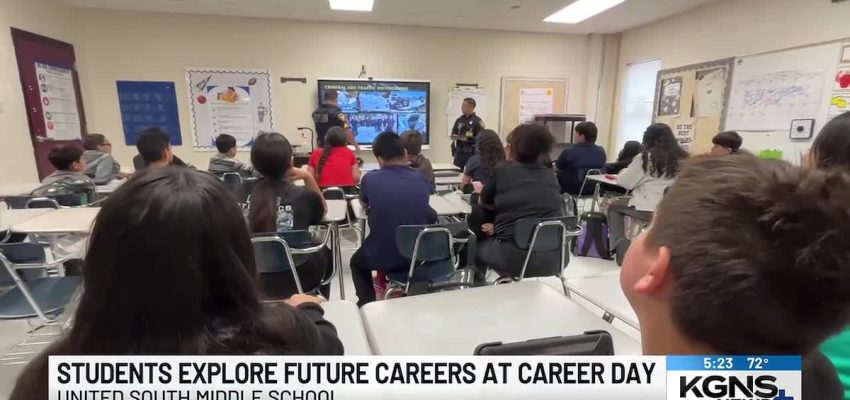

As the festive season approaches, many young minds across the nation, like the eighth-graders at United South Middle School mentioned in recent reports, are already looking beyond school halls, contemplating the vast landscape of their professional futures. This period of reflection, often sparked by career days or interactions with professionals, is more critical now than ever before. Why? Because the world these students will inherit and shape is undergoing a profound transformation, driven by the relentless march of artificial intelligence. As an AI specialist, writer, and tech enthusiast, I find myself constantly pondering what this means for the next generation. The careers that exist today may not exist tomorrow, and entirely new professions are emerging at an astonishing pace. This isn’t merely a technological shift; it’s a societal evolution that demands foresight, adaptability, and a fundamental rethinking of how we prepare our youth for the opportunities and challenges ahead.
### AI and Future Careers: Charting a Course in an Evolving Landscape
The image of eager students exploring potential career paths is a powerful one, reminding us of the hopes and aspirations tied to professional life. Traditionally, career guidance focused on established sectors – healthcare, education, engineering, business. While these pillars will undoubtedly remain, their very foundations are being reshaped by artificial intelligence. We are witnessing an unprecedented era where AI is not just augmenting human capabilities but creating entirely new paradigms for work. For instance, according to a 2023 report by Goldman Sachs, generative AI alone could expose the equivalent of 300 million full-time jobs to automation, but simultaneously, it promises to create new roles and boost productivity, potentially increasing global GDP by 7% over a decade. This duality is central to understanding the evolving job market.
Consider the historical context: every major technological revolution – from the agricultural age to the industrial revolution, and more recently, the digital age – has dramatically altered the nature of work. The steam engine automated manual labor, the computer revolutionized data processing, and now AI is poised to automate cognitive tasks. However, each revolution also led to the creation of new industries and job categories that were unimaginable before its advent. The challenge, then, is not to fear automation but to understand its trajectory and proactively prepare for the new frontiers it opens. This means students need to look beyond current job descriptions and cultivate a broader set of skills that will be resilient and valuable in an increasingly automated world. The discussion is no longer about humans versus machines, but rather humans *with* machines, leveraging AI as a powerful tool for innovation and efficiency. The very definition of what constitutes a ‘career’ is expanding to include roles deeply intertwined with AI systems, from their design and deployment to their ethical governance and creative application.
### Beyond Traditional Roles: New Opportunities in the Age of AI
While some fear job displacement, the more compelling narrative revolves around job creation and augmentation. The rise of AI has directly led to the emergence of specialized roles that demand unique skill sets. Think about the advent of the internet; few could have predicted the explosion of web developers, SEO specialists, social media managers, or UX designers. Similarly, AI is birthing a new generation of professions. Take, for instance, the **AI and future careers** that revolve around data: Data Scientists, Machine Learning Engineers, AI Researchers, and Data Ethicists. These roles are critical for collecting, cleaning, analyzing, and interpreting the vast amounts of data that fuel AI algorithms, ensuring their fairness, transparency, and effectiveness.
Then there are the roles focused on interaction and application. Prompt Engineers, a relatively new and increasingly sought-after position, specialize in crafting effective prompts for generative AI models to achieve specific, high-quality outputs. AI Product Managers oversee the development and deployment of AI-powered products, bridging the gap between technical teams and market needs. Robotics Specialists and AI Hardware Engineers design and build the physical and digital infrastructure that AI relies upon. Even in creative fields, AI is not replacing but empowering. AI Artists and AI Content Creators leverage generative AI tools to produce novel works, while AI Trainers teach and refine AI models through human feedback, a process vital for improving AI’s understanding and performance.
Crucially, many of these roles require a blend of technical expertise and distinctly human attributes. For example, AI Ethicists need a deep understanding of philosophy, law, and sociology alongside technical knowledge to navigate complex issues like algorithmic bias, privacy, and accountability. This emphasizes the enduring value of skills that AI cannot easily replicate: creativity, critical thinking, emotional intelligence, complex problem-solving, and interdisciplinary collaboration. These ‘human’ skills become even more paramount when working alongside intelligent machines, enabling us to guide AI’s development in ways that benefit humanity and unlock unprecedented levels of innovation across all sectors, from healthcare to entertainment.
### Preparing the Next Generation: Education for an AI-Driven World
Given this dynamic landscape, the question for educators, parents, and policymakers is how do we best prepare students for these emerging **AI and future careers**? It starts with a foundational shift in our educational philosophy. While STEM (Science, Technology, Engineering, and Mathematics) fields remain critical, the emphasis needs to evolve towards STEAM, integrating the Arts to foster creativity, design thinking, and ethical reasoning – skills vital for human-AI collaboration. Encouraging computational thinking from an early age, introducing basic coding concepts, and demystifying AI technologies are essential first steps.
Beyond technical proficiencies, cultivating adaptability and a lifelong learning mindset is paramount. The pace of AI innovation means that specific tools and programming languages may become obsolete, but the underlying principles of problem-solving, logical reasoning, and continuous skill acquisition will always remain relevant. Schools can foster these qualities through project-based learning, encouraging students to tackle real-world challenges using interdisciplinary approaches. Exposure to AI tools and platforms, not just as users but as creators and critical evaluators, can demystify the technology and inspire future innovators.
Furthermore, developing strong soft skills is non-negotiable. Communication, teamwork, empathy, and resilience are increasingly valuable as AI automates routine tasks, leaving more complex, human-centric challenges for people. Encouraging critical discussions around the ethical implications of AI, promoting digital literacy, and fostering a sense of civic responsibility in technology development are crucial. Initiatives that connect students with industry professionals, provide mentorship, and offer early exposure to AI research and development environments, much like the career exploration events described for United ISD students, are invaluable. These experiences help demystify the complex world of AI, making it accessible and inspiring for young individuals to envision themselves as active participants in shaping our technological future.
The journey of students exploring potential careers today is fundamentally different from that of previous generations. The AI revolution is not just a chapter in technological advancement; it is a complete rewrite of the vocational playbook. For André Lacerda, and for all those passionate about the intersection of technology and human potential, the task is clear: to guide and equip the next generation with the knowledge, skills, and ethical framework to thrive in a world increasingly powered by artificial intelligence.
The opportunities are immense, but so is the responsibility. By fostering curiosity, critical thinking, and a commitment to continuous learning, we can empower today’s students to not only adapt to the future but to actively define it. The promise of AI is not merely in its ability to automate tasks, but in its potential to unlock new frontiers of human creativity and problem-solving, propelling us towards a future where human ingenuity, augmented by AI, can achieve extraordinary feats.










