
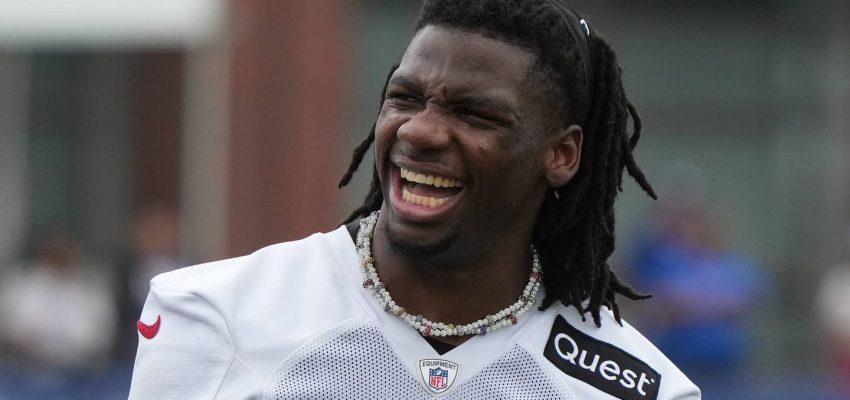

The journey of an NFL player is often a relentless pursuit of excellence, a delicate balance between raw talent and the crucible of professional pressure. For a first-round draft pick, the expectations are magnified, the spotlight unforgiving. Every snap, every tackle, every pass defended is scrutinized, not just by fans and media, but by a franchise that has invested significantly in their potential. This season, one young New York Giants defender finds himself at precisely such a crossroads, facing a make-or-break year that could define the trajectory of his promising career: Deonte Banks.
As the 2023 first-round selection steps into what is effectively a contract year, the stakes couldn’t be higher. His role, his future with the team, and indeed, his very perception within the league, are on the line. Yet, amidst this immense pressure, a confluence of factors — including a fresh defensive scheme and the palpable potential for a return to the form that made him a coveted prospect — presents a genuine opportunity for him to not just survive, but thrive. This isn’t merely a game; it’s a strategic battle for a professional future, a narrative rich with challenge and the promise of redemption.
Deonte Banks: Navigating the Crucible of an NFL Contract Year
For a top-tier athlete in the National Football League, the “contract year” is a phrase imbued with a profound weight. It signifies a period where performance directly translates into financial security and long-term stability. For a player like Deonte Banks, drafted 24th overall by the Giants in 2023, this season carries an added layer of scrutiny. As a first-round pick, he signed a four-year rookie contract, which typically includes a team option for a fifth year. The team’s decision on whether to exercise that option will be made after the upcoming season, making it an unofficial, yet undeniably critical, contract evaluation period. It’s a fundamental assessment of return on investment, where the Giants will weigh his growth, consistency, and impact against the capital they expended to acquire him.
The Giants invested heavily in Deonte Banks, trading up in the 2023 draft to secure his services. This move underscored their belief in his elite athleticism, his tenacious playing style, and his potential to become a true shutdown cornerback. Such an investment comes with inherent expectations: immediate impact, consistent improvement, and eventually, anchoring a crucial position on defense. While his rookie season offered glimpses of his high ceiling, it also brought the inevitable growing pains common to NFL newcomers. He started 15 games, recording 64 total tackles, 10 pass deflections, and two interceptions – solid numbers for a rookie, particularly one tasked with guarding some of the league’s most explosive receivers. However, consistency in coverage and tackling efficiency were areas identified for refinement, as is often the case for young cornerbacks adapting to the speed and complexity of the professional game. The leap from college to the NFL is immense, requiring not just physical prowess but a sophisticated understanding of offensive schemes and individual receiver tendencies. This year, the focus will be on transforming potential into polished, reliable performance. The pressure isn’t just to be good; it’s to demonstrate that he is indispensable to the Giants’ long-term defensive strategy.
The Shifting Tides: A New Defensive Scheme and Coaching Philosophy
The NFL is a league of constant evolution, and nowhere is this more apparent than in coaching changes and defensive scheme adjustments. For Deonte Banks, the arrival of a new defensive coordinator, Shane Bowen, marks a significant turning point. Bowen, known for his aggressive, attacking style cultivated during his tenure with the Tennessee Titans, is expected to inject fresh energy and a different strategic approach into the Giants’ defense. This shift isn’t just about new play calls; it’s about a fundamental re-evaluation of personnel utilization and philosophical alignment.
A new defensive scheme can be a double-edged sword for players. On one hand, it demands learning new assignments, techniques, and terminology. On the other, it can unlock previously untapped potential by better aligning a player’s inherent strengths with the defensive strategy. For Banks, a cornerback heralded for his physicality, speed, and ability to play press coverage, Bowen’s scheme could be particularly advantageous. The Titans’ defense under Bowen often emphasized aggressive front-seven play complemented by versatile coverage options in the secondary. This often means cornerbacks are put in positions to make plays on the ball, whether through tighter man coverage or aggressive zone reads.
If Bowen’s system leans into more man-to-man assignments or provides more support from the pass rush, it could free up Deonte Banks to utilize his impressive athletic traits more effectively. His long arms and competitive spirit are ideally suited for disrupting routes at the line of scrimmage, a critical component of successful press-man coverage. Furthermore, a simplified yet aggressive approach might reduce some of the mental processing load that can slow down young players, allowing his natural instincts to take over more readily. The previous scheme, while effective at times, might not have fully capitalized on his particular blend of raw talent. Now, with a fresh perspective and a new philosophy, there’s a real possibility that the defensive architecture will be better tailored to empower individual playmakers, positioning Banks for a more impactful role. The effectiveness of this transition will hinge on his ability to quickly adapt and assimilate the new teachings, transforming theoretical advantages into tangible on-field results.
Rediscovering Rookie-Year Form: The Path to Redemption and Breakout
The concept of “rookie-year form” can be somewhat misleading in the NFL, as a player’s initial season is often a chaotic blend of flashes of brilliance and moments of learning. For Deonte Banks, his rookie campaign demonstrated undeniable promise, showcasing his ability to compete with top-tier receivers and make significant plays. The challenge now lies in transcending those intermittent highlights into consistent, week-in, week-out elite performance. The “sophomore slump” is a well-documented phenomenon in professional sports, where the initial surprise factor of a rookie wears off, and opponents gather more film to exploit weaknesses. Overcoming this requires more than just physical talent; it demands an elevated level of mental fortitude, film study, and technical refinement.
To truly “return” to his best form and, ideally, surpass it, Banks must focus on several key areas. Consistency in coverage is paramount. This involves refining his footwork, maintaining optimal positioning throughout routes, and minimizing avoidable penalties that can extend drives. His tackling, while generally solid, could benefit from improved technique to reduce missed opportunities in open space, particularly against shifty ball carriers. Perhaps most critically, enhancing his ball-hawking skills — turning pass deflections into interceptions — would elevate his game dramatically. Elite cornerbacks don’t just cover; they create turnovers. This often comes down to anticipation, better tracking of the ball in the air, and aggressive playmaking at the catch point.
The offseason provides a crucial window for this refinement. Dedicated training regimes, intense film study sessions with coaches, and targeted drills can address specific technical deficiencies. Furthermore, developing a deeper understanding of offensive schemes and quarterback tendencies will allow him to anticipate plays rather than merely react to them. This mental aspect of the game is where many young players make their most significant leap. The competitive landscape in the Giants’ secondary also plays a role. Surrounding himself with experienced veterans and competing daily with other talented defensive backs can push Banks to elevate his own game. The opportunity for a breakout is genuine, fueled by his inherent talent, the fresh tactical approach of the new defensive coordinator, and the immense motivation that comes with a critical evaluation year. If he can harness these elements, transforming potential into consistent, impactful play, he won’t just save his Giants career; he’ll solidify his place as a foundational piece of their defense for years to come. This season is not merely about meeting expectations, but about exceeding them and proving his worth beyond doubt.
The Giants’ Defensive Backfield: A Collective Imperative
While the spotlight justifiably shines on Banks, his individual performance is inextricably linked to the collective strength of the Giants’ defensive backfield. A strong supporting cast can alleviate pressure on a young cornerback, allowing him to play more freely and aggressively. Conversely, weaknesses elsewhere can expose even the most talented individuals. The Giants’ secondary features a mix of experience and youth, with veterans providing guidance and younger players vying for significant roles. The synergy among these players — communication, trust, and shared understanding of assignments — is critical for overall defensive success.
The defensive line’s ability to generate consistent pressure on opposing quarterbacks will also directly impact Deonte Banks‘ performance. Fewer seconds for a quarterback to survey the field means less time for receivers to develop routes, giving cornerbacks a significant advantage. A robust pass rush allows defensive backs to play tighter coverage and take more risks, knowing that help is often on the way. Similarly, the performance of the safety tandem behind him is vital for providing over-the-top support and patrolling the middle of the field. This interconnectedness underscores that while Banks’ personal improvement is paramount, his ultimate success will also be a reflection of the entire unit’s cohesion and execution. The long-term needs of the Giants at the cornerback position are clear: they require a stable, high-performing anchor. If Banks can demonstrate that he is that player this season, it will not only secure his future but significantly bolster the Giants’ aspirations for defensive dominance.
Conclusion
The upcoming NFL season represents a monumental juncture in the professional career of Deonte Banks. From the moment he was drafted in the first round, the weight of expectation has been immense, and now, entering a crucial contract evaluation period, every aspect of his game will be under the microscope. His narrative is a compelling blend of high-stakes pressure, the promise of a fresh strategic approach under a new defensive coordinator, and the inherent potential to not just reclaim but redefine his “rookie-year form.” This is more than just about individual statistics; it’s about validating the Giants’ investment, demonstrating growth, and ultimately, proving his enduring value to the franchise.
As fans and analysts alike watch with anticipation, the stage is set for a truly pivotal year. The confluence of a new scheme designed to leverage his strengths and his own internal drive for excellence provides Deonte Banks with a genuine pathway to a breakout season. Should he seize this opportunity, displaying consistency, playmaking ability, and the maturity of a true professional, he will undoubtedly cement his place as a cornerstone of the Giants’ defense for years to come, turning a high-stakes challenge into a resounding triumph. His journey is a testament to the relentless pursuit of peak performance that defines professional sports, and a reminder that true potential is realized through unwavering dedication and strategic adaptation.










