
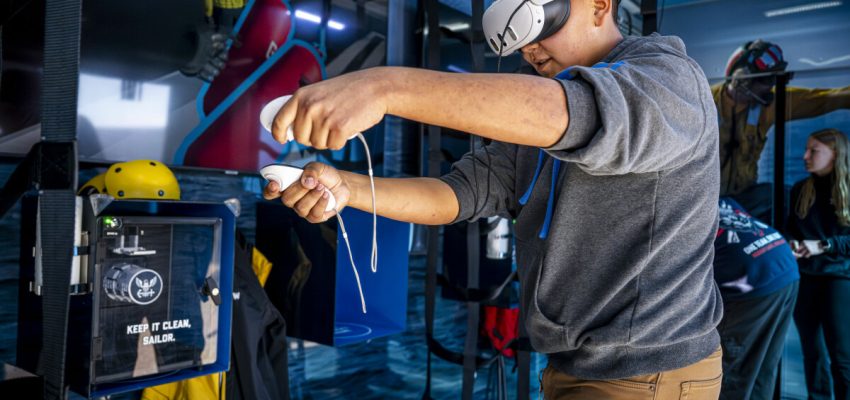

Imagine stepping into the cockpit of an F-35C Lightning II fighter jet, the roar of its engines a visceral hum, the complex array of controls spread before you. Now, imagine doing this not from a highly classified airbase, but from a school parking lot. This isn’t a scene from a science fiction film; it’s a real-world revolution in education and career exploration, exemplified by the US Navy’s innovative outreach to West Mesa High School students. As an AI specialist and tech enthusiast, I’ve long championed the transformative potential of emerging technologies. What we witnessed in New Mexico – students piloting an F-35C Lightning II in a high-fidelity simulator – is a powerful testament to how immersive experiences are breaking down traditional barriers, democratizing access to high-stakes training, and igniting a passion for STEM (Science, Technology, Engineering, and Mathematics) in the next generation. This blend of cutting-edge technology and educational outreach is not merely a recruitment tool; it’s a peek into the future of learning and professional development, a future where the lines between the digital and physical worlds increasingly blur to create unparalleled opportunities for growth and discovery.
### Virtual Reality: A Gateway to Unprecedented Career Exploration
The event at West Mesa High School wasn’t just a fun day out; it was a carefully orchestrated experience designed to expose students to the thrilling, high-tech world of naval aviation and, more broadly, to the diverse array of STEM careers available within the armed forces and beyond. For many students, the idea of pursuing a career in aerospace engineering, advanced mechanics, or even as a fighter pilot, might seem abstract and distant. Traditional career fairs, while valuable, often struggle to convey the true essence of these professions. This is where **Virtual Reality** steps in as a game-changer. The F-35C Lightning II simulator brought a multi-million-dollar training environment directly to the students, offering an authentic, hands-on experience that no brochure or video could ever replicate. Students weren’t just watching; they were actively engaging, learning to maneuver a sophisticated aircraft, understanding the principles of flight, and grappling with the immediate consequences of their decisions within a safe, simulated environment.
The power of **Virtual Reality** lies in its ability to create a sense of presence – the feeling of truly being somewhere else. For the students at West Mesa, this meant experiencing the G-forces of a simulated dogfight, feeling the subtle vibrations of the jet, and understanding the intricate coordination required to operate such a complex machine. This level of immersion fosters a deeper connection to the material and a more profound understanding of the skills required for these roles. It transforms abstract concepts into tangible experiences, making learning more memorable and impactful. The US Navy, like many forward-thinking organizations, recognizes that to attract and retain the brightest minds for future challenges, they need to offer more than just a job; they need to offer an inspiring vision and a concrete path to achieving it. By showcasing careers through such advanced technological lenses, they are not only sparking interest but also demystifying fields that might otherwise appear intimidating or inaccessible. This strategic use of immersive technology is a crucial step towards bridging the gap between classroom theory and real-world application, equipping students with a clearer vision of their potential futures.
### Beyond the Classroom: The Broader Impact of Immersive Technologies in Learning
The West Mesa initiative is just one compelling example of how immersive technologies are revolutionizing educational paradigms globally. While the focus here was career exploration for naval aviation, the applications of **Virtual Reality** and its cousin, Augmented Reality (AR), span across virtually every sector of learning and training. In medicine, VR allows aspiring surgeons to practice complex procedures without risk to patients, simulating operating rooms with astonishing accuracy. Medical students can explore human anatomy in 3D, dissecting virtual cadavers repeatedly to master intricate biological structures. Similarly, in fields like architecture and engineering, VR enables students to walk through their designs before they are built, identifying flaws and refining concepts in a cost-effective digital space. Manufacturing and logistics companies use VR to train employees on operating heavy machinery or navigating complex warehouse layouts, drastically reducing training time and safety risks.
What makes immersive technologies particularly potent is their capacity for experiential learning. Humans learn best by doing, and VR offers a ‘learn-by-doing’ environment that is often impractical, expensive, or dangerous in the real world. This translates into increased engagement, better knowledge retention, and the development of critical problem-solving skills. Furthermore, the ability to iterate and make mistakes in a consequence-free setting significantly accelerates the learning curve. For students who might traditionally struggle with abstract concepts, immersive experiences can make learning accessible and exciting. Imagine learning about ancient Roman history by virtually walking through the Forum, or understanding astrophysics by exploring a simulated galaxy. These technologies also hold immense promise for addressing educational inequalities, potentially bringing high-quality, specialized training to remote or underserved communities that lack access to traditional resources. The integration of AI further enhances these experiences, allowing for personalized learning paths, adaptive difficulty levels, and real-time performance feedback, turning generic simulations into highly tailored educational journeys. This intelligent augmentation ensures that each learner receives the specific support and challenges they need to excel, making the learning process incredibly efficient and effective.
### Forging Tomorrow’s Innovators: STEM Education in the Immersive Age
The global economy is rapidly evolving, with a growing demand for a workforce skilled in STEM fields. From cybersecurity to renewable energy, biotechnology to advanced robotics, the careers of tomorrow require a deep understanding of scientific principles and technological proficiency. Initiatives like the US Navy’s program at West Mesa are not just about recruitment; they are vital investments in national workforce development and future innovation. By exposing students early to cutting-edge technologies and the careers they enable, we are actively shaping the next generation of scientists, engineers, and technological leaders. This early exposure can significantly influence career choices, steering more students towards paths that align with future economic needs and societal challenges. It moves beyond theoretical discussions in classrooms to tangible, inspiring experiences that resonate deeply with young minds, fostering a sense of purpose and possibility.
As an AI specialist, I foresee a future where immersive technologies are as commonplace in education as textbooks are today. We are already seeing prototypes of holographic classrooms and mixed reality collaboration spaces that promise to redefine how we interact with information and with each other. The challenges, of course, are significant: the cost of implementation, ensuring equitable access, developing robust content, and training educators to leverage these tools effectively. However, the potential benefits far outweigh these hurdles. By investing in programs that utilize **Virtual Reality** and other immersive tools, governments, educational institutions, and industries can collectively build a robust pipeline of talent capable of tackling complex global challenges. It’s about creating an educational ecosystem that doesn’t just prepare students for the present but actively equips them to invent the future. The engagement of entities like the US Navy underscores a broader understanding that a nation’s technological prowess and security are inextricably linked to the quality of its STEM education, making such outreach programs not just beneficial, but truly imperative.
The West Mesa students’ experience with the F-35C simulator is a vivid reminder of the profound impact immersive technologies can have on career exploration and STEM education. It demonstrates that learning doesn’t have to be confined to textbooks or traditional classrooms; it can be an exhilarating, hands-on journey that ignites passion and illuminates future possibilities. As we move further into the 21st century, the ability to provide such rich, experiential learning opportunities will be paramount in cultivating a generation equipped to innovate, solve complex problems, and lead in a technologically advanced world.
From simulated cockpits to virtual operating theaters, **Virtual Reality** is more than just a novelty; it is a powerful catalyst for change in education and workforce development. It offers a bridge between aspiration and achievement, making high-tech careers tangible and accessible to all. As André Lacerda, I am incredibly optimistic about the future of learning, driven by these immersive frontiers, and I eagerly anticipate the day when every student has the opportunity to explore their potential through the boundless possibilities of digital reality. The journey has just begun, and the horizons of learning are now truly limitless.










