
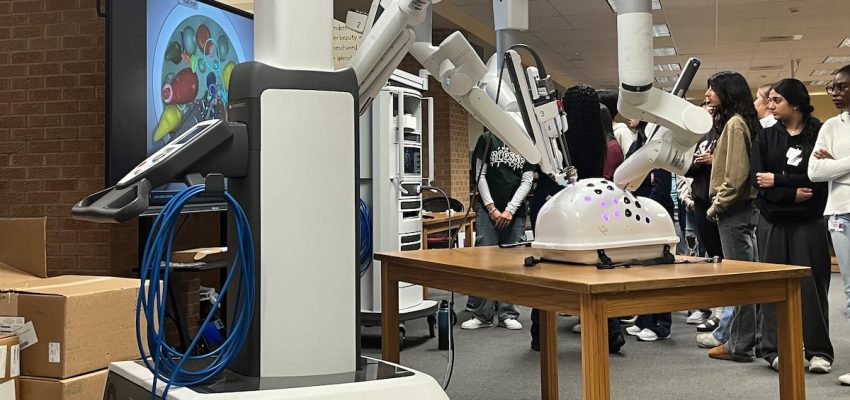

In an era defined by rapid technological advancement, the medical field stands as a testament to humanity’s relentless pursuit of innovation. From groundbreaking diagnostic tools to revolutionary therapeutic approaches, technology is continually reshaping how we understand, prevent, and treat illness. A recent event at Wichita North High School perfectly encapsulated this dynamic shift, offering students a rare glimpse into the future of healthcare by providing hands-on experience with a Da Vinci Surgical Machine. This wasn’t just an educational exhibit; it was an invitation to envision a career where human skill synergizes with advanced robotics and artificial intelligence, paving the way for a new generation of medical innovators.
The experience, facilitated by KU Medicine, wasn’t merely about observing sophisticated equipment; it was about tactile engagement, allowing young minds to manipulate the machine’s intricate controls and simulate surgical procedures. This kind of early exposure is more critical than ever, as the operating room of tomorrow will be a landscape transformed by precision robotics, AI-driven insights, and immersive digital environments. It signals a future where the traditional scalpel is increasingly complemented, and sometimes even guided, by intelligent machines, leading to outcomes that were once unimaginable.
Robot-assisted surgery: Empowering the Next Generation of Medical Innovators
The sight of high school students engaging with a Da Vinci Surgical System isn’t just a powerful educational moment; it’s a symbolic embrace of the future of healthcare. The Da Vinci system, often considered the pioneer in modern surgical robotics, represents a paradigm shift in how complex procedures are performed. Developed by Intuitive Surgical, this sophisticated platform allows surgeons to operate with enhanced precision, control, and visualization, often through much smaller incisions than traditional open surgery. Its four robotic arms, controlled by a surgeon seated at a console, translate human hand movements into precise micro-movements inside the patient’s body, filtering out natural tremors and offering a magnified 3D high-definition view of the surgical site.
The benefits of advanced robot-assisted surgery are profound and well-documented. For patients, it often means less pain, reduced blood loss, shorter hospital stays, and faster recovery times. For surgeons, it provides ergonomic advantages, reduces fatigue during long procedures, and offers an unparalleled level of dexterity in tight anatomical spaces. Procedures ranging from prostatectomies and hysterectomies to complex cardiac and thoracic surgeries are routinely performed with robotic assistance, consistently demonstrating improved outcomes and safety profiles. In 2023 alone, over 1.6 million procedures were performed worldwide using the Da Vinci system, highlighting its widespread adoption and impact on global healthcare delivery. This widespread integration underscores why early exposure, as seen with the Wichita North students, is not just beneficial but essential for future medical professionals.
AI’s Integral Role: Enhancing Precision, Prediction, and Training in the Operating Room
While robotic systems like Da Vinci provide the mechanical prowess for advanced surgical procedures, it is artificial intelligence that truly unlocks their full potential, elevating them beyond mere sophisticated tools. AI isn’t just an add-on; it’s becoming an integral co-pilot, enhancing every phase of the surgical journey, from pre-operative planning to post-operative recovery and even the training of future surgeons. The synergy between robotics and AI is transforming robot-assisted surgery into intelligent surgery.
Consider the realm of pre-operative planning. AI algorithms can analyze vast datasets of patient imaging (MRI, CT scans) to create highly detailed 3D models of anatomy, highlighting tumors, vessels, and nerves with unprecedented accuracy. This allows surgeons to meticulously plan their approach, visualize potential challenges, and even simulate parts of the procedure before the first incision is made. During the surgery itself, AI-powered computer vision can assist in real-time. It can identify anatomical structures, detect anomalies that might be subtle to the human eye, and even provide guidance on optimal incision points or tissue manipulation. Researchers are also exploring AI’s capacity for predictive analytics, where machine learning models, trained on millions of past surgical outcomes, can forecast potential complications or recommend the most effective surgical strategies for individual patients based on their unique physiological data.
Beyond execution, AI is revolutionizing surgical training. Virtual reality (VR) and augmented reality (AR) simulators, combined with AI, offer immersive and highly realistic training environments. These systems can provide immediate, data-driven feedback on a trainee’s performance, assessing precision, efficiency, and adherence to best practices. They can simulate rare complications, allowing students to practice critical decision-making under pressure without risk to a real patient. Furthermore, AI can analyze video recordings of actual surgeries to identify best practices, common errors, and areas for improvement, creating a continuous feedback loop that accelerates learning and enhances the skill development for anyone performing robot-assisted surgery.
The integration of haptic feedback, where robots can ‘feel’ tissue resistance and provide this sensory information back to the surgeon, is another area where AI is making significant strides. AI can refine these feedback mechanisms, making the virtual sense of touch more nuanced and accurate, thereby enhancing the surgeon’s situational awareness and control during delicate procedures. This holistic application of AI—from intelligent planning and real-time guidance to sophisticated training and post-operative analysis—is making surgical procedures safer, more efficient, and ultimately more effective.
The Future Surgeon: Navigating an AI-Enhanced Medical Landscape
As technology continues its inexorable march into the operating room, the role of the surgeon is undeniably evolving. The future surgeon will not be replaced by robots or AI, but rather augmented and empowered by them. The emphasis will shift from purely manual dexterity to a sophisticated blend of clinical acumen, technological proficiency, and critical decision-making in partnership with intelligent systems. Aspiring medical professionals, like those Wichita North High students, must cultivate a skillset that transcends traditional medical training.
They will need to be adept at interpreting AI-generated data, understanding the capabilities and limitations of robotic systems, and collaborating effectively with machines. This demands a foundation in computational thinking, a willingness to embrace continuous learning, and an innate curiosity for technological integration. Medical education programs are already beginning to adapt, incorporating robotics, AI principles, and data science into their curricula. Simulation labs, often equipped with advanced robotic trainers and VR platforms, are becoming standard, providing safe spaces for students to master complex procedures before entering live operating rooms. The goal is not to create robot operators, but highly skilled physicians who can leverage every available tool—whether human or artificial—to deliver the best possible patient care.
Moreover, as robot-assisted surgery becomes more prevalent, ethical considerations and the imperative for maintaining the human touch remain paramount. The decision to perform surgery, the communication with the patient, and the compassionate care surrounding the procedure will always rest with the human surgeon. AI and robotics are powerful tools, but they are tools designed to extend human capability, not to diminish human responsibility or empathy. The integration must be thoughtful, ensuring that technological advancements enhance, rather than compromise, the fundamental patient-physician relationship.
The journey of medical innovation is endless, and the recent experience for Wichita North High students with the Da Vinci Surgical Machine is a powerful symbol of this ongoing evolution. It highlights how early engagement with advanced technology is not just about piquing interest; it’s about fundamentally preparing the next generation of healthcare leaders for a world where AI and robotics are not futuristic concepts, but indispensable partners in delivering life-changing care. As André Lacerda, an AI specialist and tech enthusiast, I believe that embracing these technological frontiers responsibly and proactively will define the caliber of medicine in the decades to come.
The convergence of human expertise and intelligent machines promises a future where surgical procedures are safer, more precise, and more accessible than ever before. This synergy is already at play, transforming lives and setting new benchmarks for medical excellence. For those passionate about healthcare and technology, the opportunities to innovate and contribute to this unfolding revolution are boundless, inviting them to be part of building a healthier, technologically advanced tomorrow.










