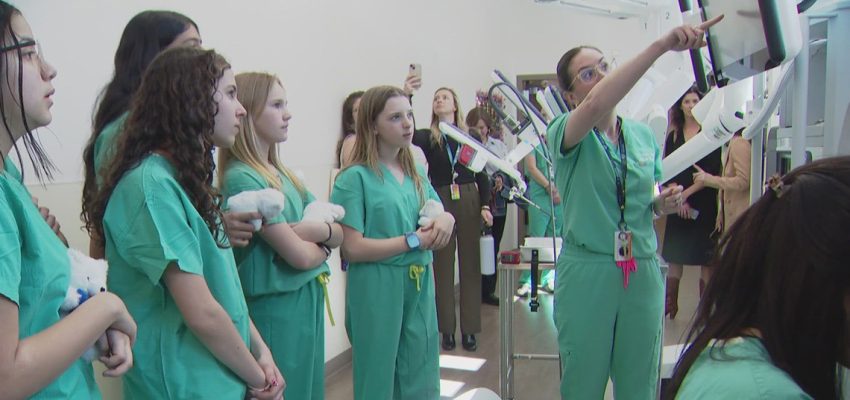

In an era defined by rapid technological advancement, where artificial intelligence is reshaping industries from finance to healthcare, the imperative to cultivate diverse talent has never been more urgent. As an AI specialist and tech enthusiast, I often reflect on the foundational elements that drive innovation and progress. Among these, the active inclusion and encouragement of young minds, especially those from historically underrepresented groups, stand paramount. Recently, a program in Denver caught my attention, one that’s not directly about AI, but whose impact on the future of technology and human progress is undeniable: empowering young girls to explore male-dominated careers in orthopedics and surgery.
This initiative, while seemingly focused on a specific medical niche, embodies a universal truth: breaking down gender barriers in any STEM field is a direct investment in our collective future. It’s about more than just surgical suites or operating theaters; it’s about fostering critical thinking, problem-solving, and innovation – skills that are transferable across all scientific and technological domains, including the rapidly evolving landscape of artificial intelligence. By opening doors for girls in fields like orthopedics, we’re not just creating more diverse surgeons; we’re nurturing a mindset that will eventually contribute to more equitable, robust, and ethical AI development and application across society.
The journey into medicine, particularly specialties like orthopedics, is rigorous and demanding. Historically, these paths have been overwhelmingly male-dominated. According to the American Academy of Orthopaedic Surgeons (AAOS), women still represent less than 7% of practicing orthopedic surgeons in the United States. This stark imbalance isn’t due to a lack of capability or interest but often stems from societal biases, lack of exposure, and an absence of visible female role models. Programs that actively introduce young girls to these professions, demystifying the day-to-day realities and showcasing the profound impact they can have, are crucial correctives. They provide hands-on experiences, mentorship, and a vital glimpse into a future they might not have otherwise considered. Such initiatives don’t just teach surgical techniques; they instill confidence, resilience, and a sense of possibility.
Empowering Girls in STEM Careers: A Foundation for Future Innovation
The Denver program serves as a powerful microcosm of a much broader movement: the global effort to encourage more girls and women to pursue careers in Science, Technology, Engineering, and Mathematics (STEM). This isn’t just about fairness; it’s about maximizing human potential and driving innovation. Diverse teams, composed of individuals with varied backgrounds, perspectives, and life experiences, consistently outperform homogeneous teams in problem-solving and creativity. When we talk about
Empowering Girls in STEM Careers
, we’re talking about enriching the talent pool that will tackle the grand challenges of our time, from climate change to disease, and yes, to the responsible development of AI.
Consider the field of medicine. While the original program focuses on traditional surgical roles, the modern operating room is increasingly a nexus of advanced technology. Robotics assist surgeons with unparalleled precision, AI algorithms analyze vast datasets for diagnostic insights, and personalized medicine, driven by machine learning, is tailoring treatments to individual genetic profiles. Girls entering these fields today will not just be doctors; they will be doctor-technologists, adept at leveraging cutting-edge tools to enhance patient care. By exposing them to challenging, complex medical fields early on, we equip them with the analytical rigor and passion for innovation that will be indispensable in an AI-powered world.
The skills fostered by engagement in practical, challenging fields like orthopedics — spatial reasoning, problem-solving under pressure, meticulous attention to detail, and a deep understanding of human physiology — are incredibly valuable. These same aptitudes are highly sought after in the development and application of artificial intelligence. An orthopedic surgeon uses geometry, biomechanics, and materials science every day; a girl inspired by this field might later apply those analytical skills to developing AI for robotic prosthetics, medical imaging diagnostics, or even AI-powered rehabilitation programs. The connections are not always obvious, but they are profound.
The Intersection of AI, Healthcare, and Gender Diversity
As an AI specialist, I’m acutely aware that the future of AI is not just about algorithms and data; it’s about the people who design, train, and deploy these systems. The absence of diverse voices in AI development can lead to biased algorithms and systems that perpetuate existing societal inequalities. For instance, diagnostic AI tools, if primarily trained on data from a narrow demographic, might perform less accurately for underrepresented groups. This issue highlights why efforts like the Denver program are so vital: they don’t just promote gender equality in a specific medical field, but they contribute to a larger, more diverse pipeline of talent across STEM, including future AI researchers, engineers, and ethicists.
The healthcare sector, in particular, stands to gain immensely from increased gender diversity in STEM and AI. Women bring unique perspectives to patient care, system design, and technological implementation. For example, AI-powered wearables for health monitoring or diagnostic apps could benefit from insights into women’s specific health needs and preferences, leading to more inclusive and effective solutions. When we talk about
Empowering Girls in STEM Careers
, we’re laying the groundwork for AI solutions that are not only technically brilliant but also ethically sound, universally applicable, and deeply empathetic to the diverse needs of humanity.
Consider the burgeoning field of robotic surgery. While immensely beneficial for precision and minimal invasiveness, these systems are still evolving. Who better to help shape their future than surgeons who understand both the intricacies of the human body and the nuances of the technology? A young woman inspired by surgical robotics today might become a lead engineer designing the next generation of AI-driven surgical assistants, ensuring they are intuitive, safe, and truly augment human capability. Her perspective, informed by her gender and lived experience, could lead to innovations that are overlooked by a less diverse team.
Building a More Equitable and Technologically Advanced Future
The economic impact of closing the gender gap in STEM is staggering. The McKinsey Global Institute estimated that advancing women’s equality could add $12 trillion to global GDP by 2025. This isn’t just about financial metrics; it’s about unlocking human potential on an unprecedented scale. When we invest in
Empowering Girls in STEM Careers
, we are investing in a future where innovation flourishes, where complex problems are approached from multiple angles, and where technological solutions are designed for the benefit of all.
Beyond individual programs, a holistic approach is needed. This includes strong STEM education from an early age, visible role models, mentorship opportunities, and policies that support work-life balance for women in demanding careers. We must challenge stereotypes and actively demonstrate that brilliance and capability are not defined by gender. By celebrating the achievements of women in STEM and AI, and by providing platforms for young girls to explore these possibilities, we create a virtuous cycle of inspiration and aspiration.
The journey from a high school girl attending a program on orthopedics to a pioneering AI scientist or a leading surgeon is complex and multifaceted. Yet, it begins with that crucial first step: exposure and encouragement. It begins with someone telling her, “Yes, you can.” These programs are not just about filling specific job roles; they are about fostering a generation of critical thinkers and problem-solvers who understand the power of technology and are committed to using it for good. They are about creating a future where the next groundbreaking medical AI application, or the next paradigm-shifting surgical technique, could very well come from a mind that was once told, through such an initiative, that the sky is not the limit.
Ultimately, the impact of programs like the one in Denver extends far beyond the operating room. By providing young girls with invaluable exposure to challenging and rewarding careers in medicine, they are simultaneously laying the groundwork for a more diverse and innovative future in all STEM fields, including the burgeoning world of artificial intelligence. As an AI specialist, I believe that the success of AI in addressing humanity’s grandest challenges hinges on the diversity of minds contributing to its development. Initiatives that empower girls to see themselves as future leaders, whether in surgery, engineering, or AI research, are not just noble; they are indispensable. They are cultivating the next generation of innovators, ensuring that the AI-driven world we build is equitable, intelligent, and truly representative of all humanity.
Let us continue to champion these vital programs, expand their reach, and ensure that every girl with curiosity and potential has the opportunity to pursue her dreams in STEM. The future of medicine, technology, and indeed, our society, depends on it. We must ensure that the architects of tomorrow’s AI are as diverse as the world they are building it for.