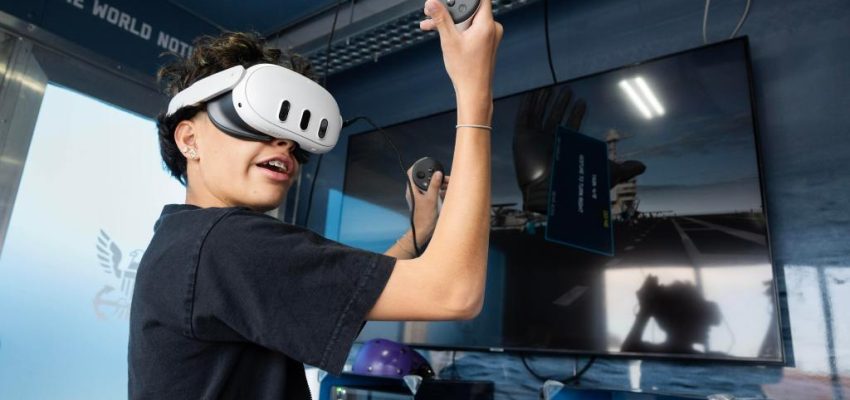

The landscape of education is undergoing a profound transformation, driven by an accelerating pace of technological innovation. For generations, career guidance has often relied on static textbooks, guest speakers, or perhaps a limited set of field trips. While valuable, these methods sometimes struggle to fully capture the dynamic, multifaceted nature of modern professions. However, a new paradigm is emerging, one that leverages the immersive power of advanced technology to transport learners directly into the heart of potential careers. This shift was vividly demonstrated on a recent Monday, March 9, when middle school students from the Torrance Unified School District had an extraordinary opportunity to engage with the U.S. Navy Strike Group **mixed-reality simulation**. This wasn’t just another school activity; it was a groundbreaking step into the future of experiential learning, offering these young minds an unprecedented, hands-on understanding of complex roles within the military and beyond. As an AI specialist and tech enthusiast, I believe such initiatives are not merely supplementary; they are becoming essential tools for inspiring and preparing the next generation for the challenges and opportunities of an increasingly technological world.
### Mixed-reality simulation: The New Frontier in Experiential Learning
The term “mixed reality” (MR) often gets conflated with its cousins, virtual reality (VR) and augmented reality (AR), but it represents a distinct and powerful evolution. While VR immerses users entirely in a digital world and AR overlays digital information onto the real world, MR seamlessly blends the two, allowing users to interact with virtual objects as if they were physically present in their actual environment. This unique capability makes **mixed-reality simulation** an incredibly potent tool for training and education, enabling scenarios that are both deeply engaging and highly realistic. The U.S. Navy’s Strike Group simulation exemplifies this perfectly.
For the Torrance middle schoolers, this was far from a passive experience. They weren’t just watching a video or reading about naval operations; they were actively participating in them. Imagine a student, perhaps still deciding between a future in coding or marine biology, suddenly finding themselves on the bridge of a destroyer, navigating through challenging waters, or on the bustling flight deck of an aircraft carrier, directing F-18s during a simulated mission. These aren’t abstract concepts; they are visceral, immediate experiences that demand critical thinking, teamwork, and rapid decision-making. The simulation, designed with high fidelity, recreates the sights, sounds, and operational complexities of a naval strike group, complete with various stations where students could rotate through different roles: from flight operations specialists managing aircraft launches and recoveries to combat information center officers tracking targets and coordinating responses. This interactive approach provides a depth of understanding that traditional methods simply cannot match. It’s about more than just showing what a job entails; it’s about letting students *feel* what it’s like to perform that job under pressure, fostering a deeper appreciation for the skills, responsibilities, and collaborative efforts required. Furthermore, such immersive simulations naturally expose students to a wide array of STEM (Science, Technology, Engineering, and Mathematics) disciplines, from aerodynamics and naval engineering to cybersecurity and logistics, sparking curiosity and demonstrating the real-world application of these academic subjects in an exciting context.
### Bridging the Gap: AI and Immersive Tech in Career Guidance
The integration of advanced technologies like MR, often powered by sophisticated artificial intelligence, is rapidly transforming how we approach career guidance and workforce development, particularly for younger demographics. In an age where information is abundant but meaningful experience is scarce, these immersive platforms offer a critical bridge. Statistics consistently show a pressing need to encourage more students into STEM fields, with global reports indicating a significant talent gap in critical areas. Providing early, engaging exposure to these careers is paramount, and AI-driven **mixed-reality simulation** platforms are uniquely positioned to do just that.
AI plays a crucial role behind the scenes in making these simulations so effective. It can adapt scenarios based on student performance, offer personalized feedback, and even generate dynamic challenges to push learners further. This adaptive learning environment ensures that each student’s experience is tailored to their pace and progress, maximizing engagement and learning outcomes. Beyond the military, industries ranging from healthcare to aerospace are increasingly relying on similar immersive technologies for training. Surgeons practice complex procedures in virtual operating rooms, engineers design and test prototypes in digital twins, and emergency responders train for crisis scenarios in hyper-realistic simulated environments. For middle schoolers, these technologies don’t just present job descriptions; they create vivid narratives. They allow students to try on different professional identities, to understand the problem-solving processes involved, and to see themselves in roles they might never have otherwise considered. This proactive engagement is vital. Research in cognitive development suggests that middle school is a formative period where students begin to develop their interests and envision future possibilities. By introducing them to diverse and challenging career paths through an immersive and exciting medium, we are not only expanding their horizons but also equipping them with the experiential context to make more informed decisions about their academic and professional futures. This isn’t just about showing them a job; it’s about allowing them to *live* a day in that job, even if only for a short, impactful period within a highly advanced **mixed-reality simulation**.
### Beyond the Classroom: The Future of Experiential Education
The Torrance Unified School District’s experience with the U.S. Navy simulation is more than just a successful event; it’s a powerful indicator of the trajectory of education. We are moving beyond the traditional confines of the classroom, embracing dynamic, interactive, and highly personalized learning experiences made possible by extended reality (XR) technologies. The future of education will likely see a significant expansion of such programs, integrating **mixed-reality simulation** into mainstream curricula to address various learning objectives, from scientific experimentation to historical reenactment.
Imagine biology students exploring the human anatomy in a 3D interactive model, or history students walking through ancient Rome, interacting with virtual citizens. The potential applications are limitless. However, realizing this future demands careful consideration and strategic investment. Educators and policymakers must collaborate to develop frameworks for integrating these powerful tools effectively, ensuring accessibility for all students regardless of socio-economic background. We must also address the ethical implications of immersive technologies, such as data privacy and the potential for digital fatigue. The goal isn’t to replace human educators or traditional learning methods but to augment them, creating a rich tapestry of educational experiences that cater to diverse learning styles and foster deeper engagement. The U.S. Navy’s initiative serves as a compelling blueprint, demonstrating how governmental agencies and educational institutions can partner to provide unique and impactful learning opportunities. It’s about leveraging cutting-edge technology not just for specialized training, but for broadening horizons and inspiring the next generation of innovators, leaders, and problem-solvers.
The advent of sophisticated technologies like the U.S. Navy’s **mixed-reality simulation** for Torrance middle schoolers marks a pivotal moment in how we prepare young individuals for their future. It underscores the undeniable power of immersive experiences to transform abstract career paths into tangible, exciting realities, offering a glimpse into professions that might otherwise remain undiscovered or misunderstood. As an AI specialist, I firmly believe that such initiatives are not just about showcasing technology; they are about investing in human potential, providing a vital bridge between theoretical knowledge and practical application.
Ultimately, by embracing and expanding the use of advanced **mixed-reality simulation** and other immersive technologies, we empower our students to explore, to dream, and to make informed decisions about their roles in shaping the world. These platforms are more than just educational tools; they are catalysts for inspiration, fostering curiosity, critical thinking, and a sense of purpose that will serve them well, no matter which path they choose to navigate in the complex and ever-evolving landscape of the 21st century.