
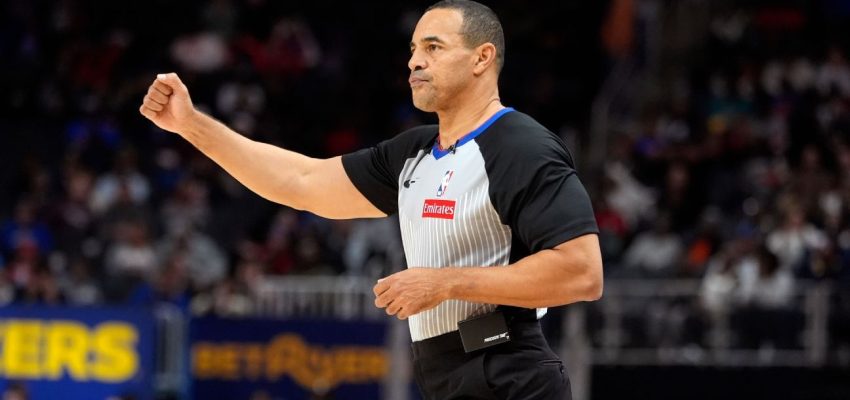

The digital age has conditioned us to expect instant notifications, immediate feedback, and the swift confirmation of our efforts. Yet, some of life’s most profound moments still unfold in the quiet, agonizing space of waiting. For NBA referee Curtis Blair, that wait was palpable – a tense vigil spent meticulously checking his inbox over an entire weekend. The anticipation was not for a simple email, but for the league’s official announcement of the referees selected to officiate the pinnacle of professional basketball: the NBA Finals. His inclusion on that coveted list marked a significant milestone, a testament to decades of dedication and a deep understanding of one of the world’s most dynamic athletic systems. As an AI specialist and tech enthusiast, I find Blair’s journey and this moment of validation incredibly compelling, not just as a narrative of human achievement, but as a rich allegory for the iterative refinement and systemic excellence we strive for in artificial intelligence.
### NBA Finals: The Pinnacle of Precision and Performance
To understand the magnitude of Curtis Blair’s accomplishment, one must first grasp the rigorous demands placed upon an NBA referee, particularly during the NBA Finals. This isn’t merely a job; it’s a calling that requires a unique blend of physical endurance, razor-sharp focus, instantaneous decision-making, and an unwavering commitment to impartiality. The stakes are astronomically high. Every whistle, every no-call, is scrutinized by millions of viewers, hyper-analytical commentators, and an army of social media critics. A single controversial decision can swing the momentum of a game, influence a series, and even etch itself into the annals of sports history.
An NBA referee’s career path is a grueling ascent, often beginning in collegiate leagues, moving through the G-League (the NBA’s developmental league), and only then, if exceptional, reaching the NBA. Curtis Blair, who played basketball at both the University of Richmond and the University of Pittsburgh, began his officiating career in 1996, working his way up through various collegiate conferences before joining the NBA G-League in 2005. He officially joined the NBA referee staff in 2008. For over 15 seasons, he has navigated the chaotic ballet of professional basketball, demonstrating a consistent ability to apply a complex rulebook in real-time, under pressure. This journey isn’t just about accumulating experience; it’s about a continuous process of learning, adapting, and refining one’s internal ‘algorithms’ for fairness and accuracy. To be selected for the **NBA Finals** crew, a referee must consistently rank among the very best in the league, a feat determined by a highly sophisticated internal evaluation system that assesses everything from game management to accuracy of calls, physical conditioning, and professional demeanor.
### The Unseen Algorithms of Officiating: A Referee’s Decade-Long Ascent
The process of becoming a top-tier NBA official, culminating in a spot in the NBA Finals, mirrors the painstaking development cycles in advanced AI. Just as machine learning models are trained on vast datasets, referees accumulate a lifetime of “game data.” They analyze countless hours of game film, review their own decisions, receive detailed feedback from supervisors, and participate in continuous training sessions. This iterative feedback loop is crucial. Each game provides new ‘data points’ – unique player interactions, evolving strategies, and unprecedented scenarios – that further refine an official’s decision-making framework.
Consider the sheer volume of information a referee processes in real-time. They must track ten players, the ball, the clock, the shot clock, the score, team fouls, and individual foul counts, all while simultaneously interpreting complex rules about contact, possession, and violations. A fraction of a second can separate a legitimate defensive play from a foul, a clean block from goaltending, or a charge from a blocking foul. This level of rapid, accurate pattern recognition and rule application, executed under extreme stress, is a testament to human cognitive processing at its peak. It’s an internal neural network, constantly learning and optimizing itself through experience. The anticipation Curtis Blair felt waiting for that email wasn’t just about a personal goal; it was the human system waiting for external validation that its years of ‘training’ and ‘testing’ had yielded optimal performance, ready for the ultimate ‘deployment’ in the NBA Finals.
The NBA’s officiating department employs advanced analytics, tracking every call, every missed call, and every correct call. This data is used to provide targeted feedback and to rank officials. It’s a data-driven meritocracy, much like the performance metrics we use to evaluate the efficacy of AI models. Only those who consistently demonstrate superior performance, exhibit exemplary professionalism, and manage games effectively are considered for the playoff and Finals assignments. Blair’s inclusion underscores his mastery of these unseen algorithms—the intricate dance of rule application, player management, and unwavering impartiality that defines elite officiating.
### Human Judgment in a Data-Driven Era: Lessons for AI
In an era increasingly shaped by data and artificial intelligence, the role of human judgment, particularly in high-stakes environments like the NBA Finals, becomes even more fascinating. We’ve seen the introduction of replay centers, coach’s challenges, and advanced camera systems designed to assist officials. This technological integration doesn’t diminish the human element; rather, it highlights the unique strengths of human intuition and contextual understanding that even the most sophisticated AI struggles to replicate. While AI can analyze vast amounts of visual data with unparalleled speed and accuracy, and can objectively apply a fixed set of rules, it often lacks the nuanced understanding of intent, the feel for the flow of the game, or the capacity for empathy required to manage complex human interactions.
A referee, like a human expert navigating a complex system, makes decisions that are not purely algorithmic. They involve interpreting ambiguous situations, understanding the ‘spirit of the rule’ versus its literal application, and managing the emotional landscape of competitive athletes. This requires a form of ‘emotional intelligence’ and ‘situational awareness’ that is still beyond the current capabilities of general-purpose AI. What can AI learn from Curtis Blair’s journey? The importance of continuous learning in dynamic environments, the value of incorporating diverse data points (not just visual, but also auditory and even kinetic feedback), and the challenge of building models that can handle subjective interpretation and human psychology.
Conversely, humans can learn from AI’s pursuit of objectivity and consistency. While perfect impartiality is an ideal often challenged by human biases, AI offers a glimpse into what unbiased rule application could look like. The collaboration between human officials and technological aids, as seen in the NBA’s replay system, serves as a compelling model for human-AI synergy, where technology augments human capabilities, providing data and support, while the final, contextualized judgment remains with the human expert. This balance is crucial for ensuring fairness and maintaining the integrity of the game, much like it is for ensuring ethical and robust AI systems in our society.
Curtis Blair’s selection for the NBA Finals is more than a personal triumph; it’s a powerful validation of a system designed to identify and elevate excellence through consistent, data-informed performance. It underscores the profound journey of mastery—a journey characterized by relentless self-improvement, an unwavering commitment to principles, and the fortitude to perform under immense pressure. In a world increasingly driven by technological advancement, Blair’s achievement reminds us of the irreplaceable value of human dedication, intuition, and the enduring quest for perfection within complex, dynamic systems. It’s a compelling narrative that resonates deeply, bridging the court with the code, and celebrating the pinnacle of both human and systemic optimization.
As we continue to push the boundaries of artificial intelligence, striving to build systems that are ever more intelligent, fair, and adaptable, we can draw valuable insights from the human endeavor exemplified by individuals like Curtis Blair. His journey to the NBA Finals is a testament to the intricate ‘algorithms’ of human ambition, the iterative process of learning, and the ultimate reward of achieving excellence within a meticulously structured environment. It’s a powerful reminder that whether on the hardwood court or within the silicon circuits, the pursuit of mastery is a continuous, evolving process, ever striving for that perfect call, that optimal decision, that flawless execution.










