
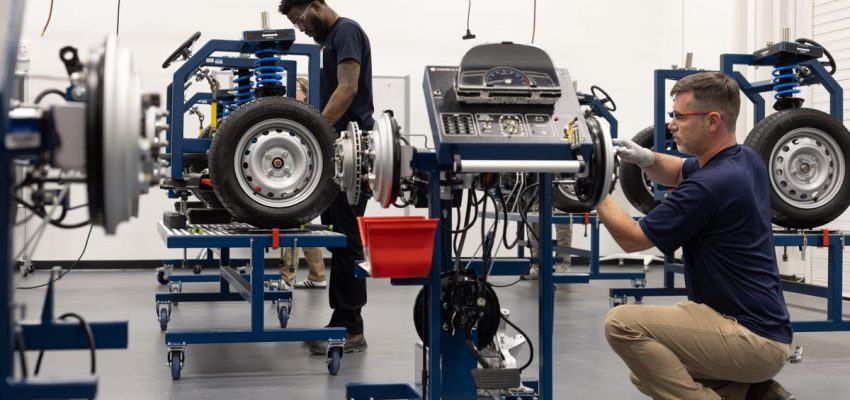

In an era often dominated by headlines of automation and economic uncertainty, the news from South Carolina offers a refreshing counter-narrative. The arrival of Scout Motors, an iconic American brand revived under Volkswagen Group, isn’t just about building electric trucks and SUVs; it’s about constructing a new foundation for the future of work itself. This isn’t merely the creation of ‘jobs’ or ‘gigs.’ It’s a profound commitment to establishing long-term, **human-centered careers**—roles that value skill, innovation, and personal growth within the rapidly evolving landscape of advanced manufacturing. As an AI specialist and tech enthusiast, I find this development particularly compelling, as it beautifully illustrates how technology, far from displacing human potential, can elevate it, fostering opportunities that are richer, more engaging, and more sustainable.
### Human-Centered Careers: A New Paradigm for the Modern Workforce
The concept of **human-centered careers** represents a significant evolution from the traditional understanding of employment. Historically, many manufacturing roles were characterized by repetitive tasks, often physically demanding and with limited scope for individual initiative. While these roles were crucial to industrialization, the 21st century demands a different approach. A **human-centered career** focuses on leveraging an individual’s unique cognitive abilities – critical thinking, problem-solving, creativity, and adaptability – in tandem with cutting-edge technology. It’s about designing work environments where individuals are empowered to innovate, learn continuously, and contribute to a larger vision, rather than simply executing predefined tasks.
In the context of modern manufacturing, especially in the electric vehicle (EV) sector, this paradigm shift is particularly evident. The complexity of EV design, the precision required in battery manufacturing, the intricate software systems that power these vehicles, and the sophisticated robotics employed on the assembly line all demand a highly skilled, engaged, and continuously learning workforce. Companies like Scout Motors are not just seeking hands to operate machines; they are seeking minds to optimize processes, troubleshoot complex systems, and develop the next generation of automotive technology. This commitment extends beyond the factory floor, encompassing roles in research and development, supply chain logistics, software engineering, data analytics, customer experience, and sustainable operations – all areas where human ingenuity is irreplaceable.
### Scout Motors and the Resurgence of American Manufacturing
Scout Motors represents a fascinating chapter in automotive history. Originating as the rugged off-road vehicles produced by International Harvester from 1960 to 1980, the Scout brand evoked an adventurous spirit and utilitarian reliability. Its revival by Volkswagen Group, with a substantial investment of $2 billion, signals a powerful commitment to American manufacturing and to a sustainable future. The selection of a 1,600-acre site in Blythewood, South Carolina, for its new manufacturing plant is a testament to the state’s growing prowess as an automotive hub.
This investment is projected to create 4,000 direct, permanent jobs, but as highlighted, these are much more than mere job openings; they are foundational opportunities for individuals to build genuine **human-centered careers**. The scale of this operation – with an initial annual production capacity of 200,000 vehicles – necessitates a vast array of specialized roles. From advanced robotics technicians who program and maintain complex automated systems, to mechatronics engineers who integrate mechanical and electronic components, to data scientists who analyze production efficiencies and supply chain flows, each role requires significant expertise and offers pathways for long-term professional development. Furthermore, the commitment to producing electric vehicles means a focus on cutting-edge battery technology, power electronics, and sophisticated software interfaces, demanding a workforce adept in these rapidly evolving domains. This is a far cry from the assembly lines of yesteryear; it’s a high-tech ecosystem where continuous learning is not just encouraged, but essential.
### South Carolina: Cultivating a Future-Ready Talent Ecosystem
South Carolina has strategically positioned itself as a magnet for advanced manufacturing, particularly within the automotive sector. With a robust existing ecosystem that includes major players like BMW and Volvo, alongside a vast network of suppliers, the state offers a compelling proposition for new entrants. Factors such as a skilled labor pool, strong logistical infrastructure including the Port of Charleston, and proactive state and local government incentives have played a crucial role in attracting investments like Scout Motors’.
However, attracting a multi-billion dollar plant is only the first step; sustaining its growth and ensuring the quality of its output hinges on a ready and adaptable workforce. This is where South Carolina’s commitment to workforce development becomes paramount. Educational institutions, from research universities like the University of South Carolina and Clemson University to a comprehensive network of technical colleges, are actively aligning their curricula with the demands of modern manufacturing. Programs in advanced manufacturing, mechatronics, industrial automation, and data science are being expanded and refined to equip students with the skills necessary for these **human-centered careers**. Partnerships between industry and academia are crucial, ensuring that training programs are relevant and responsive to the latest technological advancements. Moreover, initiatives for upskilling and reskilling existing workers are vital, allowing individuals to transition into new, high-value roles as industries evolve. The economic impact extends beyond direct employment, creating a ripple effect through local businesses, service industries, and the broader community, fostering a thriving economic environment.
### The Symbiosis of AI and Human Ingenuity in Automotive Production
My perspective as an AI specialist offers a unique lens through which to view the emergence of **human-centered careers** in advanced manufacturing. Far from being a job-killer, artificial intelligence, when implemented thoughtfully, serves as a powerful enhancer of human capabilities. In a modern automotive plant like Scout Motors’, AI applications can be found across the entire production lifecycle.
Consider the design phase: generative AI tools can explore thousands of design variations for vehicle components, optimizing for strength, weight, and aerodynamics faster than any human engineer. Yet, it’s the human engineer who defines the parameters, evaluates the AI’s suggestions, and makes the final creative decisions. In manufacturing, AI-powered computer vision systems meticulously inspect components for flaws with unparalleled speed and accuracy, ensuring quality control. But it’s human operators who interpret complex data, refine the AI’s algorithms, and intervene when anomalies require nuanced judgment. Predictive maintenance, another powerful AI application, uses machine learning to anticipate equipment failures, minimizing downtime. This creates roles for technicians who understand these AI systems, not just to fix machines, but to understand *why* the AI predicts a failure and how to best prevent it, optimizing operational efficiency.
Furthermore, AI is instrumental in supply chain optimization, predicting demand, managing inventory, and streamlining logistics – complex tasks that require human oversight to adapt to unforeseen disruptions and ethical considerations. The integration of AI also means that while robots handle repetitive and dangerous tasks, human workers are freed up to focus on higher-value activities: programming and managing robotic fleets, developing new production methodologies, and innovating solutions that push the boundaries of what’s possible. These are precisely the kinds of **human-centered careers** that foster intellectual engagement and continuous skill development, shaping a workforce that is not merely executing, but actively contributing to technological advancement.
### Beyond the Assembly Line: Cultivating Innovation and Growth
Beyond the technical skills, the success of **human-centered careers** also relies heavily on fostering a culture of innovation, collaboration, and continuous learning within the organization. Companies like Scout Motors understand that attracting and retaining top talent in a competitive market requires more than just competitive wages. It demands an environment where employees feel valued, where their ideas are heard, and where opportunities for professional development are abundant. This includes investing in ongoing training programs, mentorship initiatives, and cross-functional teams that encourage diverse perspectives to solve complex challenges.
Such a culture transforms a workplace from a mere production facility into a vibrant hub of innovation. It empowers individuals to take ownership of their work, to experiment with new ideas, and to contribute to the company’s long-term strategic goals. The emphasis on growth and well-being, coupled with the exciting prospect of shaping the future of electric vehicles, makes these opportunities profoundly attractive. It’s a holistic approach to employment, recognizing that human capital is the most valuable asset, and that nurturing it leads to sustainable success and a more resilient economy.
In conclusion, the establishment of Scout Motors in South Carolina is far more than an economic development success story; it is a powerful affirmation of the future of work. It underscores a global shift towards **human-centered careers**, where technology serves as an enabler, not a replacement, for human ingenuity. This venture exemplifies how advanced manufacturing, particularly in the EV sector, is creating high-skill, high-value opportunities that demand continuous learning, critical thinking, and collaborative problem-solving. South Carolina’s strategic investments in workforce development, coupled with Scout Motors’ commitment to its employees, set a new benchmark for what modern industrial employment can and should be.
As we look ahead, the synergy between human talent and technological advancement promises to redefine industries and economies worldwide. The narrative unfolding in South Carolina with Scout Motors serves as an inspiring example of how we can build a future where innovation and meaningful employment go hand in hand, forging not just products, but profound opportunities for personal and professional growth.










